
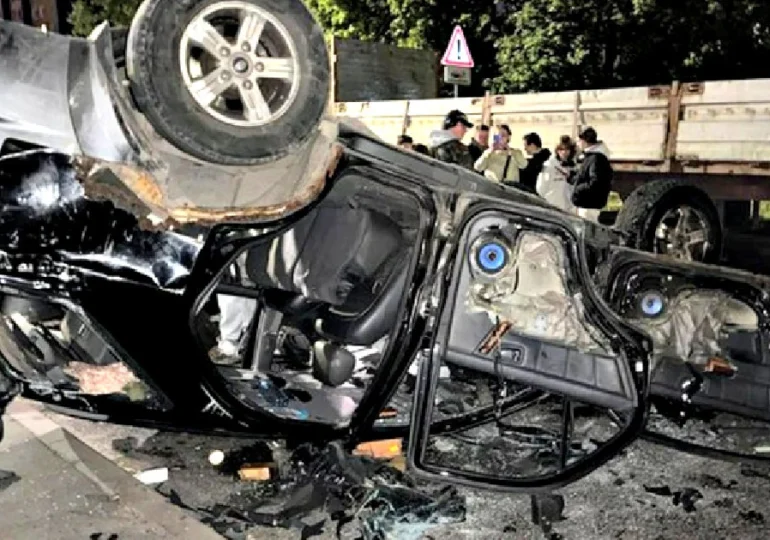
Approximately 200 people clashed on Wednesday with military recruitment agents and police in Lviv after a document check related to Ukraine’s mobilization campaign escalated into a street confrontation.
The incident, one of the most violent episodes so far in Ukraine’s smoldering mobilization crisis, has raised concerns that tensions could escalate into a threat to the country’s security.
The revolt in Lviv may signal that Ukraine's long-standing mobilization crisis is starting to shift from a political and social issue into a security threat, said Yuriy Honcharenko, President of the Ukrainian Security Club, to Kyiv Independent.
"This is a test for the authorities and police - a test of the state's ability to respond to such events within the country," he said.
Honcharenko added that the idea that Ukrainians should actively resist their own army remains a marginal one rather than a mainstream trend, but warned of the risk of further escalation.
What Happened in Lviv
According to the police, the conflict involved Ukrainian military personnel, police officers, and approximately 200 civilians.
The Recruitment Center (TCC) in the Lviv region stated that the altercation began when a 30-year-old man was stopped on the street for a military identification document check. According to the TCC, the man was subject to mobilization and was found to have violated military identification regulations.
Online videos show a crowd surrounding a black military vehicle, chanting "shame" before overturning it. Two men are then seen climbing onto the vehicle and breaking its windows, while onlookers cheer and film the scene. Many of those assaulting the recruitment agents are teenagers and young adults.
Other online images show a soldier being pushed and forced to remove his uniform. After he refused, people tried to rip it off him.
As the conflict escalated, the crowd grew to approximately 200 people and remained in the street late into the night.
The police announced that the man suspected of assaulting the officer had been identified. Subsequently, on Thursday, the Security Service of Ukraine (SBU) reported the detention of a suspect - a 23-year-old man from Lviv, who was allegedly involved in blocking and damaging the military vehicle.
"Currently, the man who violated military identification rules has been sent for a military medical examination," the TCC announced.
Who Stands to Gain
"There are many questions regarding Lviv, yesterday's incident, and the attack on the TCC military personnel. In my opinion, this situation is very serious. And the attitude towards individuals in military uniform is very poor," said President Volodymyr Zelensky in response to the attack.
The violence has triggered a broad reaction from Ukraine's military and political leadership.
The Ministry of Defense has labeled the attack on the military personnel as "unacceptable" and urged law enforcement agencies to identify and hold those responsible accountable.
"The only party that benefits from such situations is the enemy. Instigating hate speech against our own military personnel will lead to irreparable consequences. Mobilization is a necessary component of Ukraine's defense. Its methods need improvement, and this process is ongoing," the ministry stated.
Former Chief of the Main Intelligence Directorate, Kirill Budanov, also commented on the incident. "If today you tear off clothes and beat a soldier from your own army, think about who will defend you tomorrow from an enemy who will beat you and tear off your clothes in the same way," he said.
Mayor of Lviv, Andriy Sadovyi, described the incident as "very serious" and stated that those who broke the law must be held accountable. He emphasized that 58,000 residents of Lviv are currently fighting on the front lines and that the city allocates a significant portion of its budget to support the Ukrainian Armed Forces.
"The shameful behavior of a group of people cannot destroy the community's reputation, but it has cast a shadow over it," he said.
Sadovyi warned that Russia benefits the most from internal confrontations among Ukrainians, stating that any such conflict can quickly become a tool of Russian propaganda.
The Fracture Dividing the Ukrainian People
For Ukrainian soldiers, these images have revealed a fracture between those who have spent years defending the country and segments of civil society increasingly detached from the mobilization system.
Pavlo Yurinets, a Lviv native and member of Ukraine's Unmanned Systems Forces, told Kiev Independent that the anger directed solely at recruitment centers overshadows the state's broader responsibility for failures in the mobilization process. "The authorities have failed in mobilization, but the recruitment center (TCC) is the one blamed for everything," he said.
The Lviv incident comes as Ukraine faces increasing pressure to replenish depleted military units; meanwhile, mandatory mobilization of men and indefinite military service have fueled tensions that have escalated over the years, the publication noted.
Yurinets criticized the young people involved in the attack, stating that the army needs people for non-combat roles as well.
"There is much work in the army, including behind the front lines, while these young people are overturning cars. I wonder if people are as focused on helping soldiers adapt to civilian life as they are on their hatred towards the TCC," he added.
Ukrainian MP Roman Lozynskyi, also from Lviv and enlisted in the army, stated on Instagram that demonizing all TCC members without exception is "at least unfair and dishonest, serving the interests of the enemy," adding that anyone breaking the law - regardless of side - must be held accountable.
The anger among soldiers is, in turn, part of the risk highlighted by the Lviv confrontation, said Honcharenko. Many soldiers from the city are away at the front lines and are watching images of civilians attacking their comrades in their hometown. "Simply put, they are not in the city right now. And they are outraged - you can see this on social media," he said.
This anger makes the state's response particularly important, said Honcharenko, warning that a lack of action could fuel new confrontations. "However, any legal procedure must be public, transparent, intelligible, and in accordance with the law. The state must not allow the response to take the form of vigilante reprisals or informal punishments," he said.
A Test for Mobilization Reform
Punishing those responsible is necessary but will not solve the underlying problem: the state must also radically reform the mobilization system, which has eroded public trust and repeatedly pitted soldiers against civilians, said Honcharenko.
He stated that the government - whose defense policy is coordinated by Defense Minister Mykhailo Fedorov - is already working on a broader transformation of the mobilization and military service system. One proposal mentioned by him aims to withdraw military personnel from law enforcement activities on the streets and delegate these measures exclusively to the police.
"This would reduce direct confrontations between civilians and military personnel. At the same time, the police and National Guard forces are better trained to handle cases involving physical resistance; they are trained to deal with such situations," said Honcharenko.
Rebuilding Trust in the System
The broader challenge lies in rebuilding trust in a system that has not undergone major reforms for years. "Changes in such a sensitive area are very difficult, but there is no alternative," emphasized Honcharenko.
He added that the next stage of the ongoing army reform is expected to focus on territorial recruitment centers and mobilization practices, followed subsequently by demobilization changes.
The decisive moment will come when both military personnel and civilians see that soldiers who have served long periods are actually allowed to return home and that the state respects its promises. "When people understand the logic of the system and trust the state, they can calculate for themselves that perhaps it is more rational to serve for 12 or 14 months, return home, and benefit from a certain deferment, rather than hide, be found, and mobilized for three or five years," explained Honcearenko.
T.D.