


A panel of judges from the Bucharest Court of Appeal decided on March 19 to acquit Marian Vanghele, the former mayor of Sector 5, for abuse of office and money laundering, and to cease the criminal proceedings for accepting a bribe of 30 million euros, as per the prosecutors’ indictment, the acts being time-barred.
This marks the end of a decade of trials, with dozens of adjournments, changes of judges, and witness hearings being resumed, through which one of the most corrupt politicians, a PSD leader, walked away clean and kept the money following a rescue operation controlled by Judge Lia Savonea, the current President of the Supreme Court of Justice.
A panel of judges, including Lia Savonea, decided in January 2025 that the statute of limitations starts from the moment Marian Vanghelie first demanded a bribe, not from the last one. In other words, it shifted the application of the statute of limitations back by 7 years, to 2007, when the mayor began receiving money from the whistleblower, not from 2014, when the whistleblower offered a final sum as a bribe and alerted the authorities.
The above case was extensively described in the documentary Recorder, which provided a shocking overview of corruption in the justice system, triggering a reaction of amazement and outrage in a large part of Romanian society.
The Pact
The mechanism allowing major corrupt figures to escape both imprisonment and the return of embezzled funds, by creating a legal void around "statute of limitations," followed by establishing a legal framework favorable to artificially extending it in favor of criminals through controversial decisions of the Constitutional Court and case law, formed the basis of a pact concluded between PSD-PNL and judges, under the authority of President Klaus Iohannis.
The pact entailed protecting politicians from the law in cases of corruption accusations in exchange for huge material privileges - salaries and pensions - granted to judges, along with complete control of the justice system by the trio of the Supreme Court, CSM, judges' section, and the Judicial Inspection, all under the influence and authority of Lia Savonea.
"In 2022, there was a coordinated effort to subordinate independent institutions to group interests. Those think tanks aimed to erase the past of investigated cases and block the functioning of Justice…," stated Crin Bologa, former head of the DNA, at a debate in January 2026 held at Babeș-Bolyai University in Cluj.
"Think of a highway construction contract, which in Romania can last between 5, 10 years. Money is demanded at the start of the contract and continues to be received along the way. The prosecutor catches them in a sting operation after 5, 6, 7 years. The statute of limitations is calculated from the initial demand and the act of receiving the money is irrelevant, proven through the sting operation…," explained Crin Bologa, former anti-corruption prosecutor, at that time.
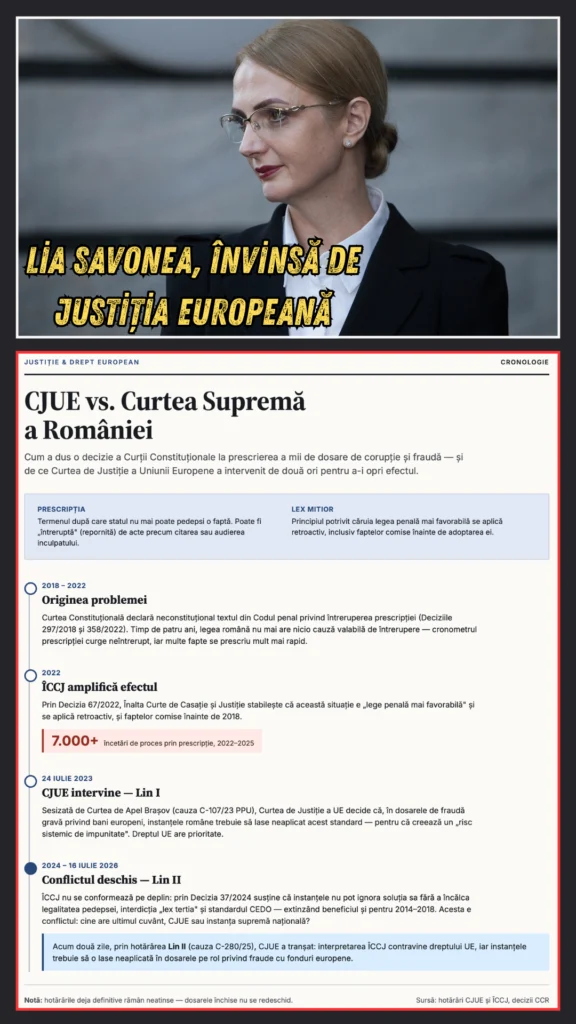
Justification
The decision of July 16, abbreviated as LIN II, by the Court of Justice of the European Union is the second one to dismantle the corrupt association mechanism between Romanian politicians and judges, following a previous decision of the CJEU in 2023.
"…national law does not provide specific criteria on the basis of which the court of the Member State can assess, in advance, the systemic risk of impunity generated by the application of this national standard in cases of serious fraud affecting the financial interests of the European Union…," as stated in the CJEU decision.
In other words, the mechanism nurtured by Judge Lia Savonea violates EU law and harms European citizens, as Romanian law neither punishes nor recovers damages for those who divert EU funds.
On the other hand, major corruption in Romania is precisely based on the misappropriation of funds coming into the country through EU funding programs.
Any significant misappropriation of public resources is, in one way or another, linked to the EU budget.
Shortly after the decision was published, Lia Savonea reacted with a statement attempting to defend her position but got lost in an attempt to justify the escape of criminals by claiming that it represented an action to protect fundamental human rights.
"The mission of the supreme court is to ensure the loyal, coherent, and predictable application of the law, in full respect of the European legal order, namely EU law, the European Convention on Human Rights, and the Romanian Constitution. The fidelity of the High Court of Cassation and Justice does not belong to a specific jurisprudential solution or a specific outcome of a case, but to the fundamental values of the rule of law," wrote Judge Lia Savonea, President of the High Court of Cassation and Justice.
The Damage
From the statement, it is evident that Lia Savonea accepts the CJEU decision and justifies the actions taken so far. There is no argument related to the authority or jurisdiction of the European Court, indicating Lia Savonea's acceptance of defeat.
Her prestige within the European legal system is severely affected after two consecutive defeats on the same issue.
The principle of the supremacy of EU law must be interpreted as opposing a national regulation or practice according to which the national common law courts of a Member State are bound by the decisions of the constitutional court, as well as by those of the supreme court of that Member State and cannot, for this reason and at the risk of the disciplinary liability of the judges concerned, fail to apply ex officio the case law resulting from the mentioned decisions, even if they consider, in the light of a Court decision, that this case law is contrary to certain provisions of EU law with direct effect.
European Court of Justice, first decision on statute of limitations, July 2023
The main effect of the CJEU decision is that the corrupt mechanism of extending the statute of limitations can no longer be applied in any ongoing trial where the damage is related to European funds of any kind.
For other types of misappropriation of public funds, it remains at the discretion of the judges, but the CJEU clearly emphasizes that European law takes precedence over national law.
After the defeat at the Constitutional Court regarding magistrates' special pensions, this new decision further shakes the system created by Lia Savonea, which has protected the corrupt elite of the Romanian state for years.