

The war with Iran and disruption of deliveries from the Middle East have significantly increased the prices of oil, gas, and fuels. Only four of the major economies of the European Union have paid nearly 41 billion euros extra for fossil fuels, even though they did not import larger quantities of energy.
The largest additional costs were recorded in the Netherlands, Italy, France, and Spain. The rise in diesel prices is particularly dangerous for the European economy, as it quickly translates into transportation, agriculture, and industry and can ultimately lead to price increases for products, as shown in a report by the Center for Research in Energy and Clean Air (CREA), cited by Euronews.
Billions paid extra for the same quantities
CREA analyzed the situation in 170 countries and found that 134 of them paid more for diesel than markets estimated before the start of the war.
Between March and August 2026, the additional costs amounted to:
- 11.5 billion euros in the Netherlands;
- 10.8 billion euros in Italy;
- 9.5 billion euros in France;
- 8.8 billion euros in Spain.
Together, these four countries incurred an additional bill of nearly 41 billion euros, without receiving larger quantities of energy in return.
Globally, the crisis added over 282 billion euros to the cost of fossil fuel imports. Nearly half of this amount, 140 billion euros, came solely from the increase in oil prices.
The European Union and East Asia bore the brunt of the bill, while exporting regions benefited from price hikes.
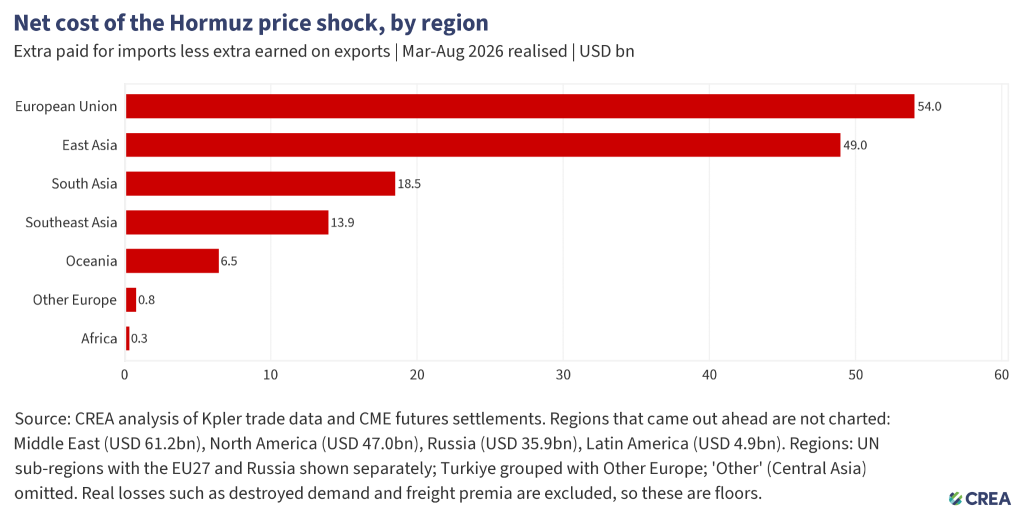
The European Union incurred an additional net cost of 54 billion dollars for fossil fuel imports between March and August 2026, while East Asia paid an extra 49 billion dollars. In contrast, the Middle East, North America, and Russia gained additional revenue due to price increases.
In essence, the crisis shifted tens of billions of dollars from import-dependent regions to major oil and gas producers and exporters.
Between March and August 2026, liquefied natural gas destined for Asia cost 75% more than anticipated by markets before the war, while European gas cost 60% more. Diesel exceeded estimates by 59%, gasoline by 43%, and Brent crude oil by 35%.
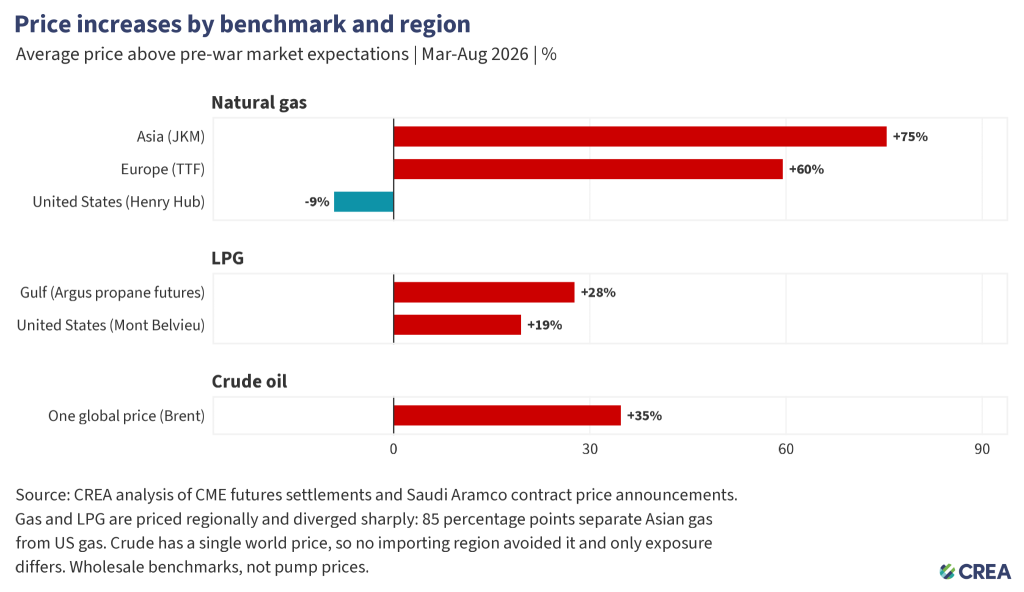
US natural gas had a different evolution. Because the American market does not depend on the route through the Strait of Hormuz, prices were 9% lower than market expectations before the war.
To compensate for the loss of deliveries from the Middle East, the EU relied mainly on the United States and Norway. These two countries were the largest suppliers to the bloc in the first quarter of the year, both for oil products and liquefied natural gas.
Why diesel price increases affect all prices
Diesel is particularly important for Europe, where it is widely used in freight transport, agriculture, and industry.
Therefore, an increase in its price does not remain only at the pump. The higher costs are absorbed by transport companies, farmers, and producers, spread along supply chains, and ultimately reach the price paid by consumers.
Thus, the crisis once again highlights the vulnerability of European economies to fluctuations in international oil and gas markets. When deliveries are affected by war or geopolitical crisis, import-dependent countries pay more even if they do not consume more.
Clean energy has reduced the bill by 36 billion dollars
The additional production of clean energy developed after 2020 has reduced the bill for coal, oil, and gas imports by approximately 36 billion dollars in the first five months of the crisis. The largest savings were recorded by China and Japan, followed by Spain, France, Italy, and the Netherlands.
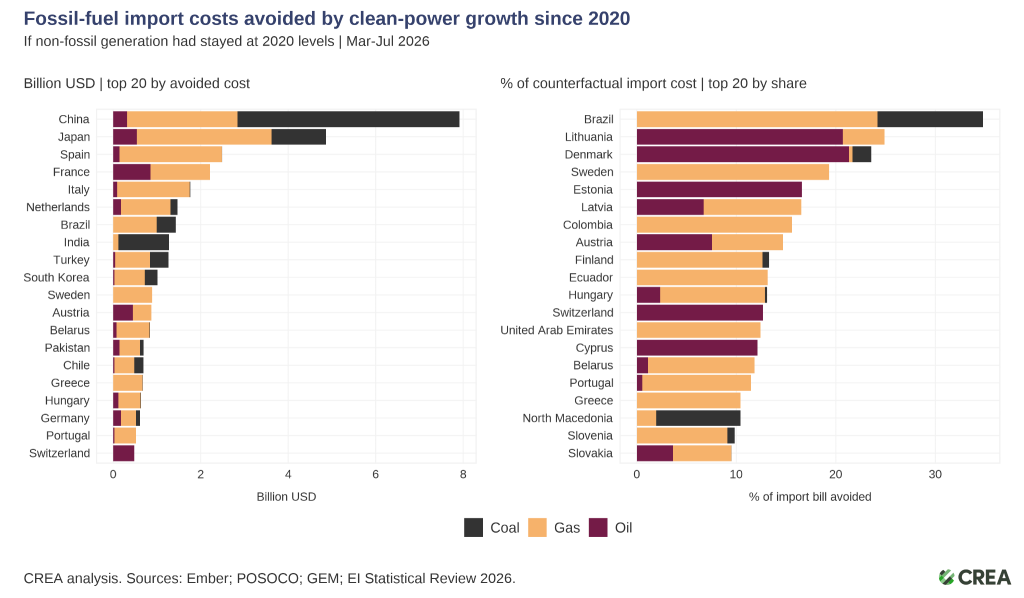
Each quantity of gas, oil, or coal replaced by clean energy production meant less fuel purchased at the high prices during the war.
“The best way to protect ourselves from high oil prices is to give it up as soon as possible,” said Luke Wickenden, an energy analyst at CREA.
He pointed out that the increase in oil and gas prices affects both household budgets and the global economy, while countries that have invested in clean energy after previous crises have saved billions of dollars.
From this perspective, renewable sources and electrification are no longer just solutions for reducing emissions. They also become a form of economic protection against conflicts and shocks in energy markets.
Countries that produce a larger share of electricity from clean sources and consume fewer fossil fuels are less exposed when international prices rise sharply.
Spain's Lesson: Clean electricity is not enough
Spain has saved billions of euros due to the development of renewable sources, but has not been fully protected from price hikes. The additional bill for fossil fuel imports was equivalent to 181 euros per inhabitant, due to the dependence of transportation, aviation, and industry on oil.
“Spain's experience shows that clean electricity must now be accompanied by a faster electrification of the entire economy,” said Isaac Levi, coordinator of the CREA team for Europe-Russia policies and energy analysis, to Euronews.
In other words, increased production of green electricity reduces the consumption of gas and coal in the energy sector, but cannot fully protect the economy as long as transportation and a significant part of the industry continue to depend on oil.
Over 100 organizations urge Ursula von der Leyen for a plan
Against the backdrop of this crisis, over 100 European and international organizations urge the President of the European Commission, Ursula von der Leyen, to present a plan for the gradual elimination of fossil fuels.
The organizations want the announcement to be made in the State of the Union address, scheduled for September 16, and ask the head of the European Commission for a common vision for the remaining period of her mandate.
“We urge you to use the upcoming speech to announce the launch of a comprehensive report, based on scientific data and independently conducted, with a clear objective: this fossil fuel crisis to be the last for Europe,” the letter states.
The signatory organizations, led by Climate Action Network Europe, argue that Europeans pay twice for their dependence on fossil fuels: once through higher energy bills and then through increasingly severe damages caused by climate change.
“Dependence on fossil fuels has repeatedly undermined Europe's prosperity and limited its ability to act globally. As long as Europe relies on fossil fuels, its citizens remain exposed to price shocks and geopolitical decisions made elsewhere,” the organizations warn.
They propose the creation of an independent report to show how the EU can accelerate the abandonment of fossil fuels without passing the costs on to consumers, employees, and industry.
The strategy is expected to be based on the development of renewable energy, increasing energy efficiency, modernizing networks, and ensuring secure supply chains of critical raw materials necessary for the European industry.