
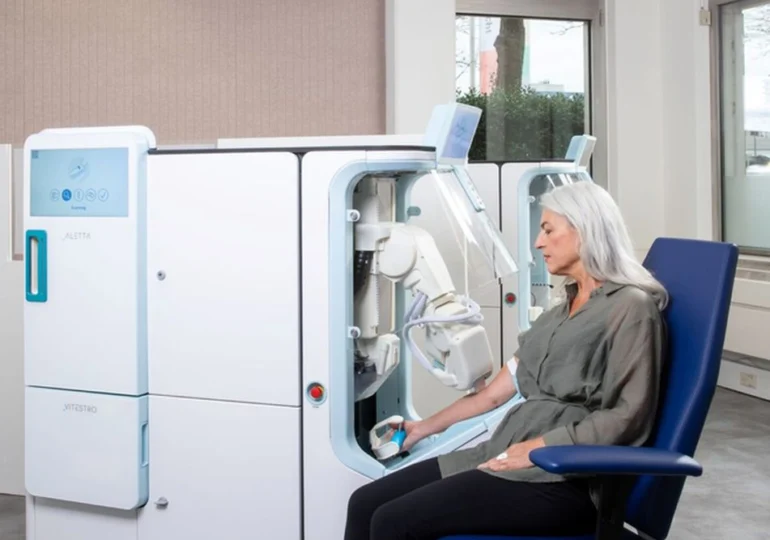
The American authority for the regulation of medicines and medical devices, the FDA, has authorized for the first time an independent robotic device capable of automatically collecting blood from the arms of adult patients.
The system Aletta, developed by the Dutch company Vitestro, can identify veins and perform the procedure under the supervision of a specialist in blood sample collection, who can simultaneously monitor up to three such devices.
The system is intended only for adults treated on an outpatient basis and automatically performs the steps of the procedure.
The specialist initiates each procedure and intervenes if issues arise. Otherwise, the system automatically performs the necessary steps for the collection.
To identify a suitable vein, the device uses near-infrared light and Doppler ultrasound. The first method allows visualization of veins under the skin, while Doppler ultrasound provides information about blood vessels and blood circulation.
After locating the vein, the system applies the tourniquet and prepares the skin for collection. The device then inserts the needle, changes the tubes in which the samples are collected, and finally, removes and disposes of the needle and applies a bandage.
After the procedure is completed, the human assistant checks if the tubes have been filled in the correct order and if a sufficient amount of blood has been collected in each.

Blood collection is one of the most common procedures performed in medical facilities. However, identifying a suitable vein can be challenging in some patients, and a shortage of specialized personnel can delay the analyses.
The authorization of the device was based on clinical data evaluating the system's ability to successfully perform the collection. According to the presented data, the rate of successful procedures was comparable to or higher than that achieved by humans.
The studies included a diverse population of patients, including individuals with various conditions, different skin tones, and individuals who stated they had difficult-to-access veins for blood collection.
Adverse events associated with the device were rare and mild, according to the information underlying the authorization.
Dr. Michelle Tarver, from the Center for Devices and Radiological Health at the FDA, stated that the authorization aims to introduce innovative medical devices that can address a public health need while maintaining safety and efficacy requirements.