

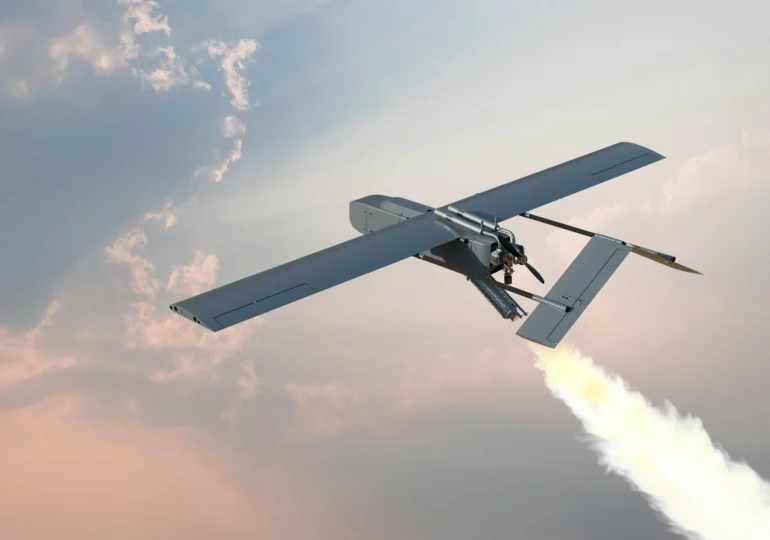
At night, after the rain stops, Ukrainian soldiers prepare the FP-2 drones for a mission in the occupied Lugansk region, over 300 kilometers away. The engines start, the devices rise one after the other, then the team packs up the equipment and leaves. The place from which they launched the drones can, in turn, become a target.
The scene described by a reporter from The Guardian, who accompanied Regiment 413 Raid in eastern Ukraine, shows how much war has changed. Drones now strike hundreds or even thousands of kilometers from the front: depots, refineries, military installations, and infrastructure on which civilians depend. Both countries are increasing their attack capabilities and seeking weapons that the enemy’s defense will find harder to stop.
Ukraine can launch hundreds of drones in an attack
The FP-2 is a drone built in Ukraine for medium-range strikes, especially against targets supporting the supply of Russian troops on the front. The Raid Regiment has been using it since last year. Initially, a single team could carry out two missions per week. Now, the unit's capacity is at least ten times greater, says one of the commanders, known by the call sign Skipper.
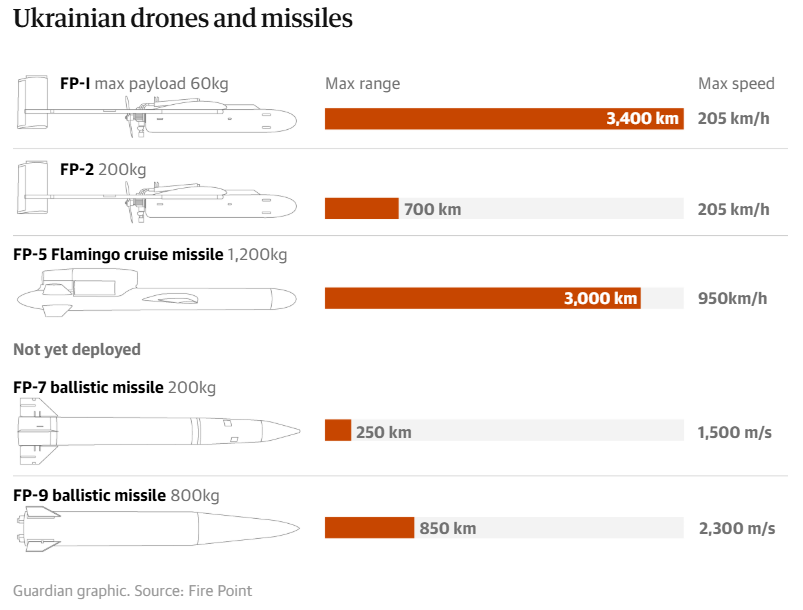
For long-distance strikes, Ukrainians also use the FP-1, which costs around $75,000 and has been sent against depots and refineries in Russia. An attack can involve up to 300 drones, launched by multiple units. Soldiers say they aim to reach the capacity to launch 1,000 in one night.
Cheaper drones can help find a route through the air defense before the devices intended for the main target reach it. However, the results are increasingly hard to achieve: Russia better conceals its equipment and uses jamming systems that reduce the precision of Ukrainian drones, as shown by soldiers quoted by The Guardian.
Russian drones have become faster
Russia has also changed its arsenal. After using Iranian-origin Shahed drones and their own versions, Moscow has introduced models with jet engines. According to The Guardian, Geran-4 can reach speeds of around 300–550 km/h, while Geran-5 approaches 600 km/h.
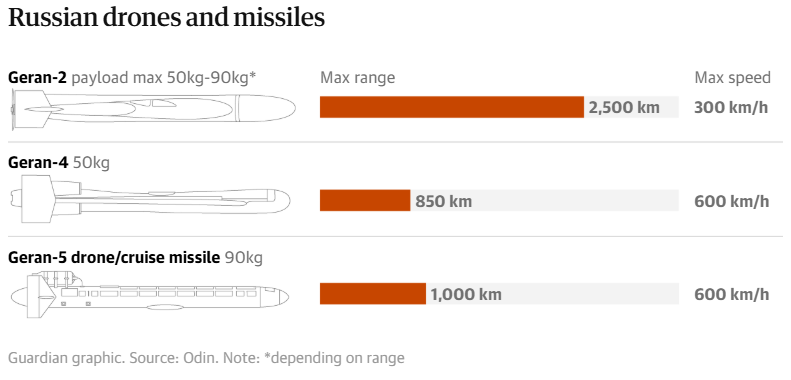
This is an immediate problem for Ukraine: some of the new drones fly faster than interceptors designed to stop older Shahed models. The publication indicates that the interception rate, which exceeded 90% for these, has dropped to around 60% against the new models.
Another concern is the approaching winter. Serhii Beskrestnov, advisor to President Volodymyr Zelensky for military technology, warns that Russia continues to develop its weapons. According to estimates presented by The Guardian, Moscow could produce tens of thousands of fast drones and other long-range weapons in 2027, which could be used against Ukraine's electricity, heating, and water networks. These are estimates regarding future production, not weapons already available in that quantity.
Strikes are increasingly hitting civilians' lives
The attacks do not only affect military targets. Supermarket warehouses, the Nova Poshta postal service, and online commerce firms in Ukraine have been hit. Ukrainian drones have also targeted commercial depots in Russia.
The human cost is rising. According to UN data cited by The Guardian, 2,222 civilians were killed in Ukraine in the first eight months of this year, more than in the entire year of 2025. In August alone, 368 people died in Ukraine. Another 113 deaths were reported in Russia.
However, Ukraine has an additional problem, explains analyst Sidharth Kaushal from the Royal United Services Institute (RUSI), a British defense and security research center: Russia has more types of long-range weapons and a broader air defense. At the same time, Kyiv must find funds to continue the war and protect its infrastructure before winter. Yet, neither side seems close to a decisive defeat.