
Putin’s regime continues the tradition of Soviet repression. However, nothing and no one is eternal, and it is just a matter of time before Russia will have another chance to turn the page of history and launch democratic reforms, according to Russian opposition politician Vladimir Kara-Murza.
Two very telling news stories about Russia emerged last month, within a few days, writes Vladimir Kara-Murza, a Russian politician, author, and historian, in The Washington Post:
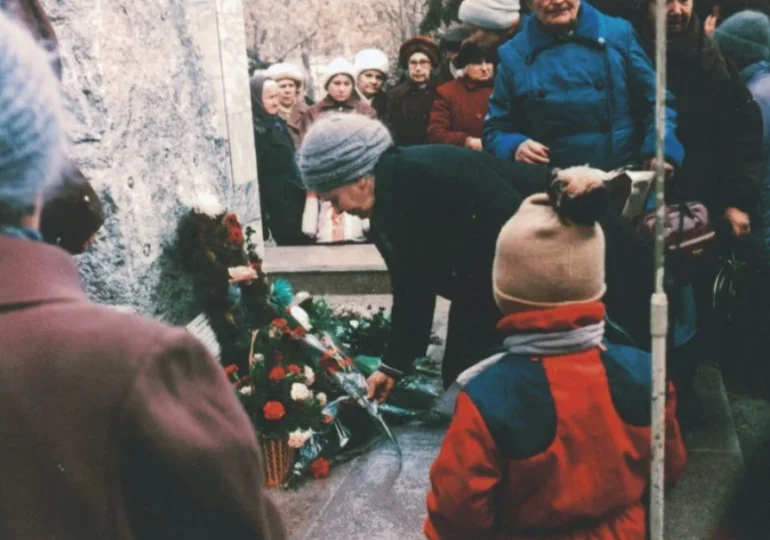
- On April 19, under the cover of darkness, authorities in the Siberian city of Tomsk demolished The Stone of Sorrow, a monument dedicated to the victims of Soviet political repression, erected in one of the city's central squares since the early '90s, in honor of the hundreds of thousands of people killed in this region by the communist regime. According to eyewitnesses, the monument was destroyed by tractors using buckets to bring it down.
- On April 22, through a special presidential decree, Vladimir Putin renamed the FSB academy - the Federal Security Service of Russia and the main internal successor of the KGB - after Felix Dzerzhinsky, the founder of the state terror machine who, throughout decades of Soviet domination, was responsible for the killing of millions of Russians and people from other nations subjugated by the Kremlin. As a reason for this decision, Putin cited "Dzerzhinsky's remarkable contribution to ensuring state security."
Putin's War on Memory
Obviously, there is nothing new in the Kremlin's campaign to erase the memory of the crimes that the Soviet state committed against its people and to glorify the authors and masterminds of these crimes, writes Kara-Murza.
One of Putin's first actions in power in December 1999, just before officially succeeding President Boris Yeltsin in the Kremlin, was to install a memorial plaque honoring Yuri Andropov, the longtime head of the Soviet KGB, whose tenure was marked by a relentless campaign to eradicate dissent, he recalls. A few months later, Putin reintroduced the national anthem from the Soviet era, personally chosen by Joseph Stalin.
Earlier this year, authorities closed the Museum of the History of the Gulag in Moscow, the only permanent national exhibition in Russia commemorating the victims of repression from the Soviet era. And last month, Russia's Supreme Court banned all activities of the Memorial organization, dedicated to preserving the memory of Soviet repression and its victims, labeling it an "extremist" entity.
Putin's war on memory is not surprising at all, emphasizes the Russian opposition politician who was imprisoned in Russia from April 2022 to August 2024 for speaking out against the war in Ukraine.
Kremlin officials consider themselves - with pride - the direct successors of the Soviet security services, and any reminder of the heinous crimes of their heroes is naturally unwelcome. Furthermore, the same crimes have long been a reality of the current Russian regime - from killing opposition leaders to mass incarceration of those who disagree with the government, to brutal expansionist wars aimed at recreating external "spheres of influence," most notably and tragically in Ukraine.
The Fatal Mistake Made by Russia's Democratic Leadership
All of this is a painful reminder of the mistake made by Russia's democratic leadership after the fall of the Soviet regime, Kara-Murza believes.
World history has undoubtedly shown that the trauma of a totalitarian regime, especially if it lasts for decades, cannot simply be ignored. It must be addressed and overcome through a concerted effort of the state and society.
Various countries have found different formats to do this - from judicial tribunals in post-dictatorship Latin America, to lustration procedures in post-communist Eastern Europe, to truth and reconciliation commissions in post-apartheid South Africa. However, the central principles have always been the same: transparency and accountability. The crimes committed by past regimes have been made public; the perpetrators of these crimes have been held accountable; and the ideologies and practices of the old systems have been unequivocally condemned.
In the early '90s, similar movements existed in Russia, the author recalls:
- Vladimir Bukovsky, a writer and legendary dissident from the Soviet era, advocated for full opening of the Communist Party and KGB archives.
- Galina Starovoitova, a prominent member of parliament, introduced a bill on lustrations that would have banned former officials of the Communist Party and KGB agents (including Putin) from access to executive authority positions.
- Anatoly Kononov, a judge at Russia's Constitutional Court, wrote a landmark legal opinion, advocating for a complete process of the former communist regime in accordance with international statutes on genocide, war crimes, and crimes against peace and humanity.
In the end, none of this happened. Post-Soviet inertia in the state bureaucracy proved stronger than the public desire for change.
"It will turn into a witch hunt," government officials shrugged at Bukovsky's calls for accountability. "Then the witches will return and start hunting us," he replied - and, of course, he proved to be right. When evil is not reflected, not accounted for, and not publicly condemned, it will inevitably return, emphasizes the Russian opposition figure.
A New Chance for Change Will Come in Russia
More than a reflection on the past, this is a crucial lesson for Russia's future. Nothing (and no one) is eternal, and it is just a matter of time before Russia will have another chance to turn the page after this shameful period and launch democratic reforms.
For this chance to succeed, reforms must be accompanied by a robust transitional justice process, and all those responsible, from Putin downwards, must be fully held accountable for committing crimes against our own people and the peoples of other countries.
The tools for this future accountability are already in place - from the Special Tribunal for Aggression against Ukraine to the recent international initiative to document human rights violations in Russia.
We owe this not only to future generations of Russians but also to the rest of Europe and the entire rules-based international order, concludes Vladimir Kara-Murza. These witches must never be allowed to return.
T.D.