
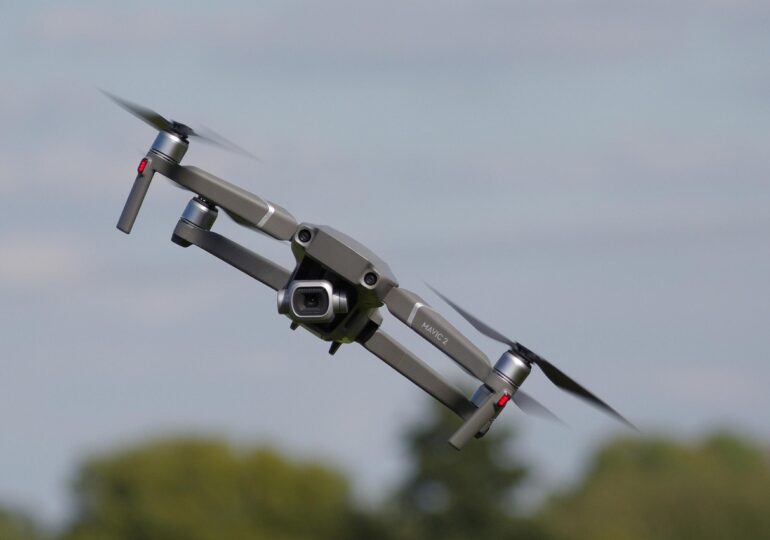
There is a possibility that the dreaded hum of propellers heard on the Ukrainian battlefields may come from drones built in a country with a population of just over a million people, located on the southeastern edge of Europe.
We are talking about Cyprus. Swarmly, the producer, says there are over 200 H-10 Poseidon drones assisting Ukrainian artillery batteries in identifying ground targets, in any weather, accumulating over 100,000 hours in the air over the past three years, as reported by Associated Press.
Its 5,000-square-meter factory has become a major source of unmanned aerial vehicles dispatched to countries such as Indonesia, Benin, Nigeria, India, and Saudi Arabia, according to company officials.
- NATO to Boost Automatic Defense Zone with Drones and Robots in Romania
- Poland Invests 3.5 Billion Euros in a "Revolutionary" Anti-Drone System
Most of the factory is dedicated to the production of unmanned aerial vehicles. However, hidden in a secure area is a production section for super-fast marine drones Swarmy, equipped with high-quality cameras and .50 caliber machine guns.
Russia's invasion of Ukraine has prompted even the smallest EU member countries to develop their high-tech defense industries internally, just as necessity has made Kiev a global leader in cutting-edge drone technology.
Many EU countries have partnered with Kiev to develop this technology, and the frontlines in Ukraine are usually their testing grounds.
Like Cyprus, the Baltic countries and Denmark have ramped up their internal drone and counter-drone technology. In Greece, drones are part of a 25 billion euro overhaul of its armed forces.
"The example of Swarmy, as well as other major companies based in small EU countries, is evidence of the serious effort made by the private sector in Europe to innovate and build mass production capacity for defense items, including unmanned systems," said Federico Borsari, an expert at the Center for European Policy Analysis, based in Washington.
Force Multipliers
Drones are reshaping warfare by offering less militarily capable countries a certain influence over superior adversaries.
Drones will not completely replace heavy weaponry such as tanks, artillery, and warplanes, said Borsari. But they offer flexibility and excellent value for money, making them a formidable force multiplier.
"Take the Hydra marine drone, satellite-guided and filled with explosives, from Swarmly. Each one costs 80,000 euros, which means deploying a group of such drones to neutralize a billion-euro warship can be a deal," said the company's director, Gary Rafalovsky.
This type of weapon that can destroy a much larger warship has already been demonstrated by Houthi attacks in Yemen, according to Fabian Hinz, a researcher on rocket and drone technologies at the International Institute for Strategic Studies, Europe.
Entry barriers for undercapitalized companies are low, he added, as drones are often designed and assembled from cheap and readily available components in the global market.
"And that, of course, means that you practically don't need a large industrial investment at the outset, which you need alongside other military capabilities. You don't need decades of experience in certain material sciences or such things," Hinz said.
Who's Getting Involved
In Denmark, two companies focused on anti-drone devices reported an increase in new clients, and some of the devices were set to be shipped to Ukraine to help jam Russian technology on the battlefield. Ukraine announced in September that it had partnered with Danish companies to build components for missiles and drones at a factory in Denmark.
In the Baltic country Lithuania, scientists and businessmen have joined forces under the name VILNIUS TECH to develop drones, automatic mine detection, and other military technologies. The state ammunition factory Giraite says it has increased its production capacity by 50% from 2022.
Greece showcased homemade drones and anti-drone technology for the first time during a full tactical exercise in November, while NATO urged the defense sector in Europe to accelerate its pace.
"We need capabilities, equipment, real firepower, and the most advanced technology," warned NATO Secretary-General Mark Rutte during a visit to Romania at the beginning of that month. "Bring your ideas, test your ingenuity, and use NATO as a testing platform."
Although drone development is accelerating, Borsari warned that the advantages of drones are often tempered by numerous variables, such as the harsh conditions they sometimes fly in, the levels of training and qualification of operators, and the extent of logistical support to keep them operational.
Europe Shifts into Defense Mode
Russia's war in Ukraine and the conflicting messages from the Trump administration, which strained relations with NATO allies, have forced European leaders to consider the need to become more autonomous in defense. Therefore, the EU has made billions of euros available to encourage investments and strengthen its collective deterrence capacity.
This has been a boost for states like Cyprus, which took over the EU's six-month presidency on January 1. Last week, the EU's executive body approved financial assistance for eight members, including Spain, Croatia, Portugal, Bulgaria, Belgium, Romania, and Cyprus.
Cyprus is set to receive final approval from EU leaders for around 1.2 billion euros in long-term, low-cost loans under the EU's joint public procurement program worth 150 billion euros, called the Security Action for Europe (SAFE).
Its nascent defense industry already consists of about 30 companies and research centers producing technology for both civilian and military sectors, including robotics, communication networks, anti-drone systems, and even satellite communications and surveillance, said Panayiotis Hadjipavlis, head of armament development and defense capabilities at the Ministry of Defense in Cyprus.
"We have niche capabilities in high-tech products, and this needs to be taken seriously into consideration," Hadjipavlis told the Associated Press.