
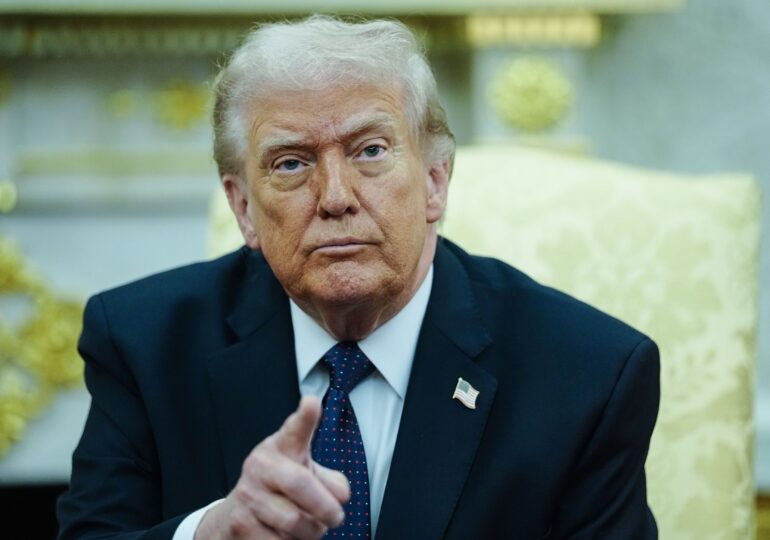
Donald Trump dramatically escalated threats against NATO this week, fueled by his growing anger towards America’s allies after they refused to join the US war against Iran.
On Wednesday, the US President stated that he seriously considers withdrawing from the alliance. Although he did not detail this threat in a televised speech later that evening, his statements were the firmest to date, underscoring his aversion to the 77-year-old pact.
"I will talk about my disgust with NATO," he said before the speech, later adding for Politico: "I am disappointed with them... if I ever needed them, they wouldn't be there."
So far, Trump has not taken concrete steps to leave the alliance - a decision that US law does not allow him to make without Congressional approval. However, his threats against the alliance, his use of the term "they" instead of "we" when speaking about NATO, and his previous calls to annex Greenland from the Danish ally indicate a country that no longer sees itself as an integral part of the alliance it founded.
But what could the US practically do if it wanted to give substance to the president's threats?
Politico spoke with nine experts, lawyers, and NATO officials who described Trump's options, how realistic they are, and how damaging they would be for the alliance.
Scenario 1 — Rhetoric Intensification
Increasing the level of threats, criticism, and rhetoric would continue what Trump is already doing.
The US President has repeatedly undermined NATO's collective defense clause, known as Article 5, and questioned whether he would actually send American troops to defend allies. Reiterating this week that the alliance is a "paper tiger," he added that even Vladimir Putin "knows that."
European leaders have highlighted this risk.
"Alliances like NATO are valuable because of the trust that underpins them. If you create daily doubts about your commitment, you hollow out NATO," said Emmanuel Macron on Thursday.
"Every time the US President questions the alliance, it "seriously affects the credibility of NATO's defense and deterrence posture," said Gerlinde Niehus, an independent security expert.
"Deterrence also works psychologically in the adversary's perception," she said. "If the adversary believes you are a paper tiger, then, of course, it is an open invitation for Vladimir Putin and, to some extent, Xi Jinping to test the alliance."
Within the Pentagon, the feeling is that Trump's threats are a continuation of his long-standing skepticism towards NATO.
Probability: 5/5
Damage Level: 
Scenario 2 — Internal Sabotage
Trump could choose to make life difficult for allies within NATO without triggering a direct conflict.
This is already happening to some extent. The US has taken advantage of the fact that all policy documents in NATO committees must be approved unanimously to block reports on "softer" issues, such as climate change and human security.
Overall, the US still actively participates, but it could cause more damage if it decides to block activities in essential committees, such as those related to Ukraine and Russia.
The US could also refuse to pay its contribution to NATO's common budget (approximately 800 million euros). Although disruptive, this would not be catastrophic for other allies.
Some in the Trump administration are also considering a "pay-to-play" model, which would limit the role of countries that do not meet spending targets.
Probability: 3/5
Damage Level:
Scenario 3 — Withdrawal of American Troops
Washington could decide to withdraw its troops from Europe.
Currently, the US has between 67,500 and 85,000 troops on the continent. The 2025 law limits the withdrawal to about 9,000 soldiers without Congressional approval.
This would be "quite damaging," but not catastrophic, as European allies could compensate.
However, this scenario is unlikely, as the US needs these troops for rapid deployments in other conflicts, including in the Middle East.
Probability: 2/5
Damage Level:
Scenario 4 — "Soft" Exit
Trump could paralyze the alliance without officially leaving it.
The US could exit NATO's military planning cycle, freezing existing commitments and leaving Europe to fill the gaps - including in air defense and intelligence.
Also, the US could boycott NATO meetings or withdraw its delegation, effectively paralyzing the alliance's activities, as decisions are made unanimously.
A historical precedent: Charles de Gaulle withdrew France from NATO's integrated military structure in 1966.
In the case of the US, such a step would have devastating effects, including troop withdrawals and the departure of the alliance's supreme commander.
Probability: 2/5
Damage Level:
Scenario 5 — "Hard" Exit
An official exit from NATO involves serious legal obstacles: Trump would need the support of two-thirds of the Senate and the triggering of Article 13, a process that takes a year.
However, the president can try to unilaterally withdraw from treaties, as he did in 2020 with the Open Skies Treaty.
Such a step would almost certainly trigger legal proceedings and political opposition.
"It's hard to imagine NATO without US participation," said a NATO diplomat. "This should weigh in on any decision Washington makes or doesn't make."
Probability: 1/5
Damage Level: 