
Thousands of tourists who arrive annually in Bucharest could unknowingly stay in buildings that could become traps in the event of a major earthquake.
Tourists in the capital of Romania, Bucharest, are accommodated in lodging spaces listed illegally on Airbnb and Booking.com, located in buildings considered so vulnerable from a seismic standpoint that they could collapse in the event of a major earthquake, according to data exclusively provided to The Guardian.
An analysis of data collected by Re:Rise, an organization in Romania dedicated to reducing seismic risk, identified at least 207 properties illegally promoted on the two platforms in Bucharest at the end of May, with a total accommodation capacity of over 1,000 visitors per night.
Booking.com had 116 of these listings, 47 were available on Airbnb, and 44 listings appeared on both platforms. All were in buildings classified at the highest level of seismic risk.
Bucharest is the capital with the highest seismic vulnerability in the European Union, having been affected by two major earthquakes in the last century. The most recent, occurring in 1977, killed over 1,500 people, injured more than 10,000, and led to the collapse of 32 buildings in less than a minute.
Experts believe that another earthquake of such magnitude is inevitable and warn that the damages could surpass previous disaster levels.
In an attempt to limit unsafe accommodations, Romania banned in 2024 the short and long-term rental of properties in buildings with high seismic risk, classified as RS1. In the capital, there are at least 404 such buildings where any form of rental is illegal, and violations are sanctioned with fines ranging from 1,000 to 2,000 euros.
As only a portion of the city's housing stock has been officially assessed for seismic risk, experts believe the actual extent of unsafe accommodations is likely higher.
Tourists are not informed about risks
However, these risks are rarely brought to the attention of tourists booking accommodations. Neither Airbnb nor Booking.com require owners to declare whether their properties are structurally safe.
“We tried all possible ways to draw the platforms' attention to this issue, but they told us it's the owners' responsibility, not theirs,” said Matei Sumbasacu, an engineer and founder of Re:Rise.
Ana Todor, who booked two Airbnb accommodations in 2025 in apartments located in RS1 buildings, said she had the impression that owners and platforms are ‘counting’ on guests not checking the rules and regulations too carefully.
“When I got there, the building looked terrible from the outside and didn't give me a good feeling. Descriptions that downplay the danger are like a Hello Kitty band-aid over a deep crack,” Todor said.
Todor said she was unaware that renting in such buildings was illegal and stated that from now on, she will consider the condition and location of the building when making a reservation.
A property identified by The Guardian and Re:Rise on Airbnb, a two-bedroom apartment in the University Square area, has a rate of around 100 euros per night and can accommodate up to six people. A review left by a family who stayed there last October mentioned that the property was ‘old and looks suspicious from the outside’.
An Airbnb superhost has 25 properties listed on the platform, at least six of which are in buildings considered to have the highest seismic risk, according to the analysis.
An apartment managed by this individual in an RS1 building in Roman Square is described as a combination of ‘classic charm and modern comfort, perfect for both business and leisure stays’.
The actual number of tourist rentals in RS1 buildings is likely higher, as only properties with confirmed addresses were included. Of the confirmed listings, only two mentioned in the description that they are in a building with high seismic risk. Even these, however, tried to downplay the danger.
In one case, the host specifies that the accommodation space “may appear in older seismic risk classifications,” adding that this is “common for historic buildings in the city center” and that the property is “inhabited and regularly maintained.”
Another listing does not directly mention the risk, but in the host's English description, there is a phrase in Romanian that says the building where the apartment is located has a ‘sticker,’ without explaining what this means.
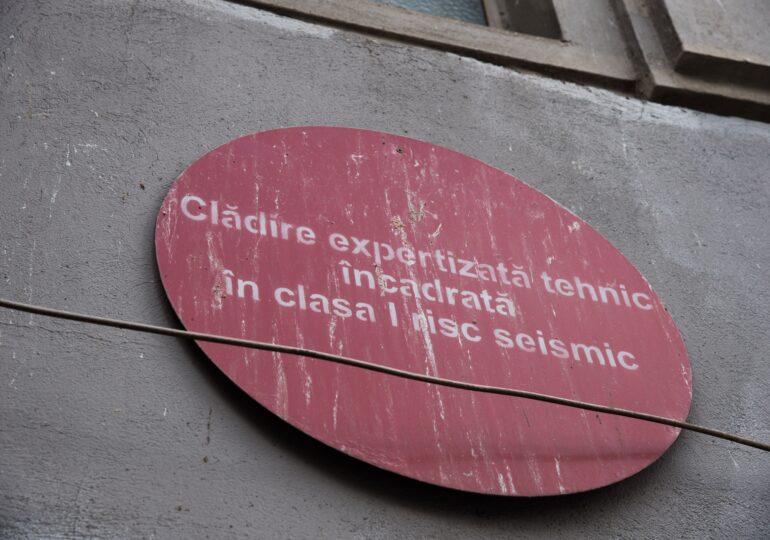
According to the law, RS1 buildings must display above the entrance a red sticker containing a warning in Romanian stating that the building has been evaluated and classified in the I seismic risk class. For most foreign visitors, the warning is practically invisible if they do not know Romanian, say representatives of civic organizations.
Volunteers take action
After attempting to alert Airbnb and Booking.com about risky listings, Re:Rise ultimately decided to take action on their own. Volunteers began affixing hard-to-remove stickers on key boxes mounted outside RS1 buildings that had vacation apartments, each sticker featuring a QR code linking to a website where tourists could read about the seismic risk of the property they were about to stay in.
“The state could directly contact the platforms and compel them to act. The main institution responsible for anyone visiting the city is the municipality,” said Sumbasacu.
The municipality stated that local police conduct checks only as a result of complaints.
“An information campaign was organized for apartment owners and owners of buildings whose properties are on the list of buildings classified in the I seismic risk class. Approximately 3,000 notifications were sent,” added the municipality.
An Airbnb spokesperson stated: “Safety is a priority for Airbnb, and we take issues like this seriously. We are currently investigating based on the available information, so we can take appropriate action.”
A Booking.com spokesperson stated: “Our accommodation partners must ensure they are aware of their obligations and comply with all local laws, and authorities can report any listings that raise questions for them.”
2 million tourists last year in Bucharest
Bucharest had over 2 million visitors in 2025, more than any other city in the country, according to the National Institute of Statistics.
However, a significant part of the city's infrastructure — including some schools, administrative buildings, theaters, fire stations, as well as private properties — remains exposed to high seismic risk.
Consolidation works initiated after the 1977 earthquake were interrupted when communist dictator Nicolae Ceaușescu redirected funds to build the People's House, now the Palace of Parliament. Since the adoption of legislation on consolidation in 1994, only 35 buildings have been consolidated.
An assessment of risk conducted in 2022 by the Bucharest Municipality Emergency Situations Committee estimated that a major earthquake could severely affect about 23,000 buildings in the city, could cause the death of approximately 6,500 people, and could leave another 16,000 severely injured.