
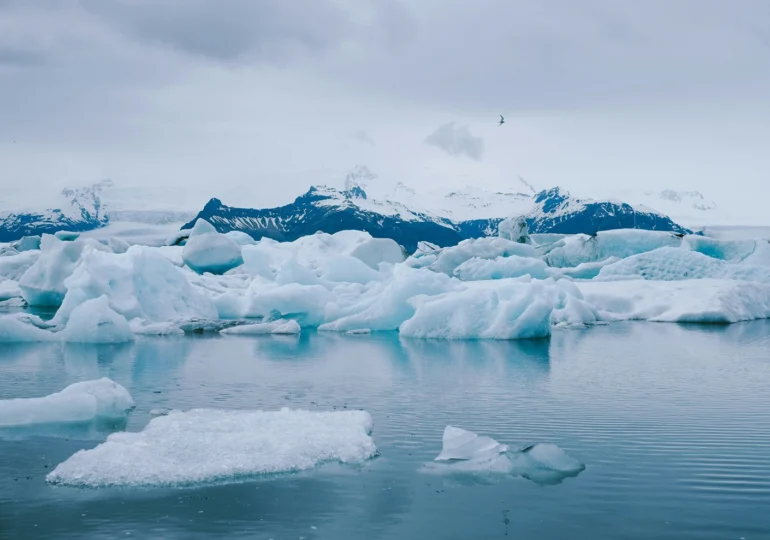
The cryosphere – the solid state of water on Earth, including all ice and snow – risks irreversible damage if the 1.5°C threshold is exceeded globally, scientists warn.
The frozen regions of the Earth are facing such dangerous melting that global warming should be brought back below the 1°C threshold, after an inevitable period during which global temperature targets will be exceeded, according to a UN report cited by The Guardian.
The document, prepared by 80 scientists gathered by the International Cryosphere and Climate Initiative (ICCI) and the United Nations Environment Programme (UNEP), shows that much of the damage would be irreversible, even if global temperatures were brought back to 1.5°C; among these are glacier melting, which leads to sea level rise and threatens water resource security.
Permanent and extensive losses of snow and ice dismantle the myth that exceeding the 1.5°C threshold set by the Paris Agreement (reaching, for example, 2°C or 3°C) could be manageable or even preferable to urgent emission reductions, the report emphasizes.
Main conclusions of the UN report on the cryosphere:
- The planet has warmed by 1.3°C compared to the preindustrial period, and given the failure to limit greenhouse gas emissions, some overshoot of established thresholds is inevitable. However, considering the extreme effects on the cryosphere, temperatures should exceed this threshold for as short a period as possible.
- Moreover, it is necessary to remove a sufficient amount of carbon from the atmosphere – responsible for planetary warming – so that long-term warming is significantly reduced, ideally below 1°C by the year 2150.
- A significant overshoot of climate limits, projected under current policies – with a maximum overshoot of about 3°C beyond the Paris target – would lead to the near-complete thawing of surface permafrost, likely cause “severe and possibly abrupt” disruptions of ocean circulation, and result in widespread acidification. The latest scientific research suggests that sea ice recovers more slowly than previously thought.
- Glaciers, which are still responding to past warming, would retain only about 70% of their current volume over several centuries if long-term warming were reduced to 0.8°C.
- At the same time, the ice sheets covering Greenland and Antarctica – which are melting today about six times faster than in the 1990s – would continue to lose ice even in scenarios where the overshoot is short-lived and temperatures return to 1.5°C.
- Current policies, which will lead to global warming of 2.8°C, would reduce glacier mass to less than 10% in the Rocky Mountains, Alps, Iceland, and Scandinavia. If warming were limited to 1.5°C, about 20–35% of this mass would remain.
- In the Hindu Kush-Himalaya region, where glaciers are a water source for nearly a quarter of humanity, current policies will leave only 41% of the ice mass intact. If warming were limited to 1.5°C, 83% would remain.
James Kirkham, a glaciologist at ICCI and lead author of the report, stated that the cryosphere is “one of the most sensitive components of the climate system,” and the consequences of its loss affect the entire planet.
“This year, we have already witnessed one of the largest and most devastating ice and rock avalanches ever recorded, at the Nepal-China border – an event that killed thousands and caused damage equivalent to 10% of Nepal’s GDP,” said Kirkham. “Switzerland has lost 20% of its glacier ice in the last five years, and thousands of glaciers worldwide are set to disappear in the next decade – a process that will repeat every year.”
Last month, a UNEP report concluded that, to have a real chance of preventing temperature rises of more than 1.7°C above preindustrial levels, the world must cut emissions by 18% by 2030 and by 45% by 2035. The report emphasized that keeping temperatures above the 1.5°C threshold would lead to “no positive outcome.”
T.D.