

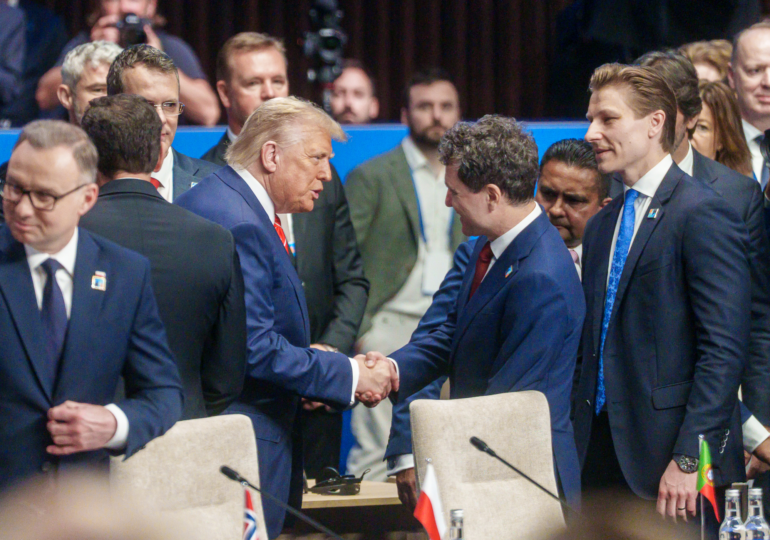
US President Donald Trump will not attend the B9 Summit scheduled for May 13 in Bucharest, but Washington could be represented at a high level. The head of the State Department, Marco Rubio, could arrive in Bucharest.
In a letter sent to President Nicușor Dan and quoted by news agencies, the American leader thanked Romania for increasing defense spending and for involvement in the regional security context, including in the current conflict in Iran.
Additionally, Trump conveyed that Secretary of State Marco Rubio's team will remain in contact with Romanian authorities to ensure a substantial American presence at the meeting.
Summit with significant stakes for the eastern flank
The B9 format meeting brings together NATO states from the eastern flank - Romania, Poland, Bulgaria, Czech Republic, Slovakia, Hungary, Lithuania, Latvia, and Estonia - with the aim of coordinating positions ahead of major decisions within the Alliance.
The Bucharest summit is considered high-stakes, given the war in Ukraine and increasing regional tensions.
Romania has proposed using the bases at Mihail Kogălniceanu and Câmpia Turzii for international efforts to reconstruct Ukraine and for post-conflict security guarantees.
Zelenski and Rutte confirm attendance
The President of Ukraine, Volodymyr Zelenski, is also expected at the May meeting, returning to Bucharest after a recent visit.
Furthermore, NATO Secretary-General, Jens Stoltenberg, has confirmed his participation following an invitation from Nicușor Dan. In total, approximately 15 allied leaders and partners are expected to be present.
What is the B9 format
The Bucharest 9 format was launched in 2015 at the initiative of former President Klaus Iohannis and the President of Poland, Andrzej Duda, in response to Russia's annexation of Crimea.
B9 is not a decision-making structure within NATO, but a mechanism for political coordination among the states in the Alliance's east. Its main role is to align regional positions in key areas such as defense, energy security, and military mobility ahead of NATO summits.