

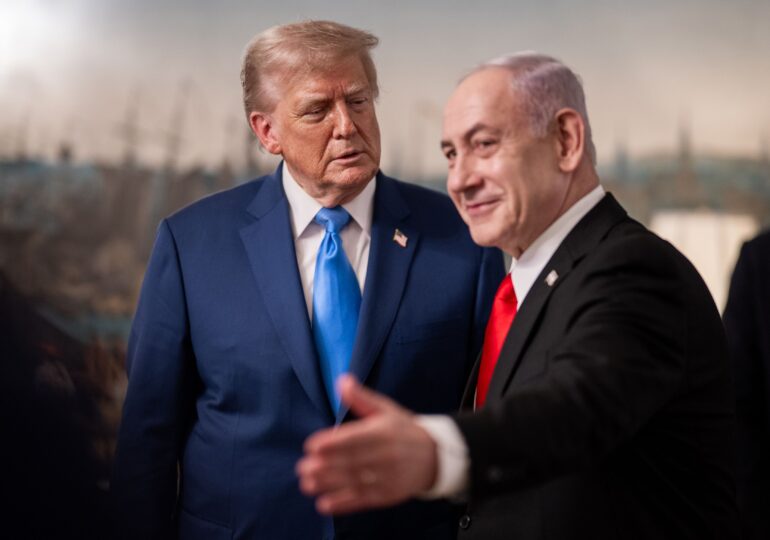
If the US and Israel’s war against Iran were to stop at this moment, the political balance is already taking shape: Israeli Prime Minister Benjamin Netanyahu emerges strengthened, while American President Donald Trump faces difficult economic and strategic consequences, and the Gulf states risk bearing the highest costs, according to an analysis by Reuters.
For Netanyahu, the conflict has reshaped Israel’s internal agenda, shifting attention from the war in Gaza to Iran – a subject that generates a much broader consensus in Israeli society and strengthens his security leadership profile.
"There is a clear winner and a clear loser"
Former American Middle East negotiator Aaron David Miller states that the balance is already visible. He indicates that Netanyahu is "by far the main winner," demonstrating Israel's military capability, while the Gulf states are "by far the biggest losers."
Regarding Trump, Miller emphasizes that there is "no way out that allows him to declare victory and withdraw."
Trump, without an exit strategy
The American president entered the conflict demanding Iran's unconditional surrender, but the initial calculations did not materialize.
Analyst Karim Sadjadpour explains the difference in expectations: Trump seemed to be looking for a pliable interlocutor but faced a rigid and defiant regime. He says the American leader "expected to find an Iranian Delcy Rodríguez," but instead "found an Iranian Kim Jong Un."
Currently, Trump is faced with three unfavorable options: to continue strikes, declare a victory and hope for an Iranian withdrawal, or escalate the conflict - yet none offer a clear solution.
Israel sees a "war of necessity"
Unlike Washington, in Israel, the conflict is perceived as inevitable.
Analyst Natan Sacks emphasizes that the war is not seen as a choice but as a strategic necessity. He points out that even in the absence of a regime change in Tehran, "weakening Iran and the axis it leads is a huge goal for Netanyahu."
Israeli officials state that the offensive was divided: Israel primarily targeted western and northern Iran, including ballistic missiles and nuclear infrastructure, while the US focused on the east and south, including the Strait of Hormuz region, to hit Iranian naval capabilities.
Eliminating Iranian leaders does not change the course of the war
Israel also led a campaign to eliminate high-ranking officials in Iran, including security chief Ali Larijani and information minister Esmail Khatib.
Israeli Defense Minister Katz stated that the army is authorized to target any identified high-ranking Iranian official without further approvals.
However, these tactical successes have not brought the conflict closer to an end.
Gulf states, "the biggest losers"
The effects of the war are most strongly felt in the Gulf states.
Amid Iranian attacks and disruptions to traffic through the Strait of Hormuz - a route through which about a fifth of the world's oil transits - these states are directly exposed to economic and security risks.
Aaron David Miller warns that the region's stability and development model are at stake.
Israel and the US view risk differently
Reuters' analysis highlights a major difference between the two allies.
Israel seems more willing to tolerate instability in Iran, calculating that the regional impact would be limited, especially after the weakening of Hamas and Hezbollah in recent years.
On the other hand, the US and Gulf partners are much more vulnerable to attacks on energy infrastructure and oil price spikes.
Former Israeli military official Assaf Orion says that some regional states wonder if Israel is implicitly pursuing Iran's destabilization, being less affected by the consequences.
Tensions between allies
Differences in interests became visible after the Israeli attack on the South Pars gas field, shared by Iran and Qatar.
Trump publicly reacted, stating that the US "knew nothing about this specific attack" and emphasizing that Qatar was not involved.
The statement underscores the delicate balance Washington is trying to maintain between support for Israel and relations with Arab states in the Gulf.
A possible yet risky victory for Netanyahu
Although the war consolidates his image as a security leader, the political benefits are not guaranteed.
Polls show that his alliance would not secure a majority in the Knesset ahead of the year-end elections.
Former advisor Aviv Bushinsky states that the final outcome will be judged in simple terms: either the Iranian regime falls or it doesn't.
If the system led by Ali Khamenei survives, even weakened, military success could be reinterpreted as excessive ambition, and threats from Gaza and Lebanon would return to the forefront.