
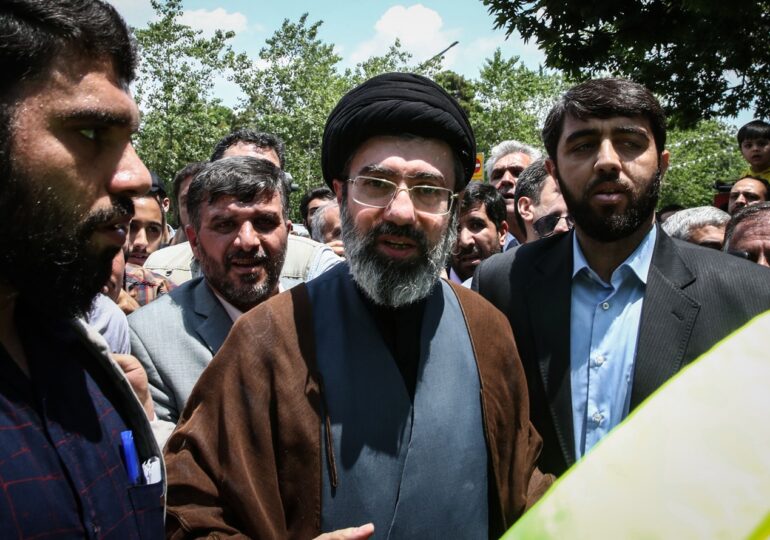
The choice of Mojtaba Khamenei as the new Iranian Supreme Leader, succeeding his assassinated father, represents a symbolic and real triumph for conservative continuity at a time when the regime faces unprecedented challenges.
At the same time, this decision raises questions about how the hereditary principle aligns with a revolutionary ideology created in 1979, which never envisioned the transfer of the position of Supreme Leader from father to son, as stated in an analysis published in The Guardian.
A defeat for reformists
Mojtaba Khamenei is considered close to the conservative wing of the regime, especially to the Islamic Revolutionary Guard Corps (IRGC), the most powerful military structure of the state.
His appointment represents another defeat for the reformists who argued that the evolution of the war required postponing the decision, at least until a full meeting of the Assembly of Experts, the clerical body composed of 88 members responsible, according to the Iranian Constitution, for electing the Supreme Leader.
Hassan Rouhani, a former reformist president, warned that the elections organized by the assembly distract attention at a time when maintaining national unity is essential. He stated that any announcement "should come at a proper time that does not distract public attention from sacred defense."
However, Khamenei's supporters believe that assembly members do not need to be present to vote, given the threat posed by such a meeting. Instead, the secretariat could simply declare that a consensus has been reached.
"The name of Khamenei will endure," said Hosseinali Eshkevari, a member of the council tasked with choosing a new leader, shortly before the official announcement of the results.
Mojtaba Khamenei is likely to be rejected by Donald Trump, who called him "unacceptable." The US President insisted on playing a decisive role in choosing the new Iranian leader, while Israel threatened to kill the next Supreme Leader and those who elected him.
There are forces in Iran that believe handing over power in a time of war to a relatively inexperienced figure will have a negative effect. They argued that defense efforts should be left in the hands of the armed forces and Ali Larijani, the experienced secretary of the Supreme National Security Council.
Khamenei, who served as deputy chief of his father's cabinet, was close to the internal mechanisms of the Supreme Leader's office and is presented as a renewed version of him.
Iran's apologies, a criticized move
Iran was temporarily led by a tripartite leadership council that included President Masoud Pezeshkian. On Saturday, Pezeshkian made an unsuccessful attempt to reset relations with Gulf states, apologizing for Iran's attacks on their territory. He announced that the attacks would cease if the Gulf states did not allow strikes against Iran from their countries.
Pezeshkian's comments came after Russia's mediation efforts, and a positive response was expected from at least two Gulf states. However, immediate internal opposition to his position and continued attacks on Gulf states thwarted this.
Trump also wrote on Truth Social, calling Pezeshkian's move a humiliating capitulation—a triumphant tone that further undermined Pezeshkian's position.
Iran's Foreign Minister, Abbas Araghchi, defended the decision to apologize to Iran's neighbors, stating that in Iranian culture, it is "a sign of dignity and power."
Pezeshkian's statement was immediately contradicted by the Iranian military, which considers American bases in the Gulf as legitimate targets. So far, 10,000 civilian buildings have been damaged inside Iran.
The military was also outraged by Pezeshkian's claim that the Revolutionary Guards fired at will.
Larijani clarified Iran's position in a televised interview. "We told our neighbors, and we repeat: if a base is to be made available to the Americans from your territory to attack Iran from there, it is our undisputed right to respond to these bases. We have stated this clearly, and we are not lying."
"It makes no sense for a country to declare friendship with us, but at the same time, its base is in the hands of the enemy to attack Iran. The countries in the region must prevent the US from using their territory against Iran, or we will do it. America's prestige in the region has been destroyed, and these countries now understand that America is no longer able to ensure their security," the official emphasized.
Iran has upset all its neighbors
Military sources stated that the range of attacks on American assets in the Gulf will be expanded in response to the American attack on Iranian refineries and fuel depots. Iran responded by reducing its maximum daily gasoline consumption but stated that the supply is stable. Iranian officials did not deny receiving assistance from Russian intelligence services.
Western diplomats say they have not seen any decrease in Iran's capacity to organize drone and missile attacks and have warned that the scale of military assets poured into the region does not suggest that the US intends to make a unilateral declaration of early victory.
Larijani appeared confident in his televised interview that Iranian society would not turn against the government and stated that Trump's plan to divide the country into an ethnic mosaic would be rejected by Iranians, including the Kurds.
Despite growing anger towards Iran for focusing so much on attacks on Gulf states, most governments in the region have not yet supported a counteroffensive against Tehran that would align them with the US and Israel.
Iran admitted that 60% of its missiles and drones were directed towards Gulf states, compared to 40% towards Israel. Foreign Ministers of the Arab League met on Sunday to discuss options, with a Western diplomat stating, "Their patience is running out. The attractiveness of their economies and their reputation for stability are being destroyed."
A greater evil on the horizon for Gulf countries
Oman told its neighbors that Iran's offer regarding its nuclear program was serious in talks interrupted by the American-Israeli attack, but any agreement will likely need to be much broader and include an Iran-Gulf cooperation council.
The United Arab Emirates government described Iranian attacks as brutal and unprovoked, stating that over 1,400 ballistic missiles and drones were aimed at its infrastructure, saying, "These attacks constitute a flagrant violation of international law and the UN Charter, a violation of the sovereignty and territorial integrity of the United Arab Emirates, and a direct threat to its security and stability."
Despite all their reservations about Iran's role in the region, some Arab diplomats believe that the greater risk is for Israel to emerge stronger from this war.
"The ongoing attack on Iran is not just an Israeli adventure in which Netanyahu has managed to draw the United States, but a planned American strategic move in which Washington has engaged Israel as a regional partner, a major step towards transforming the Middle East, including the Arab world, into a regional geopolitical situation that Israel is trying to lead," said Amr Moussa, the former Secretary-General of the Arab League.
T.D.