
A familiar feeling for millions of Ukrainians was suddenly experienced throughout the Middle East over the weekend – the terror caused by Shahed drones flying overhead and crashing into buildings.
The images flooded social media as Iran launched such drones in response to the American-Israeli bombardment that began on February 28, writes Kiev Independent.
"Welcome to the club, guys," said Vladislav Vlasiuk, adviser to Ukrainian President Volodymyr Zelensky, to the cited source when asked about his initial reaction upon seeing images of Shahed drones hitting Dubai.
"But, on a serious note, I must say that this is very concerning," he added.
Vlasiuk's reaction is understandable - Ukraine has been warning for many years about the threat not only from Shahed drones but also from the increasing Russian-Iranian cooperation, calling for stricter sanctions to deprive both countries of the numerous Western-made components still used in the production of Russian and Iranian drones.
It seems that this alarm signal finally arrived over the weekend in the form of over 1,000 drones targeting Iran's Gulf neighbors, hitting hotels, residential buildings, and both American and British military bases.
How big is a Shahed drone and how far can it fly
Long-range attack drones, such as Shahed, are massive. A Shahed drone was used in an Iranian attack on an Israeli tanker in 2012, but the first mass combat use was carried out by Russia against Ukrainian cities during the 2022 invasion.
These relatively inexpensive, long-range drones, sometimes described as "kamikaze drones," are programmed to fly directly towards a target and detonate upon impact.
Russia now domestically produces its own Shahed drones, which it calls Geran, and although Moscow has made several improvements and modifications, the basic silhouettes are identical.
The Shahed-131 is approximately 2.6 meters long, with a wingspan of 2.2 meters and a range of about 900 kilometers.
But even this is overshadowed by the Shahed-136, which is 3.5 meters long with a wingspan of 2.5 meters. This type is the one that targeted locations in the Middle East and Cyprus.
It seems that Iran has deployed the basic propeller version of the Shahed missile, which is said to have a range of 2,000 kilometers, a relatively low maximum speed of 185 km/h, and a standard warhead of 50 kilograms.
What a Shahed drone looks like and the sounds it makes
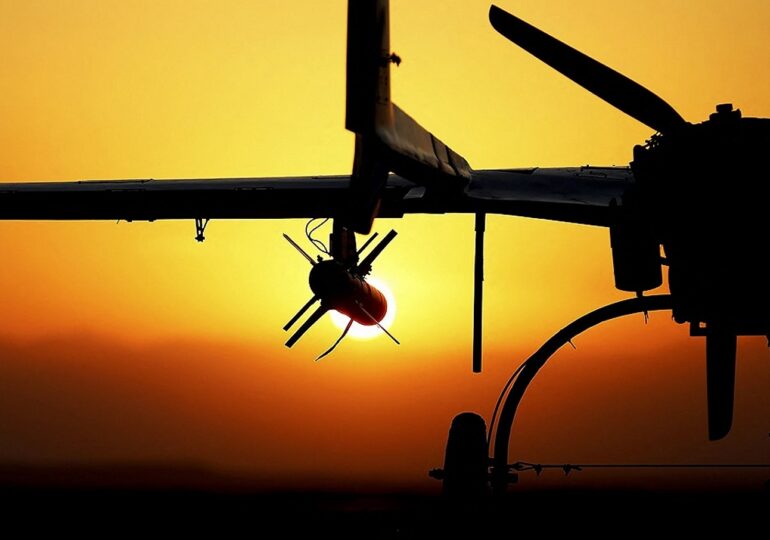
A Shahed drone has a distinct triangular shape and narrow, straight wings. At the back, there is a small propeller engine that emits a loud buzzing sound, often compared to that of a moped or a chainsaw.
This sound makes them not only a destructive weapon but also a psychological warfare tool.
During mass attacks, the night air above Ukrainian cities is often filled with the buzzing of these drones. People are attentive to listen to the increase and decrease in tone, indicating whether they are accelerating or decelerating, or climbing or descending.
In the final descent, before hitting their targets, the buzzing increases dramatically, reminiscent of the Stuka dive bombers from World War II.
What to do if you see a Shahed drone
The first thing to know is that if you are in a tall building and see or hear a Shahed drone, do not go to the window to film it, as this could happen:
The second thing to know is that if you can reach an underground shelter, do so, as it will provide you with the best protection - but do not risk walking or running long distances in open space if the drone is already in close proximity.
If you are indoors and spot a Shahed, immediately move away from windows and go into a room with at least two walls between you and the outside - three is even better.
Shahed drones often fly low over cities, especially in their final approach to a target, so if you are in a tall building, consider moving to a lower floor. A stairwell, if located in the center of a tower, can be a suitable shelter as the surrounding structure provides protection.
One of the main sources of injury inside buildings during explosions is being hit by glass shards, so a windowless room is ideal.
Although images of Shahed missiles hitting buildings and exploding are terrifying, its 50-kilogram warhead is relatively small compared to cruise and ballistic missiles, which can carry warheads of hundreds or even thousands of kilograms.
Can Shahed drones be stopped?
The attacks by Iran over the weekend highlighted a new serious reality - drone warfare has become global and will remain so.
The US has also deployed its own versions of Shahed drones called LUCAS. "The early hours of the operation included launching precision munitions from air, land, and sea and used low-cost one-way attack drones for the first time in combat," said US Central Command on February 28.
However, no one has more experience in stopping Shahed-type drones than Ukraine - President Volodymyr Zelensky has already offered to send experts to allied countries to share expertise, adding that "everyone now sees that our defense experience is largely irreplaceable."