

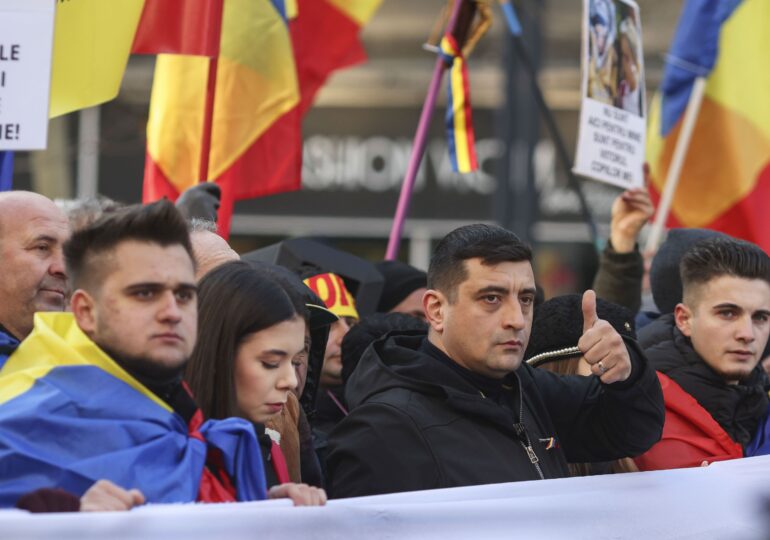
AUR once again surpasses the 40% threshold in the voting intention for the parliamentary elections.
According to the January 2026 edition of Barometrul Informat.ro, conducted by INSCOP Research, AUR, led by George Simion, approaches a cumulative score of the following three ranked formations – PSD, PNL, and USR – which together gather 43.4% with 40.9%.
The survey was conducted from January 12-15, 2026, through telephone interviews (CATI), on a sample of 1,100 people, representative of the adult population of Romania.
AUR, comfortably in first place. PSD and PNL, at a great distance
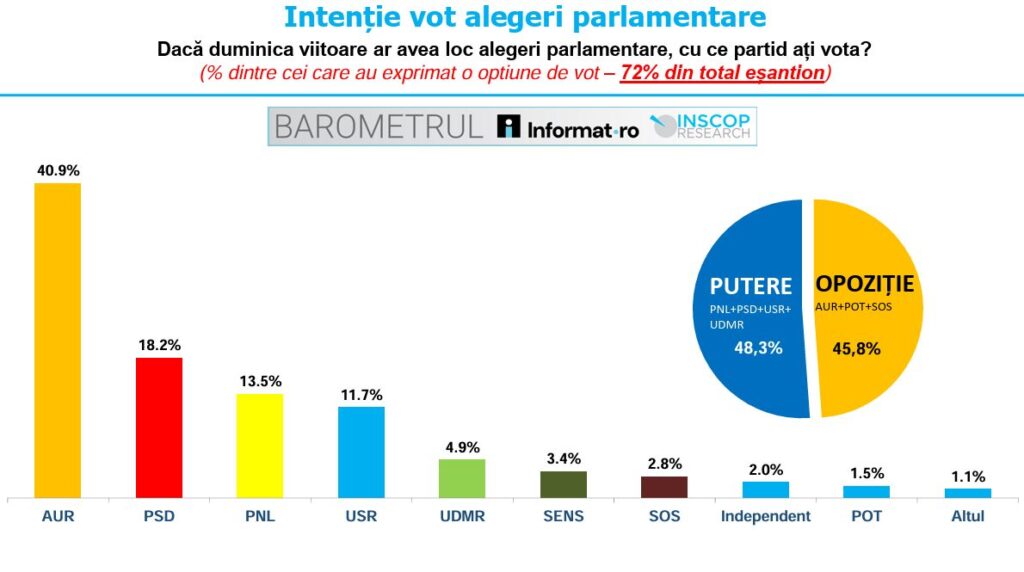
According to the data, concerning respondents who indicated a party (72% of the sample), the ranking is as follows:
- AUR – 40.9%
- PSD – 18.2%
- PNL – 13.5%
- USR – 11.7%
- UDMR – 4.9%
- SENS – 3.4%
- SOS Romania – 2.8%
- POT – 1.5%
- Other parties – 1.1%
- Independents – 2%
Thus, AUR consolidates its leadership position, surpassing the level from the end of last year when it temporarily dropped to 38%.
Almost as much as PSD, PNL, and USR combined
Combined, PSD (18.2%), PNL (13.5%), and USR (11.7%) reach 43.4%, a score that places AUR very close to the main three traditional parties combined.
The difference is only 2.5 percentage points, a balance of power rarely seen in Romanian politics in recent years.
Political stability despite economic and external tensions
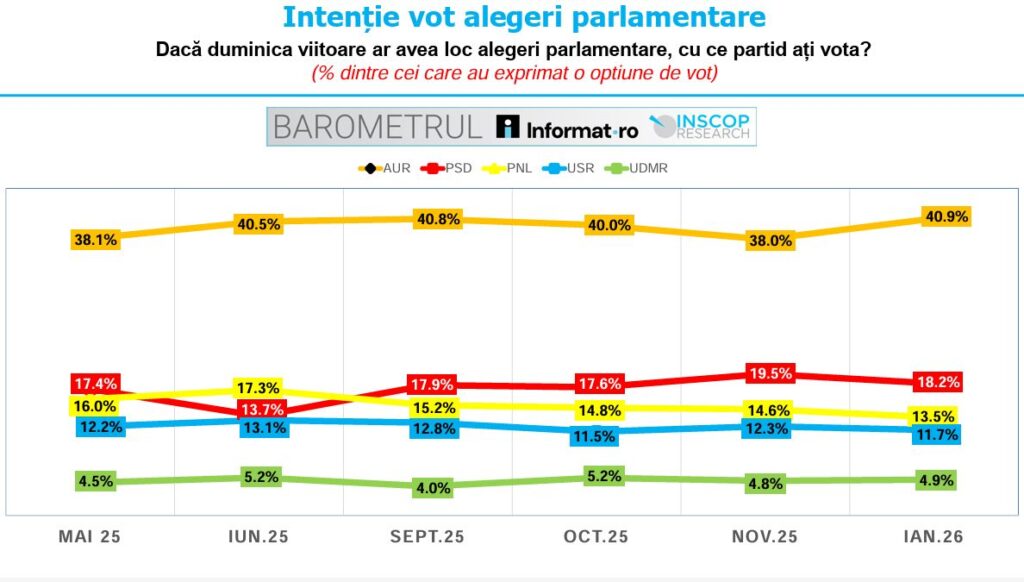
INSCOP Research Director, Remus Ștefureac, explains that beyond punctual variations, the general picture is one of stability.
“The voting intention ratio between the parties in government (cumulative score of 48.3%) and the parties in parliamentary opposition (cumulative score of 45.8%) tends to balance at the beginning of 2026, as AUR returns to a voting intention of over 40%, after the decline at the end of last year when it had reached 38%,” says Ștefureac.
He emphasizes that in the last nine months, variations have been minimal for all parties, despite a tense context marked by inflation, controversial fiscal policies, security issues, and war themes.
A “rigid political status quo”
“A rigorous analysis of the evolution of the voting intention in the last 9 months highlights a remarkable stability for all parties. This shows that parties are not gaining significantly, but they are not losing significantly either,” explains the INSCOP Research Director.
The sociologist's conclusion is that Romania is, at least at the beginning of 2026, in a “rigid political status quo” that discourages major ruptures and large-scale political crises.
Voter turnout: nearly 6 out of 10 say they will “definitely” vote
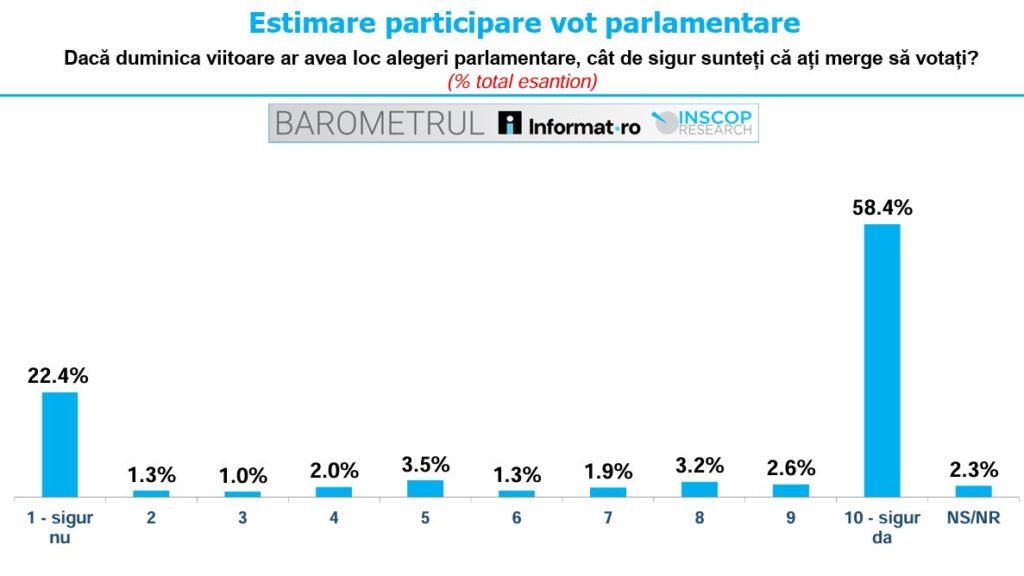
The barometer also shows a high level of declared intention to participate in voting. On a scale of 1 to 10:
- 58.4% of respondents chose 10 – “definitely yes”
- 22.4% chose 1 – “definitely no”
The rest of the options have low values, each below 4%. 2.3% do not know or do not respond.
The survey was conducted by INSCOP Research at the request of the Informat.ro platform, in partnership with Strategic Thinking Group. The data was collected through the CATI method (telephone interviews) on a sample of 1,100 people, with a maximum error of ±3%, at a confidence level of 95%.