
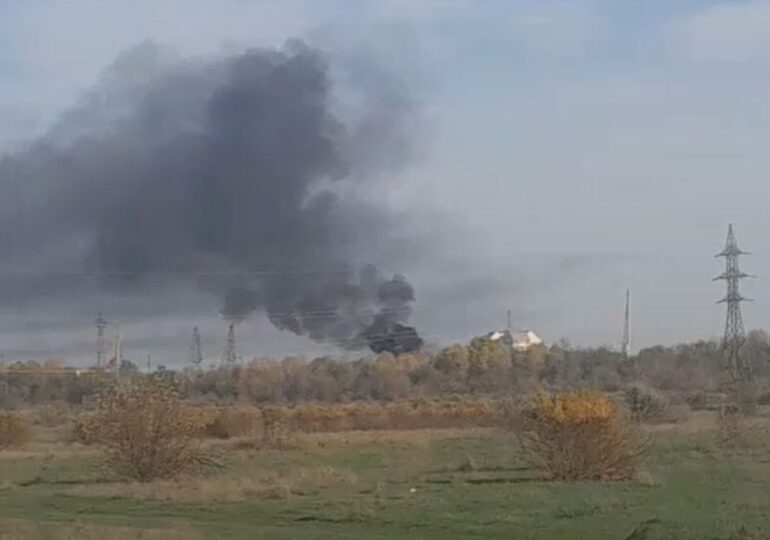
The Romanian authorities are on high alert after a ship loaded with approximately 4,000 tons of LPG was hit by a drone and caught fire on the Ukrainian bank of the Danube, near the port of Izmail. Nearby is the village of Plauru in Tulcea County, part of the commune of Ceatalchioi, which has been evacuated.
– [A village in Tulcea was evacuated after a ship full of LPG caught fire and there is a risk of explosion. A local resident recounts how she experienced the bombing: We stayed behind the house, behind the wall, lying on our stomach (Video)](https://spotmedia.ro/stiri/eveniment/satul-plauru-din-judetul-tulcea-a-fost-evacuat-o-nava-plina-cu-gpl-a-luat-foc-dupa-ce-ar-fi-fost-lovita-de-o-drona)
Technical sources consulted by Mediafax estimate that the chemical energy stored in the 4,000 tons of LPG is theoretically equivalent to tens of thousands of tons of TNT, but emphasize that in practice, only a portion of this energy may convert into a shockwave, depending on the fire’s evolution scenario.
Beyond its name, LPG is essentially stored chemical energy. Calorifically, 4,000 tons of LPG equate to approximately 1.8 × 10¹⁴ joules.
Translated into the language we are familiar with from movies and history, this amounts to an equivalent of around 44,000 tons of TNT.
In other words, if the entire cargo could explode in an ideal environment (from a technical perspective), it would represent two to three times the energy released by the atomic bomb in Hiroshima.
However, reality is more complex.
Unlike a nuclear bomb, a ship loaded with LPG is not designed to „detonate.”
The way it burns or explodes depends on many factors: temperature, pressure in the tanks, cracks, ventilation, how much gas leaks and mixes with the air, the presence of obstacles that can amplify the shockwave.
Not all of this energy can transform into a shockwave, but in unfavorable conditions, even a fraction is sufficient to cause a disaster with impacts on both sides of the border.
Experts discuss several scenarios:
– BLEVE – the explosion of a pressurized tank overheated by fire. In this case, a LPG tank can suddenly rupture, throwing out a massive fireball, accompanied by a strong shockwave and metal fragments projected over a long distance.
– Explosion of a vapor cloud (VCE) – if the gas leaks, vaporizes, and forms an inflammable cloud, which is then ignited, the cloud can detonate. Usually, only a small part of the total energy enters the shockwave, but even so, it can reach equivalents of several kilotons of TNT, comparable to tactical nuclear weapons, but without radiation.
– „Simple” high-intensity fire – the gas can burn continuously, without a massive explosion, but with a gigantic flame and thermal radiation capable of severely affecting the surrounding area.
In the worst-case scenario, the effects on both banks of the Danube could include: shattered windows and damaged houses from hundreds of meters to kilometers away; burns and injuries caused by the blast or shards; secondary fires in households and vegetation areas; pollution and toxic smoke.