
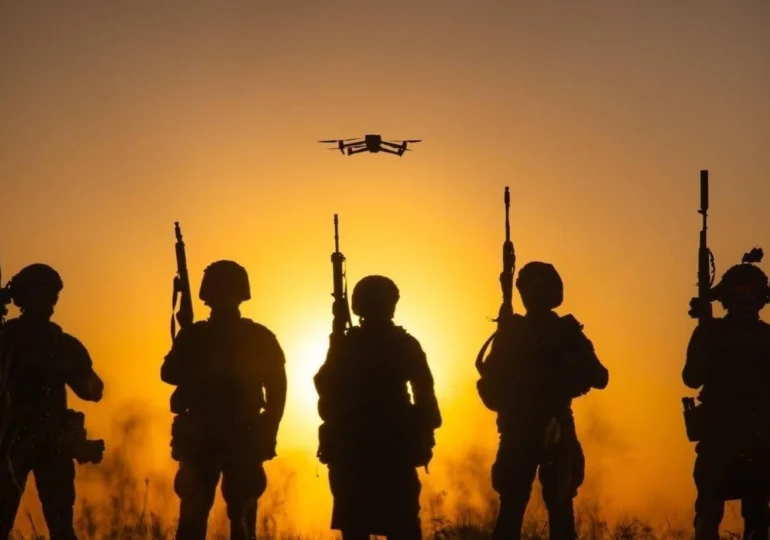
Poland, Germany, and Czechia are evaluating the potential security risks associated with the post-war demobilization in Ukraine. Experts warn that risks related to organized crime and arms trafficking need to be addressed without stigmatizing veterans, who, through their combat experience, could enhance European security.
When Yevhenii Polishchuk was injured, his participation in the war ended prematurely. He remembers how he put his khaki cap on his wife’s head – a symbol that he had finally returned – and how he embraced his family. But he quickly realized that he would have to find his way in life again, while his friends continued to fight.
"I realized that, even though a chapter had ended for me personally, nothing had truly ended, as many people were still defending my country," he said, to TVP World.
Polishchuk found a new rhythm of life in Krakow, a city in southern Poland; he is just one of the many Ukrainian veterans who have moved to the EU after completing military service. Many others could follow in their footsteps after the end of the war with Russia, a prospect that has begun to raise concerns in some European countries.
The police forces of Poland, Germany, and Czechia – the three countries hosting the largest Ukrainian communities in the EU – are jointly preparing an analysis of security threats that could arise following the conflict. Such a threat is seen as the possible arrival of battle-hardened Ukrainian veterans – many of them likely bearing the psychological scars of the conflict, as reported by the Polish publication.
In April, Czech Police Chief Martin Vondrášek stated that the influx of war veterans, once the fighting ceases, represents "the greatest security risk for the Czech Republic that I perceive at this moment."
However, for others, these concerns are exaggerated and could be exploited by hostile actors eager to fuel fear and resentment towards Ukrainians living in the EU.
How Czechia and Poland are preparing
The details of the analysis prepared by Poland, Germany, and Czechia remain strictly confidential.
The Czech police confirmed to TVP World the existence of this joint evaluation, stating that the three countries "are preparing an analysis of security threats that could arise after the end of the war in Ukraine."
However, its representatives mentioned that the document is still a work in progress and has not reached its final form.
Polish police also confirmed collaboration with the police structures of Czechia and Germany but stated that they would not comment on the "activities and analyses" carried out within the "trilateral cooperation."
Nevertheless, the institution indicated several ways in which the end of the conflict could pose security risks for neighboring countries.
"After the end of the war beyond our eastern border, there is a risk that the demobilization process could contribute to the amplification of organized crime – a real and historically proven phenomenon," the Polish police told TVP World.
The intensification of arms trafficking, drug smuggling, extortion, money laundering, as well as the recruitment of veterans by criminal groups, are the main risks being analyzed.
"War corrupts, and those with combat experience often face enormous difficulties in returning to civilian life. We must be prepared for various scenarios in the post-war period in Ukraine," the document stated.
This preparedness targets aspects that go beyond conventional crime.
The police specified that Poland, as a "key logistical hub" for providing aid and support to Ukraine, has become particularly vulnerable to sabotage, disinformation, and cybercrime.
The institution asserted that the solution lies in early preparation before threats materialize – for example, by establishing a new National Police Investigation Office to combat organized crime.
The Polish police mentioned that its approach is based on "concrete statistical data, not generalizations or stereotypes," also referring to the experience gained during previous conflicts in the Balkans and Afghanistan.
It also stated that it would monitor with "maximum professional attention" the potential presence of veterans, ensuring at the same time that the military community is not stigmatized.
People who want to live their lives
Andrii Kucher, a Ukrainian war veteran, acknowledges that some former combatants will face post-traumatic stress disorder (PTSD), substance abuse, or manifestations of aggression in civilian life. He stated that this will be "a huge challenge" for them in the years to come but believes the issue will not be widespread.
"For the most part, they are ordinary people who want a peaceful life. They want to return to their families or have a safe place to survive and simply live their lives," he emphasized, to TVP World.
Iana Chepailo, the director of the Leadership Center for Ukrainian Defenders – an organization that collaborates with veterans to enhance their leadership potential – rejects the idea that veterans pose a threat to collective security.
"I wouldn't put veterans and criminals in the same sentence," she said. Any crimes committed by them should be handled by the police on a case-by-case basis. However, "you can't take the behavior of individuals and apply it to the millions of people defending their country."
"Harmful clichés" and propaganda
There is concern that fears regarding Ukrainian veterans could be deliberately amplified by foreign actors to create a rift between Ukrainians and their neighbors.
"I think all Europeans need to understand that all of this is part of a hybrid war. And unfortunately, the Russians are the most skilled at propaganda," said Kucher.
For Maria Piechowska, an analyst at the Polish Institute of International Affairs (PISM), this socio-political perspective is the most worrying.
"The Polish police and state have tools to tackle security issues. However, when it comes to disinformation and Russian propaganda, we are not as well-prepared," she stated.
Piechowska emphasized that Polish-Ukrainian relations have already been vulnerable to political disputes and Russian disinformation, and that a limited number of incidents involving veterans could provide new arguments to turn public opinion against Ukrainians.
Irina Dobrohorska, an expert at Adam Smith International, a global consulting company, warned that the lack of available data could exacerbate the issue.
Millions of Ukrainian women and children have already moved to Europe, creating an attraction for veterans. However, it is too early to estimate how many could move, Dobrohorska said, as much will depend on how the war ends, as well as factors such as job opportunities abroad and the EU's temporary protection mechanism.
"What worries me is the politicization of veterans. In the absence of concrete data, this could become a major risk," she said.
Piotr Łukasiewicz, the Charge d'Affaires of Poland in Ukraine, previously warned that European governments must be very careful in how they address this issue.
"The worst thing we could do... would be to succumb to harmful clichés," he said, cautioning against the idea that Ukrainian veterans will "lay the groundwork for mafia networks" or become a problem related to crime or drugs after the war.
An opportunity, not a threat
Asked about the security plans being prepared by Poland, Germany, and Czechia, the Ukrainian Ministry of Veterans emphasized that those defending the country are among the most interested in a peaceful and secure future.
"The majority of veterans entered military service from civilian life – they were entrepreneurs, engineers, doctors, IT specialists, and teachers," the ministry stated. "Many will return to these professions, start businesses, and continue to contribute to their communities after completing military service."
In Ceapailo's opinion, war veterans should be seen more as an asset than a threat. "They have already demonstrated that they have numerous skills and expertise. They are resourceful, make quick decisions, and have survived the war," she said.
The Ukrainian Ministry of Foreign Affairs previously stated that veterans "do not pose a threat but rather a security factor for Ukraine, Poland, and the whole of Europe." Therefore, the challenge lies not only in how to manage the reintegration of veterans into civilian life but also in ensuring that their experience is not lost.
"We must view the situation as a challenge, not as a problem. We must think about opportunities and how we can leverage their skills," Piechowska said, suggesting that former combatants could be extremely useful in emergency services.
What comes next
Asked about the concerns expressed by veterans and organizations in Ukraine, the Polish Ministry of the Interior stated to TVP World that ensuring public safety and monitoring the consequences of the war are its "absolute priority."
"We consider various scenarios, including the risk associated with illicit arms and ammunition trafficking, as well as increased activity of organized crime groups," the ministry stated.
The institution added that it continuously exchanges information with Ukraine, including within the cooperation between police and border services.
However, experts and veterans argue that training should go far beyond the realm of public order measures.
The challenge of helping former combatants reintegrate into civilian life will be greatest in Ukraine, a country that is already developing a support system that includes medical assistance, rehabilitation, mental health care, housing, and much more.
In Kucher's view, European countries could contribute to expanding these efforts, instead of waiting for veterans to move to the EU. He advocates for funding programs dedicated to veterans, separate from general humanitarian resources, and sends a simple message to governments seeking practical ways to provide support: "You must support NGOs dedicated to veterans."
T.D.