
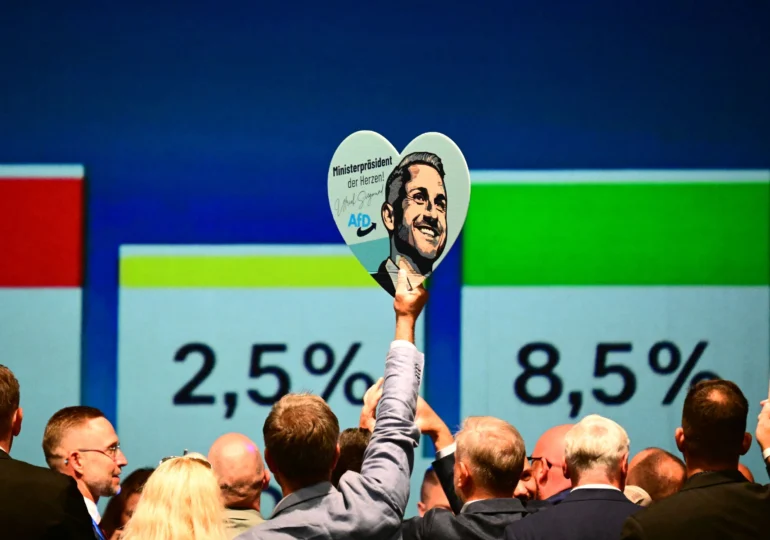
„Political earthquake,” „social upheaval,” or „turning point for Germany.” That’s how the resounding victory of the Alternative for Germany (AfD) in the Saxony-Anhalt elections was described.
It might seem exaggerated. Saxony-Anhalt is one of the smallest of the 16 German states and has only 1.7 million out of the country’s approximately 59 million voters. Moreover, despite its clear win, AfD fell short of an absolute majority.
However, the outcome is much more significant than the size of the state where it was achieved. It could shift the balance of power in Germany, further weaken the government in Berlin, and cause unease in Brussels at a time when Europe needs unity in the face of Russia, pressures from Donald Trump, and economic competition from China, as analyzed by BBC.
AfD secured 43.8% of the votes, nearly double its 2021 result, and will hold 39 out of the 83 seats in the new regional parliament. It is just three seats short of an absolute majority. CDU, the party of Chancellor Friedrich Merz, plummeted to 17.2% and 15 seats.
It is the first time since the fall of the Third Reich in 1945 that an extreme right-wing party has achieved such a resounding victory in the elections of a German state.
Pressure Mounts on Friedrich Merz
The vote was regional, but its effects are national. AfD's victory adds even more pressure on the centrist coalition in Berlin, already deeply unpopular.
Conservative Chancellor Friedrich Merz had promised to halve support for AfD. Instead, the opposite happened, and according to the BBC, the result in Saxony-Anhalt could be the political blow from which the chancellor won't recover.
The weakening of the Berlin government also has consequences beyond the country's borders. Germany is the largest economy in the EU and the most important political player in the bloc, at a time when Europe is trying to respond simultaneously to Russia's war, pressures from the United States, and increasing competition from China.
At the same time, the result sparks a painful debate in a country where the Nazi past continues to weigh heavily. German authorities view parts of AfD as antidemocratic, and several regional organizations, including those in Saxony-Anhalt, have been classified by domestic intelligence services as far-right extremist.
AfD was already particularly popular in eastern Germany. The novelty is that the party has now taken the lead in some national polls. The question now is what traditional parties can do to regain the voters they seem to have lost.
Trump and Moscow React Immediately
The shockwaves quickly crossed Germany's borders. On Sunday, Donald Trump shared on Truth Social an exit poll image showing AfD's victory without adding any comment.
The party's anti-immigration and "anti-woke" messages, as well as the idea of a "Germany for Germans," resemble the MAGA discourse promoted by the American president. Like other European nationalist parties, AfD has adopted several elements from Trump's political strategy: attacks on the traditional press, questioning judges' impartiality, and the promise to make the country "great again."
However, Trump is rarely directly invoked in European election campaigns. Politicians know that the American president remains deeply unpopular among many voters on the continent.
Shortly after Trump's post, influential Russian businessman Kirill Dmitriev, the director of the Russian Direct Investment Fund, reacted, calling the result "historic," claiming that the German government is "discredited," and Friedrich Merz is "humiliated."
Dmitriev compared the German chancellor to Keir Starmer, the former British prime minister who resigned this summer.
Moscow's interest is easily explained. Germany is the largest individual provider of aid to Ukraine, and the UK has supplied Kiev with missiles used in attacks on Russian territory. Both decisions have angered the Kremlin.
AfD Aims to Revive Relations with Russia
AfD has a much more favorable stance towards Moscow. The party calls for halting military aid to Ukraine, lifting sanctions on Russia, and resuming imports of much cheaper Russian energy.
The message resonates in eastern Germany. The German industry, which consumes significant amounts of energy, suffered a severe blow after halting Russian imports following the large-scale invasion of Ukraine in 2022.
In addition, eastern Germany remains much poorer than the west, despite the state spending, according to various estimates, between 2,300 and 3,000 billion euros on integrating former communist East Germany after the fall of the Berlin Wall in 1989. The difference in estimates depends on how inflation is taken into account.
Saxony-Anhalt is the poorest German state. Like in other parts of the east, the phenomenon known as "Ostalgie" can be found here – nostalgia for what some residents perceive as the greater stability of the communist era.
Brussels Fears the Upcoming Elections
The outcome was closely watched by the European Union. Important elections are expected in France, Italy, Spain, and Poland in the next 12 months, and Brussels fears that extremist parties, especially those on the right, could gain ground in several countries.
The leader of the Spanish nationalist party Vox, Santiago Abascal, wrote on X that AfD's victory represents "great hope for Germany and Europe."
On the other hand, French Minister for European Affairs Benjamin Haddad, an ally of President Emmanuel Macron, warned that Europe is in a "serious moment" after the far-right's victory in a German state.
AfD and other European parties described as far-right or radical right-wing reject these labels. There are significant differences between their programs and discourses.
Marine Le Pen's National Rally excluded AfD from its European Parliament group two years ago, considering it too radical. However, the two parties share opposition to immigration and a strong nationalist message.
This is one of Brussels' major concerns. Whether the slogan is "Germany first," "Italy first," or "France for the French," the rise of these parties could weaken European cohesion at a time when external events make it more necessary than ever.
Why Nationalism Scares Brussels
Parties like AfD or the League in Italy are deeply eurosceptic. However, European institutions argue that member states must remain united to withstand pressures from Donald Trump and protect their companies from the influx of cheap Chinese products.
European defense officials also warn that cracks in the sanctions regime against Russia or weakening support for NATO only serve to encourage Moscow.
If Russia is not stopped in Ukraine, security service chiefs warn, the Kremlin could be tempted to test the North Atlantic Alliance with an attack on a member state, most likely in the Baltic region.
European voters are aware of these threats but also feel their effects in their daily lives. They are concerned about the wars in Ukraine and the Middle East, the degradation of healthcare services, and the economic insecurity of their families. Uncontrolled immigration and street safety are also among their main concerns.
Voters Want to Try Something New
Here lies the true importance of the vote in Saxony-Anhalt. It is a warning to traditional parties and institutions like the judiciary and security services, which AfD portrays as components of a system concerned with defending its own interests.
Many European voters feel abandoned by the parties they have supported for decades. Turning now to the right or left does not mean they have suddenly become extremists, notes the BBC. It does show, however, that they are willing to try parties that have so far been kept away from governance.
AfD entered the Saxony-Anhalt campaign with the optimistic slogan "Anything is possible!" and the promise that Germans will once again be proud of their country. The party has not been tested in government so far. However, Sunday's result shows that an increasing number of people are willing to give them this chance.
G.P.