
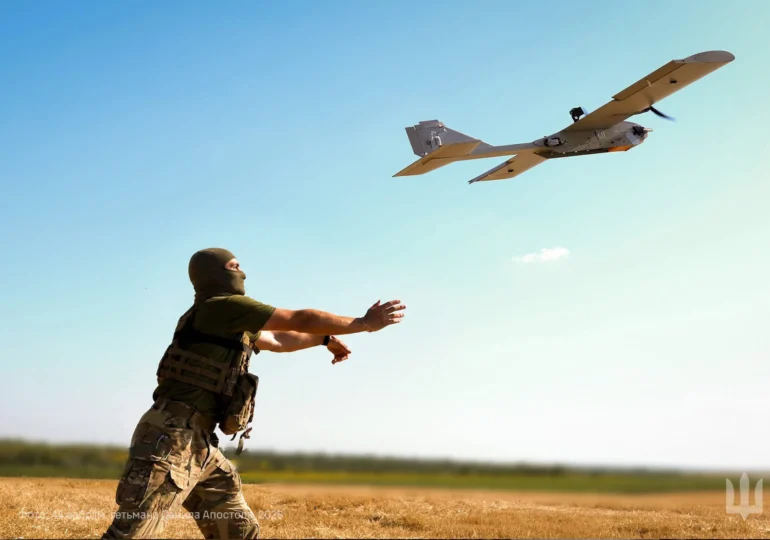
Ukrainian drones are increasingly targeting Russian military vehicles traveling on the roads in the occupied territories in southern Ukraine. The target is the supply line: fuel, ammunition, and personnel that Russia needs to transport through the region. Moscow is now protecting its convoys with mobile teams and interception drones, in a confrontation where each side is trying to adapt faster than the other.
A report by Kyiv Independent within the 422 Unmanned Systems Regiment shows how this unit operates in southern Ukraine. The military uses multiple types of drones to hit targets beyond the front line, including on the main supply routes of the Russian army.
These are medium-range strikes: farther than the FPV drones usually used near the front, but closer than the targets attacked in Ukrainian deep campaigns. Over the past year, Ukraine has significantly expanded these operations as drones have become more advanced and purchased in greater numbers.
The route of the Russian supply line
One of the important targets of the regiment is the E58 highway, used for Russian transports in the occupied south, on the route to Crimea. The open terrain offers few places for trucks, tanks, or other military vehicles to hide.
The regiment commander, Mykola Kolesnyk, known as "Tyson," says the Hornet drone is the main means by which the unit monitors and attacks this route. Manufactured in the United States, it costs around $5,000 and uses a Starlink connection. The relatively low price allows for its deployment in large numbers against Russian military transports.
According to the commander, the unit can hit targets up to about 50 kilometers behind the front line. He claims that the Russians' significant movements have become much more difficult, as well as supplying the troops. These are assertions from the Ukrainian commander, and the report does not independently establish the extent of the effects on the entire Russian logistics. The Russian lines have not collapsed, the publication notes, but the repeated attacks are putting pressure on the transports needed to continue the fighting.
The regiment also uses the Zozulia drone, capable of carrying a 50-kilogram warhead over a distance of at least 300 kilometers. This is intended for larger fixed targets, such as depots, command posts, or power stations used by the Russian army. Teams prepare and launch it from the field, after which the device can be piloted by operators elsewhere in Ukraine through satellite internet.
Russians are changing their tactics
The attacks have forced the Russian forces to alter their routes and send mobile teams to protect the convoys. Some accompany the vehicles, while others are placed along the roads. The Russian drone unit Rubicon has also released images of intercepting Ukrainian drones.
Tyson admits that the Russians are now shooting down some of the regiment's drones, but he says this has not decisively changed the operations. The mobile teams defending the roads have become priority targets for the Ukrainians themselves. At the same time, the commander says that moving some Russian interception teams behind the front line may leave more room for action for other Ukrainian drones.
Another part of the confrontation concerns communications. Russia is trying to jam the Starlink connections used by the Ukrainian drones. Regiment 422 claims to have participated in the destruction of at least five such Russian systems. According to the publication, the Russians are also testing other solutions to maintain communication with their own drones, including radio systems that allow signal transmission between devices.
The report also follows a mission with four Zozulia drones against a power station in the occupied Zaporojie region. According to the commander, the station powered equipment used by the Russian forces, including radars, drone batteries, and electronic warfare devices. Two drones were shot down, and the other two hit the target, he claims.
For the interviewed soldiers, the success of these attacks depends on Ukraine's ability to improve its technology faster than Russia finds defense methods. However, one team member warns that medium-range strikes alone cannot end the war. His perspective is that of a confrontation that could last a long time.
G.P.