
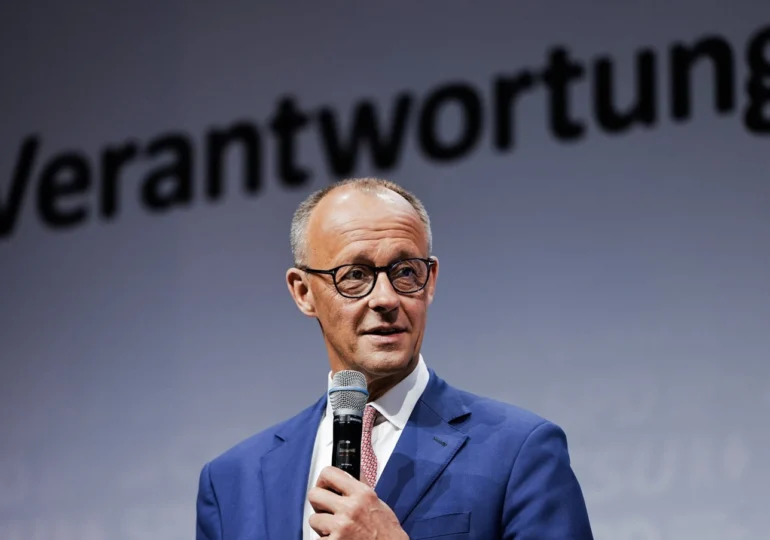
The far-right in Germany is trying to turn the overwhelming electoral victory into a decisive blow for Friedrich Merz and his conservatives, who are already in a difficult position. And the chancellor seems unsure how to react.
Facing the most serious political crisis since taking office, Merz seems to lack a concrete plan to save neither his government nor his party. Instead, after 16 months in office, he talks about the need to become a better, more empathetic, and more connected politician, as commented by Politico.
"We are all deeply shocked," Merz declared on Monday, after the far-right party Alternative for Germany (AfD) achieved a record score in the weekend elections in Saxony-Anhalt. At the same time, support for the Christian Democratic Union (CDU) was reduced by more than half.
"This is the most severe electoral defeat that the CDU has suffered in recent years — or even decades," added the chancellor. "Of course, there will have to be consequences."
However, what these consequences will be remains to be seen. Merz's extremely low popularity, combined with AfD's clear victory, has fueled speculation that his conservatives might resort to a Kanzlertausch - a "chancellor swap" - to rejuvenate their political chances.
Merz, however, rejected this idea. He stated that he will remain in office and will continue his economic reforms, which he claims are long overdue and will ultimately contribute to solving Germany's economic problems.
AfD does not hide its intention to turn the electoral loss into an even greater disaster for Merz. The far-right party openly tries to convince conservative parliamentarians from Saxony-Anhalt to leave the CDU and join them. The stakes are not only about obtaining the three additional mandates that AfD needs to govern alone. The strategy also aims to fragment the conservative camp and weaken Merz's position within his own party.
"The conservative bloc will never win federal elections again, that is a fact," stated Alice Weidel, AfD's co-leader, in Berlin on Monday. "The difference between us and them is already 10 percent, and my declared goal is to significantly increase this difference in the shortest possible time."
Merz acknowledged on Monday that he himself is part of the problem. According to an exit poll for German public television, only 9% of voters in Saxony-Anhalt have a favorable opinion of his chancellorship.
"I know that I have been a recurring topic in this election campaign," said Merz. "Germans are concerned about their economic well-being and security in a turbulent period," he continued, adding: "We must try — including myself — to connect more deeply with people, including with their full range of emotions."
Under Pressure
It is expected that the pressure on the chancellor will increase in the coming weeks, especially since elections are scheduled on September 20 in two regions in eastern Germany.
Merz's CDU is heading for a clear defeat in the state of Mecklenburg–Western Pomerania, where AfD leads all other parties. In Berlin, where CDU currently governs, the party risks losing power to a left-wing coalition.
With four more regional elections scheduled next year, conservatives face a clear choice: to continue the fight against the rising far-right under the leadership of a deeply unpopular chancellor or to fundamentally change direction with a new leader at the helm.
Merz seemed to acknowledge the dilemma facing his party. "This election result provokes a major change, not only in our country but also within my party," he said on Monday. "I take this extremely seriously and intend to do everything I can in the coming days and weeks to personally address the seriousness of the situation."
Although most discussions about replacing Merz take place in private, signs of discontent among conservatives with his leadership are starting to emerge.
"Anyone who wants to regain trust and credibility must, after such a result, put everything into question," wrote CDU parliamentarian Sepp Müller on social media.
And Gordon Schnieder, the premier of Rhineland-Palatinate from CDU, conveyed a similar message:
"After such a result, we cannot simply continue as before," he wrote. "If the democratic center wants to regain people's trust, we must start with ourselves. It is not the people who need to better understand our politics. We need to offer what people expect from politics: fewer conflicts, clear decisions, and concrete results."
"A Matter of Compassion"
AfD attacks the chancellor on several political fronts. The party criticizes him for migration policy, blames him for the problems in the German industry due to his energy policies, and demands the resumption of cheap energy imports from Russia.
But many of AfD's most effective attacks are simply tactical.
While trying to come to power in Saxony-Anhalt by attracting conservative parliamentarians to their side, AfD also presents itself as a party willing to cooperate with CDU.
The party is well aware that Merz would not accept the breakdown of the so-called "firewall" that prevents centrist parties from collaborating with the far-right.
The strategy allows AfD to attack Merz from two directions simultaneously. On the one hand, they accuse him of ignoring the voters' will, as AfD gains more ground. On the other hand, they portray conservatives as "disguised leftists" for preferring alliances with left-wing parties rather than cooperating with AfD.
The elections in Saxony-Anhalt illustrate the strategic dilemma facing CDU — and from which AfD benefits. To avoid governing with AfD, CDU would theoretically have to collaborate with all other parties in the regional parliament, all located on the left side of the political spectrum, including the far-left. As conservatives yield to the pressure of governing alongside ideological opponents, AfD hopes that the growing divisions around the "firewall" will eventually lead to Merz's downfall.
"People have lost confidence in the party," said Weidel, AfD's leader, on Monday. "Before elections, they always promise one thing. And after elections, they do the exact opposite. And so every party loses the acceptance and trust of its voters. No previous chancellor has been as unpopular as Friedrich Merz, who has become a major obstacle to Germany's prosperous development."
Tino Chrupalla, the other national leader of AfD, stated that if CDU does not give up the "firewall," this will mark the end of the party. If the party "continues on this path," he said, "then, in the short term, there will be no CDU in eastern Germany."
While these lines of attack from AfD prove to be extremely effective, Merz offered no clear plan on Monday to counter them — apart from becoming a better politician.
"It is not just a matter of rational understanding of politics — it is also a matter of compassion, empathy, and emotions," Merz told journalists in Berlin in a somber tone. "I am not the kind of person who displays emotions every day, but the public wants to see different responses."
He admitted that he has failed to connect with the voters — but suggested that he still has time to learn.
"It is certainly true that I have this problem - and it shows in polls - that many people do not follow me in the way I think and evaluate things," said Merz. "This is my responsibility, and I take it. I will try to do things differently - to cope better - in the coming weeks and months."
The question is whether his party will have that much patience.