
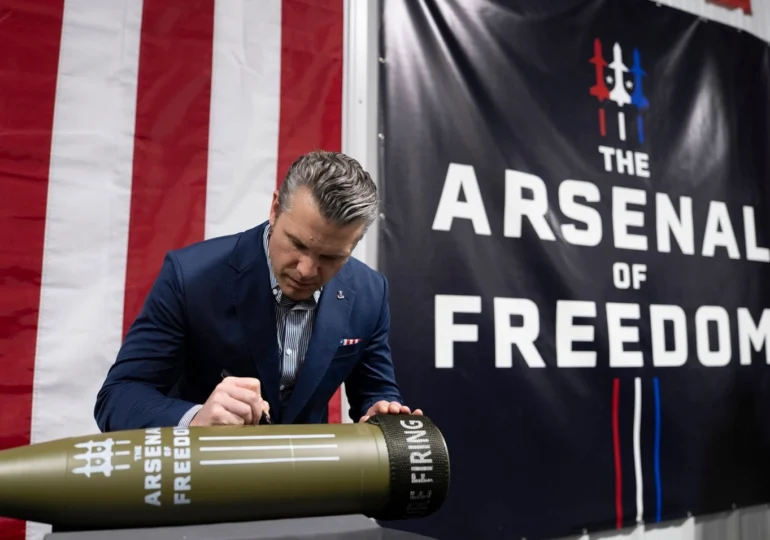
A series of firings and conflicts triggered by the U.S. Secretary of Defense, Pete Hegseth, has practically left the U.S. military without leadership, while facing the threat posed by drones and cheap but lethal rockets that have hit U.S. bases in the Middle East.
The U.S. military has not had a Chairman of the Joint Chiefs of Staff – the highest military rank in this branch of the armed forces – since Hegseth dismissed General Randy George without any explanation back in April. There are no indications that a successor is being prepared in the near future, current and former officials told the New York Times, speaking on condition of anonymity.
Additionally, it is anticipated that the U.S. Army Secretary, Daniel P. Driscoll, the highest civilian official of this branch, will leave the administration in the coming months; he has already moved out of the spacious rental home near Washington's Fort Myer, officials said.
This tense situation arises at a time when the U.S. Army - the largest branch of the American armed forces - is going through its most intense period of activity since the wars in Iraq and Afghanistan. Soldiers in the army's anti-aircraft defense units play an essential role in protecting American troops in the Middle East from increasingly sophisticated Iranian missile attacks.
Furthermore, the U.S. Army Command in Europe provides vital information and other forms of support to Ukraine as it struggles to resist a numerically superior Russian force.
Hegseth eliminates his potential successor
Until recently, Driscoll was widely considered a potential candidate to succeed Hegseth in the event that he decided to step down or lost the confidence of President Trump.
Driscoll and General George worked together to prepare the army to operate on a battlefield invaded by drones. Last year, towards the end, the White House asked Driscoll to play a key role in its efforts to secure a peace agreement to end the war in Ukraine.
According to officials, these peace efforts have largely stalled, the rapid modernization initiative has been curtailed, and the relationship between Driscoll and Hegseth is extremely tense, with the two barely communicating.
In addition to General George, Pete Hegseth has ousted or forced the departure of six senior officers - an entire generation of army leaders with extensive combat experience - thus weakening the command structure for the years to come, officials said.
"Removing proven leaders, the most effective in battle and with the greatest front-line experience, in a time of war, means that troops are less protected, and our chances of victory diminish," said Congressman Pat Ryan, a Democrat from New York and a former military intelligence officer.
A long-term concern is that these dismissals send the message that officers who provide unvarnished military advice or do not pass ideological loyalty tests do not belong in a force that should be apolitical, army and congressional officials said.
"We are causing long-term damage - at the generational level - to the perception that the military is a non-political and trustworthy institution that swears allegiance to the Constitution, not to a president," added the congressman.
The four stars, an indicator of leadership void
An indicator of the leadership vacuum at the top of the U.S. Army is the number of active-duty four-star generals.
In January 2025, when Hegseth took office, there were 10 active-duty four-star generals. Currently, this branch of the armed forces has only five, the lowest number in decades.
Some of these positions cover the command of regions of the world, such as the Middle East or Asia, and are now held by senior officers from other branches of the armed forces, the newspaper reported.
Some positions have been eliminated. Others, such as the role of coordinating the Army's Training and Doctrine Command, have remained vacant for months.
Last summer, Hegseth appointed General David M. Hodne to lead this command, only to dismiss him eight months later without explanation.
This command is responsible for training and equipping Army ground units, including Patriot missile system crews. Patriot systems are the primary defense against Iranian ballistic missiles launched at U.S. bases in the Middle East.
Another crucial vacant position emerged in July when Hegseth downgraded the role held by General Christopher T. Donahue - who oversaw U.S. ground forces in Europe - to the rank of three-star general; this decision forced the Army's senior officer to retire, with no other four-star general position available.
Also, last October, Hegseth secured the removal of General James Mingus, the Army's Vice Chief of Staff, a year before his term was due to end.
In his place, Hegseth and the White House nominated General Christopher LaNeve - Hegseth's top military adviser - to take over as the Army's deputy commander, responsible for overseeing the current operations of this branch of the armed forces.
His decision to remove General Mingus without providing a clear reason has raised reluctance among some Senate members and contributed to a further deterioration of the already strained relationship between Mr. Hegseth, on the one hand, and the Army and Congress, on the other.
Hegseth's man leads without support
Several lawmakers, dissatisfied with Hegseth's lack of transparency regarding military personnel appointments and ammunition stocks, have blocked the confirmation process of General LaNeve. This has effectively prevented him from assuming the position.
General LaNeve took the oath as the Deputy Chief of Staff in February. Less than two months later, Hegseth dismissed General George in a 15-second phone call, defense officials said.
Currently, LaNeve - Hegseth's choice to lead the Army - does not have sufficient support from Republicans in the Senate to be confirmed in the position. Usually, generals and admirals nominated to command branches of the armed forces receive unanimous or near-unanimous support in the Senate.
LaNeve now fulfills both the role of Deputy Chief of Staff and the interim Chief of Staff, both high-ranking positions requiring the rank of four-star general.
Advantages for U.S. adversaries
Critics have warned that in the absence of strong leadership, the military risks being left vulnerable to adversaries such as Russia and China, who are making rapid progress in integrating artificial intelligence and new types of drones into their military structures.
In his first major message to the troops, published online last week, General LaNeve addressed these challenges, warning that the U.S. military must be prepared to "master an operational environment fundamentally different from battlefields of the past."
However, in discussions with senior army commanders, he expressed concern that the modernization efforts of his predecessors did not focus enough on essential combat skills, officials said. In this regard, he emphasized the need to return to the fundamentals.
"Any shortcuts in training and any deviation from discipline will be paid for in blood," he warned.
T.D.