
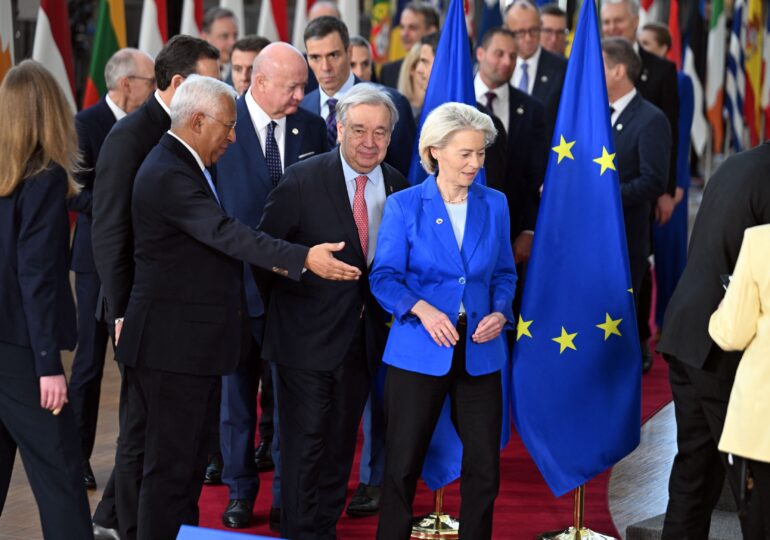
Europe is simultaneously facing aggression from Russia, hostility from the Trump administration, and the rise of the far right within its own borders.
The two organizations that the continent has relied on so far, NATO and the European Union, are not built to respond quickly to such a combination of threats.
NATO has the necessary military force but depends on the United States, whose support can no longer be considered guaranteed. The European Union has the will to act but is slow, divided, and designed for times of peace.
This is the conclusion of political scientist Nathalie Tocci, former advisor to European diplomatic chiefs Federica Mogherini and Josep Borrell, in an analysis published by The Guardian.
Tocci believes that Ursula von der Leyen’s recent proposals are moving in the right direction, but she warns that the President of the European Commission may not be the right person to convince all member states.
The author argues that Europe is already at war. The conflict is openly fought in Ukraine but is spreading across the continent through hybrid attacks and increasingly serious incidents.
In just a few weeks, Germany attributed to Russia the drone attack on Leipzig airport, a Russian drone hit a train near the border between Ukraine and Poland, an Italian plane shot down a Russian drone over Lithuania, and a Russian military ship fired signal rockets at a Danish helicopter.
Taken together, these incidents show that Moscow is willing to escalate the confrontation. Russia can do this either because it fails to advance in Ukraine or because Vladimir Putin believes that the United States will not intervene to defend Europe.
The three threats:
The first threat is Russia, testing the limits of European states and their ability to respond together.
The second comes from the United States under Donald Trump. The American President frequently attacks Europe and has threatened with new tariffs if Brussels offers Canada a form of associated status in the EU. Beyond the trade conflict, such threats show Trump’s hostility towards the European project and fuel doubts that Washington would respect its commitments in the event of a Russian attack.
The third threat is right within Europe: the rise of the far right. Tocci believes that this endangers liberal democracy, deepens divisions between states, and favors the „divide and conquer” strategies of hostile powers.
The success of Alternative for Germany in regional elections prompted Ursula von der Leyen to openly acknowledge that some of the dangers to Europe come from within.
What happens if the US does not intervene:
NATO has the structures and means to defend Europe from Russia. The issue arises if its main member, the United States, refuses to act.
In such a situation, the existence of Alliance’s plans and military capabilities could become almost irrelevant. If a hybrid attack were to cause casualties in a European state, allies might even avoid activating collective defense mechanisms, fearing that Washington would not support them.
This gap is what Ursula von der Leyen’s proposed European security protocol aims to cover. It would be used in situations more serious than a mere crisis but not reaching the level of an armed attack that would trigger the mutual assistance clause in EU treaties.
The attacked state would activate the protocol, the European Council would meet urgently, and the Commission and the High Representative for Foreign Policy would propose common measures. These could include population evacuation, medical assistance, stockpiling, energy supply protection, economic sanctions, or facilitating troop and military equipment movements.
The mechanism could also be open to partners outside the EU, such as Canada, the UK, Norway, and Ukraine.
Why Canada comes into play:
This logic also applies to the proposal for a possible association of Canada with the European Union. The content of such a status has not been established yet, but the idea is for democratic states outside blocs dominated by Russia, China, or Trump’s America to collaborate more closely.
An alternative EU membership formula could also be of interest to the UK. A similar idea was initially proposed by Germany for Ukraine, but Kiev rejected it, considering it a form of second-tier integration.
Tocci argues that Ukraine deserves full membership. However, if it were quickly offered a substantial associated status, Kiev might accept it as an interim step without giving up the goal of full integration.
A more restricted security council:
The rapid implementation of the new protocol would be challenging. The Union has complex procedures, makes decisions slowly, and member states are often divided.
For this reason, von der Leyen also proposes the creation of a European Security Council. It would bring together countries that can and want to contribute effectively to the defense of the continent, including without US participation.
The structure could include both EU member states and countries like Canada, the UK, Ukraine, and possibly Turkey.
A more restricted structure could make decisions faster than the EU as a whole. Its necessity will increase if nationalist and far-right parties gain influence because achieving consensus among the 27 states will become even more difficult.
Good ideas, but the messenger creates problems:
The fundamental problem, writes Tocci, is that current multilateral organizations no longer correspond to the strategic situation. NATO remains tied to the United States, while the EU is too slow and does not include all countries important for the continent’s security.
According to her, Ursula von der Leyen’s proposals are necessary and urgent. However, the obstacle may be the President of the Commission herself.
During her years at the helm of the European Executive, von der Leyen has built a reputation as a leader who concentrates power and sometimes exceeds the Commission’s mandate. This style has displeased both other European officials and several capitals.
Defense and security are areas where national governments are very reluctant to relinquish control. Thus, there is a risk that member states will reject useful proposals not because of their content but due to institutional conflicts and mistrust towards Ursula von der Leyen.
As external and internal pressures mount, Europe cannot afford to waste time in an institutional battle, warns Nathalie Tocci.