

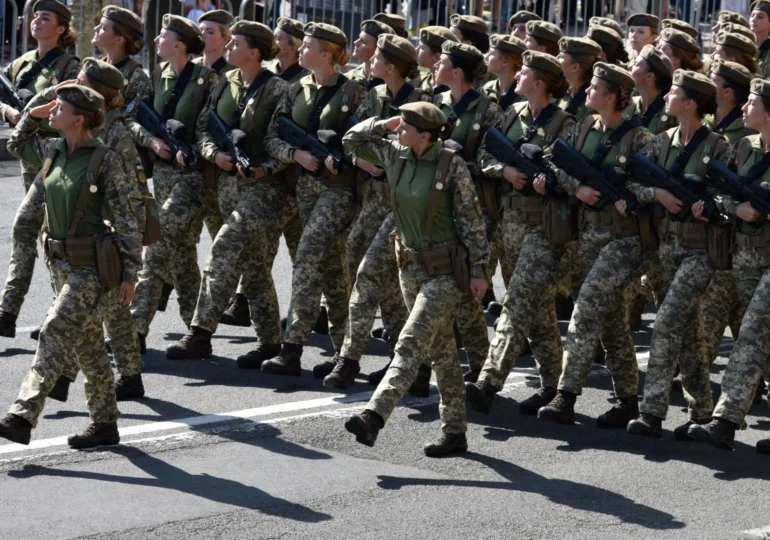
Over 75,000 women are already serving in the Ukrainian Armed Forces, and their number has nearly doubled since the beginning of the large-scale Russian invasion. However, the possibility of women being conscripted remains one of the most sensitive topics in Ukrainian society.
The debate was reignited by former Defense Minister Oleksii Reznikov, who argued that military service should become mandatory for both men and women. Such a measure would „immediately double the number of people who can be mobilized,” he argued.
However, doubling the recruitment base on paper would not automatically mean a doubling of army personnel, as an analysis published by Kiev Independent shows. The Ukrainian army particularly needs people for infantry and assault units on the front lines, where physical and psychological requirements are very high. At the same time, women already serving face issues with ill-fitted equipment, prejudices, and health risks.
The issue was also amplified by the U.S. Special Envoy for Ukraine, Keith Kellogg. „Yes, I believe that women should be mobilized because they fight as well as men,” Kellogg stated in an interview published on August 24 by the YouTube channel Naspravdi MAX.
A few hours after these statements, the Parliament in Kiev clarified that the mobilization of women „is not being carried out, prepared, or considered.”
In Ukraine, military service for women remains voluntary. Only those with medical or pharmaceutical training are required to enroll in military records. In 2023, President Volodymyr Zelensky promised that he would never sign a law providing for the mandatory mobilization of women.
According to the General Staff, over 75,000 women currently work within the Ukrainian Armed Forces. Approximately 55,000 are classified as military personnel, while the rest hold civilian positions.
Most of them work in medicine, logistics, support activities, analysis, and operating drones. There are far fewer in infantry and assault units, precisely where the army faces the most severe personnel shortage.
„The idea of Reznikov is logical in theory, but in practice, it has significant limitations,” said Viktor Kevliuk, a retired colonel and analyst at the Center for Defense Strategies. According to him, recruiting a large number of women for combat roles would not produce, at least in the short term, the change the Ukrainian army needs.
Reznikov argues that women could take on more roles behind the front lines, allowing more men to be moved to combat units. However, this option is not as straightforward. „Many of the men in positions behind the front lines have health problems and, according to the law, cannot be sent to combat units,” Kevliuk explained.
The government might seriously consider mobilizing women only if Ukraine were facing a „catastrophic shortage” of people who could be called up for military service, the analyst believes. In his opinion, Ukraine has not reached that point yet. It is estimated that between 2.5 and 3 million men have not updated their military records.
The authorities have other options as well. They could reevaluate criteria for partial or total exemption from military service or allow civilians to help the army in positions behind the front lines without officially enlisting.
Iulia Mikitenko, a reserve officer and member of the Veteranka movement, does not oppose women entering the army but questions the need for their mass mobilization.
„At the beginning of the large-scale war, we had an army of nearly a million motivated soldiers, each equivalent to ten. How was this resource squandered to the point where we are talking about mobilizing women?” she asks.
The issue is not just about the number of available recruits, Mikitenko argues. The army’s efficiency is also affected by the disregard for soldiers’ rights, the lack of clear communication about battlefield objectives, exemptions from mobilization granted for economic reasons, and the number of individuals evading military service.
Mandatory inclusion of women in the recruitment base would not solve these problems. Instead, it would show that the army has been pushed to a critical limit.
„If we truly reach the mobilization of women, I will automatically consider that our country has lost,” Mikitenko concludes.