
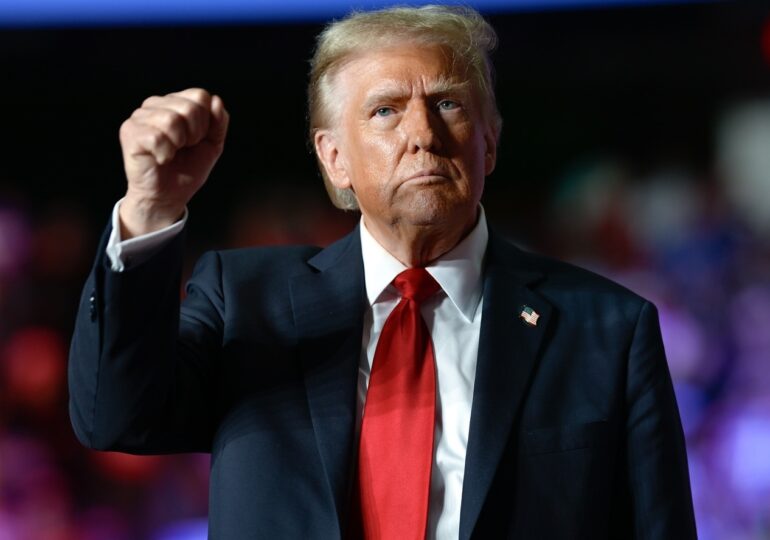
US President Donald Trump issued a direct threat to the interim leader of Venezuela, Delcy Rodríguez, warning that she will face severe consequences if she does not comply with Washington’s demands following the American military intervention that led to the capture of former President Nicolas Maduro.
In a phone interview with The Atlantic magazine, Trump stated: "If she doesn't do what she's supposed to, she will pay a very big price, probably bigger than Maduro," referring to the former Venezuelan leader, who is currently in a prison in New York.
The statement comes as Rodríguez publicly condemned the U.S. armed intervention (as barbaric), which Trump deemed as a defiant attitude.
According to the American President, the United States demands that Venezuela cease involvement in drug trafficking operations to the U.S., distance itself from Washington's adversaries like Cuba and Iran, as well as militant groups like Hezbollah, and allow the U.S. to oversee operations in the oil sector.
Trump's tough tone contrasts with statements made just a day earlier when, shortly after Maduro's capture, the American President suggested that Delcy Rodríguez might be willing to cooperate with the U.S. At that time, Trump stated that the United States would "temporarily lead" Venezuela, a statement that high-ranking Republican officials, including Secretary of State Marco Rubio, later tried to distance themselves from.
The Supreme Court of Venezuela has decided that Delcy Rodriguez should assume the duties of interim president after Maduro's removal.
Meanwhile, Trump openly defended the idea of regime change, despite criticism coming even from a portion of his MAGA political base. "Rebuilding there and regime change, whatever you want to call it, is better than what's there now. It can't be worse," he said.
The Atlantic interviewer reminded Trump that he campaigned in the past against a policy favoring regime change in other countries and that in 2024, he ran on the "America First" doctrine, advocating for avoiding military interventions abroad, as reported by The Guardian.
Trump did not explain why he believes that removing the Venezuelan president and attempting to decide how this country will be governed would represent a fundamentally different action from the U.S. invasion of Iraq, the removal of Saddam Hussein, and the subsequent administration of the country.
"I didn't do Iraq. That was Bush. You'll have to ask Bush, because we should have never been in Iraq. That's where the Middle East disaster began," stated the American President in response.
Secretary of State Marco Rubio also tried to draw a clear distinction between the intervention in Venezuela and other past U.S. military operations, such as the invasion of Iraq, stating that the situation is "very different." Rubio emphasized that pressure on Caracas will continue, including through the confiscation of Venezuelan oil shipments, with the Trump administration repeatedly expressing interest in controlling the country's vast oil resources.