
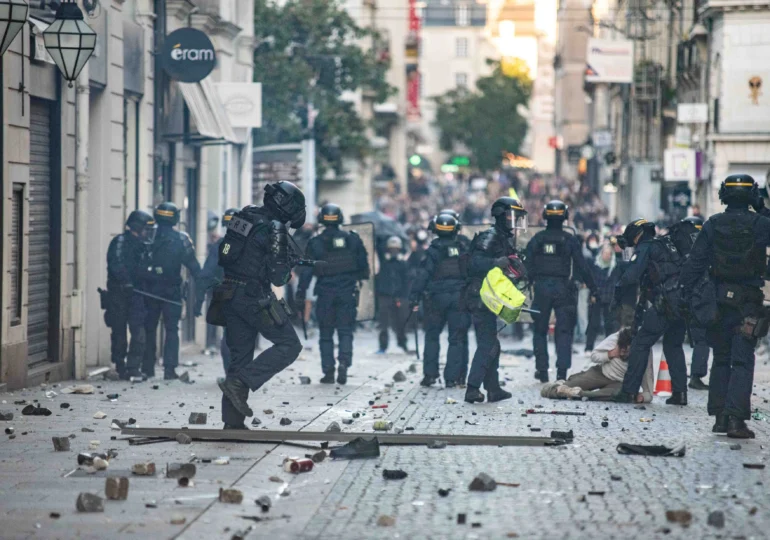
French authorities are imposing traffic restrictions in several cities as the country grapples with the most serious unrest in years.
The measures were taken after weekend protests escalated into a wave of violence. Tensions remained high on Monday, and Prime Minister Sébastien Lecornu urged several cities to implement „partial traffic restrictions” to protect the population, property, and businesses.
- Massive Protests and Violence in France. 1,800 Detentions and 500 Injured Police Officers. Limoges City Hall Destroyed. Robberies in Paris and Marseille (Video)
- What France Looks Like a Day After Some of the Largest Protests (Photos & Video)
In Paris, Place de la République will be subject to traffic restrictions from Monday at 11:00 p.m. until Tuesday at 6:00 a.m. Similar measures will be applied on the streets around Les Halles area, starting from Monday at 10:00 p.m. until Tuesday at 6:00 a.m., as reported by CNN, citing local officials in Paris.
In Marseille, authorities have banned all gatherings and demonstrations from 12:00 p.m. to 8:00 p.m. local time.
According to the mayor of Nice, a curfew for minors will be imposed in the city center from Monday at 9:00 p.m. until Tuesday at 6:00 a.m. Similar measures will be implemented in several other localities.
BFMTV, citing the prime minister's office, reported that the restrictions will target the cities of Lille, Douai, Wattignies, and Denain and will be in effect from Monday at 8:00 p.m. until Tuesday at 6:00 a.m.
The decisions were made after over 2,000 people were arrested during the weekend protests. At least two people have died, and several others have been seriously injured.
During the demonstrations, the police used tear gas against the crowds and faced groups of protesters dressed in black with covered faces. They set buildings on fire and forcibly entered shops and public institutions. Images captured during the violence even showed historic buildings engulfed in flames.
As France begins to assess the damages, the government faces increasing accusations of failing to anticipate the extent of the crisis. The situation is particularly delicate as the elections to choose President Emmanuel Macron's successor are scheduled in just six months.
Authorities and political leaders emphasize that the vast majority of participants protested peacefully. However, the confrontations and destruction, the most severe in years, have shaken the country and elicited strong condemnations from both the political class and the population.
"Those who have destroyed must pay. Those who have looted must reimburse the damages. Those who have attempted to overthrow the Republic will be held accountable," Macron declared on Sunday evening.
The President also promised to organize meetings this week to discuss "concrete proposals" and listen to the protesters' demands.
However, it remains to be seen if these measures will be sufficient to quell the protests in France.
How the Protests in France Started
The protest movement began in September when students and teachers at a high school in the suburbs of Paris went on strike to demand more staff and additional resources. Their demands were met, and the strike ended, but the action sparked a wave of discontent that quickly spread across the country.
Students and young people in several regions, dissatisfied with an education system affected by staff shortages and overcrowding, organized demonstrations that, in some cases, turned violent.
The perceived overly harsh police interventions fueled public anger and brought hundreds of thousands of people to the streets. A moment that intensified outrage was the emergence of videos showing a police officer using a banned chokehold technique on a girl.
In just a few weeks, the protests surpassed the scope of education demands and evolved into a broader movement reflecting grievances about the cost of living, government inaction, deepening wealth disparities, and the desire for social and political change.
"This cannot continue like this," said 57-year-old Maria Pallas, a member of a major French union, to CNN during the protest organized in Paris on Saturday.
"We have the issue of the cost of living. We have unemployment. There are a lot of things. A young person goes in search of a job, many promises are made, and in the end, they end up with nothing," she said.