
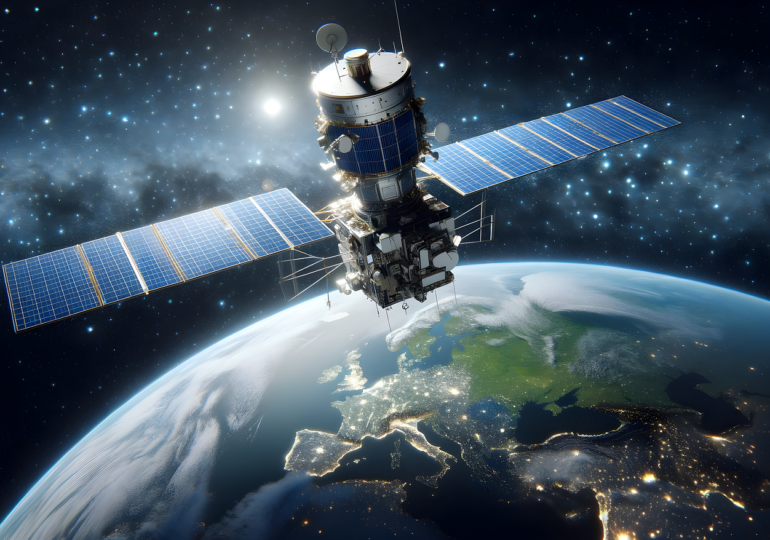
Sweden uses satellite images taken at night over the capital of Russia to assess the state of the Russian economy, as it does not trust the official data published by Moscow.
The decline of Russia’s economy health is as clear as daylight and is best seen at night, according to Swedish Finance Minister Elisabeth Svantesson.
She stated on Wednesday, at a meeting within the World Economic Forum in Davos, that she shares the skepticism of several officials regarding the official data Russia publishes about its economy. She explained that she uses her own method to verify this information - comparing satellite images taken at night over Moscow, as reported by Business Insider.
Svantesson pointed out that the lights of Moscow in an image from 2023 are dimmer than in 2021, indicating a decrease in the standard of living in the Russian capital.
In the 2023 image, it is noticeable that the lights in the suburbs of Moscow appear smaller and less frequent than in the image before the start of the conflict in Ukraine, as noted by the American publication.
"It is very clear that Russia's economy is definitely not as strong as Putin wants us to believe," Svantesson said.
"It's a much darker picture of Moscow," she specified about the 2023 photograph.
"They don't use much electric energy," highlighted panel moderator Ravi Agrawal, editor-in-chief of Foreign Policy magazine. "No, no, no. It's more darkness," Svantesson added.
Inflation in Moscow has been "much higher than what the official data states." Russia's latest figure places it at 9.5%, but Svantesson believes that this level does not align with the main interest rate of 21%.
The Swedish minister also stated that the levels of capital leaving Russia suggest an economy in distress, similar to the space photographs of Moscow.
Western countries have imposed severe sanctions on Russia following its 2022 invasion of Ukraine, primarily aimed at halting essential exports of oil and gas crucial for its economy.
The Kremlin claims to have withstood the most severe potential effects of the sanctions.
Svantesson said that the vision of a strong economy was a tactic to convince Ukraine and its allies that the sanctions are not effective.
She concluded that we do not know the true state of Russia's economy, "but what we do know is that its narrative and 'truth' are not real."
American President Donald Trump stated that Vladimir Putin is destroying his country if he refuses to make a peace deal with Ukraine. "I think Russia would have had big problems. Just look at the inflation in Russia… I hope he wants to make a deal," Trump said.
Later, Trump threatened to impose severe sanctions on Russia if Putin does not negotiate an end to the war with Ukraine.
According to Kiev's estimates, Russia has lost around 700,000-800,000 soldiers, killed or wounded, in nearly three years of war in Ukraine and is facing a challenging economic situation. Meanwhile, Russian forces continue to advance in eastern Ukraine, while Kyiv faces a shortage of troops on the front line.
T.D.