

We could pay 370 lei more for a refrigerator-freezer, 343 lei more for a washing machine, and over 200 lei more for an air conditioning unit. These could be the effects of a new European tax on electronic waste, which is on the table for EU leaders at the meeting on November 26-27.
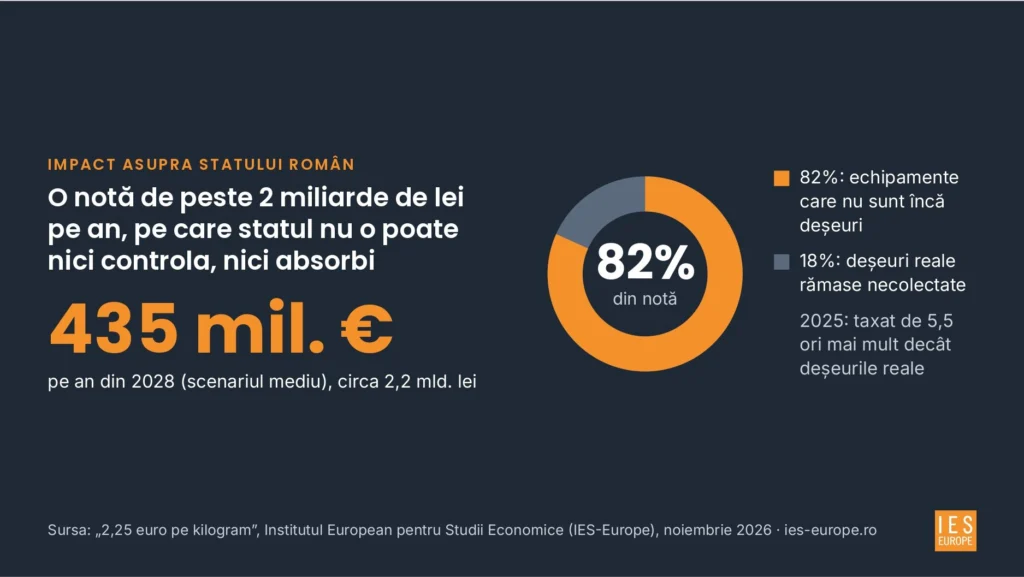
Romania would have to pay, in 2028, approximately 435 million euros (2.2 billion lei), according to a study published Wednesday by the European Institute for Economic Studies (IES-Europe), signed by Christian Năsulea and Diana Năsulea.
The paradox pointed out by economists is that a large part of the amount owed would be calculated for equipment that has not yet become waste, such as refrigerators, washing machines, or televisions that people continue to use. Although the contribution should be paid from the state budget, the authors of the study estimate that, due to the state of public finances in Romania, the cost could be passed on to consumers through price increases.
How much household appliances could become more expensive
Currently, when we buy an electrical or electronic device, we also pay the so-called green stamp, a contribution included in the product's price or shown separately, intended to finance the collection and recycling of equipment that has reached the end of its life.
According to IES-Europe calculations, if the new European contribution were fully transferred to prices, to the current cost of the green stamp, estimated on average at 1.47 lei per kilogram, approximately 5.3 lei per kilogram with VAT would be added.
Here is how this increase would translate into the prices of some products, according to IES calculations:
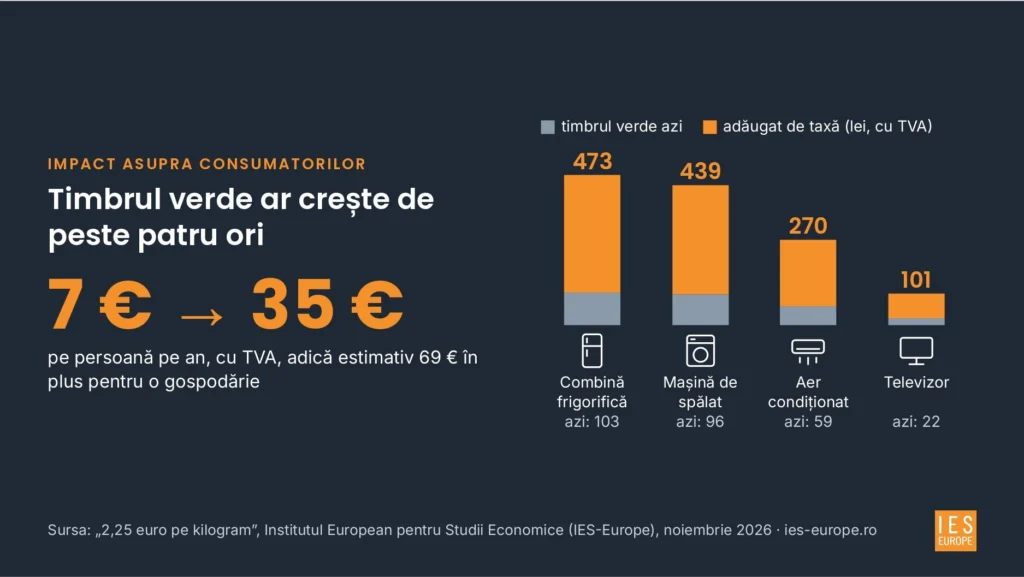
- Refrigerator-freezer (70 kg): the green stamp would increase from 103 to 473 lei, which means a price increase of 370 lei;
- Washing machine (65 kg): from 96 to 439 lei, a price increase of 343 lei;
- Air conditioning unit (40 kg): from 59 to 270 lei, a price increase of 211 lei;
- Television (15 kg): from 22 to 101 lei, a price increase of 79 lei;
- Laptop (2 kg): from 2.90 to 13.50 lei, a price increase of 10.60 lei.
All these values include VAT and represent simulations made based on the typical weight of the products and the current average cost of the green stamp.
According to IES-Europe estimates, the average annual cost of the green stamp would increase from 7 to 35 euros per inhabitant. For an average household, this would mean additional expenses of about 350 lei per year for the purchase of electrical and electronic equipment.
Because the additional amount would be calculated based on weight, not on the product's value, heavy and cheap household appliances would be the most affected. For example, a 65-kilogram washing machine, which currently costs 1,300 lei, would reach approximately 1,643 lei if the other price components remain unchanged. This is a price increase of over 26%.
The burden would therefore be proportionally greater for low-income families, who usually buy cheaper models.
Moreover, once included in the product price, the new contribution would also be part of the VAT calculation base. The Romanian state could thus collect up to 91 million euros more per year, money paid again by consumers, estimate the study's authors.
How the new European tax works
The contribution on uncollected electronic waste is part of the package of new funding sources proposed for the European Union budget for the period 2028-2034.
Initially, the European Commission proposed a contribution of 2 euros per kilogram. However, the project presented on November 21 by the President of the European Council, António Costa, raises the amount to 2.25 euros per kilogram, with annual indexation and no transition period, according to IES-Europe.
The calculation formula starts from the average quantity of electrical and electronic equipment placed on the market in a country over the last three years, from which the quantity of electronic waste collected in the current year is subtracted. The difference would be taxed at 2.25 euros for each kilogram.
The mechanism aims to stimulate the collection of electronic waste. However, economists warn about a problem: states would have to pay even if they fully meet their legal collection obligations.
Currently, European legislation requires the collection of an amount of waste equivalent to 65% of the average weight of equipment sold in the last three years or, alternatively, 85% of the waste actually generated.
Let's assume that in a country, on average, 100 tons of electrical equipment are sold annually. If the state collects 65 tons of waste, it meets the legal target. However, according to the new formula, it would have to pay a contribution for the difference of 35 tons, which amounts to 78,750 euros.
And this regardless of whether the difference represents uncollected waste or devices that people are still using.
The tax paradox: Romania would pay even for devices that are still functioning
The authors of the study calculated how much Romania would have had to pay if the new tax had been applied in 2025. Although our country was very close to reaching the European target for electronic waste collection (64%, compared to the goal of 65%), the bill would have amounted to 303 million euros.
If only the waste actually left uncollected were taxed, Romania would have had to pay about 55 million euros, according to IES-Europe estimates.
In other words, even if Romania had managed to collect all existing electronic waste, it would still have had to pay about 248 million euros, according to the economists' simulation. The reason is simple: in Romania, more electrical equipment is sold than reaches the end of its life annually. The difference would be taxed, although those devices are still used in people's homes or companies.
“This is not an environmental tax, but a consumption tax disguised as an environmental measure. It does not measure how well a country collects, but how much it sells. A tax that you cannot avoid by doing things right is not an incentive,” says Christian Năsulea, executive director of IES-Europe and co-author of the study.
The economist also points out the contradiction between the proposed formula and European policies that encourage repairing and reusing products. “It is hypocritical to ask people to repair their devices and use them longer and, at the same time, to tax states precisely because these devices have not yet become waste,” states Christian Năsulea.
A bill of 3.2 billion euros for Romania
For 2028, the first year the new tax is expected to apply, economists estimate that Romania would have to pay approximately 435 million euros (2.2 billion lei). Over the entire period 2028-2034, the amount would reach 3.2 billion euros.
However, this money would not be fully added to Romania's contribution to the EU budget. The new tax would change the way part of this contribution is calculated: instead of being based on the size of Romania's economy, the amount would depend on sales of electrical equipment and the amount of waste collected.
According to IES-Europe's medium scenario, under the new calculation method, Romania would end up paying about 50 million euros more in 2028 than if the current method were maintained.
Economists warn that Romania's bill could be even higher. Eurostat has not published data on the collection of electronic waste in our country for the years after 2021. If a European audit showed that Romania collected less waste than reported, the amount payable would increase.
Up to 1,100 jobs could be at risk in factories in Romania
Although the tax of 2.25 euros per kilogram would be the same in all member states, each country would have its own bill. The fewer waste they collect relative to equipment sold, the higher the tax cost per kilogram of product sold.
For example, Bulgaria collects, proportionally to sales, much more electronic waste than Germany. Hence the price differences: if states fully passed the tax on to consumers, the same 65-kilogram washing machine could increase in price by 29 euros in Bulgaria, 68 euros in Romania, and 119 euros in Germany, according to IES-Europe estimates for 2028.
In calculating the tax, it does not matter where the electrical equipment is manufactured, but in which country it is placed on sale. A refrigerator produced in Romania and exported to Germany would be included in Germany's contribution calculation, not Romania's.
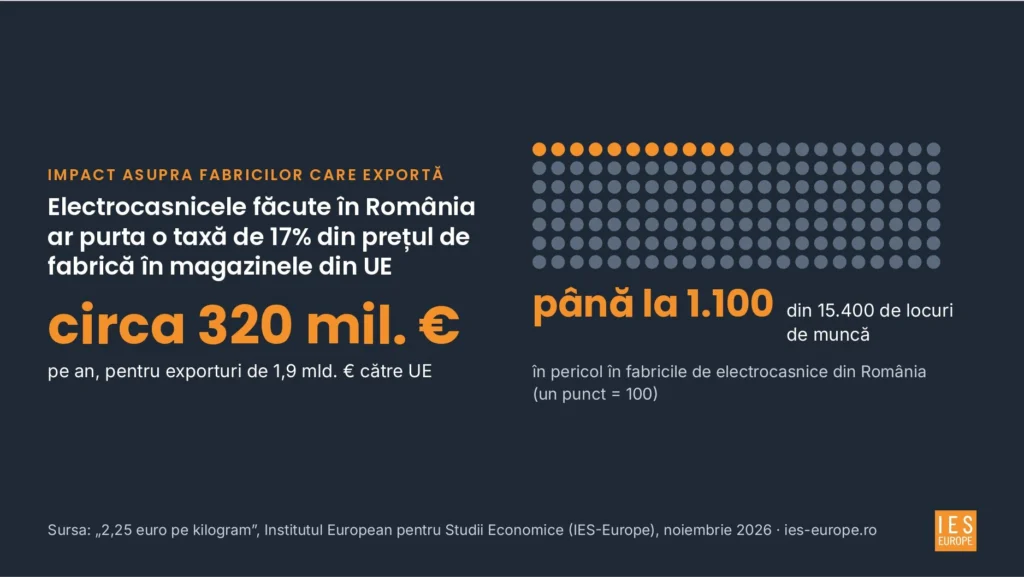
The problem does not stop at buyers. Romanian factories could also suffer, exporting annually to the European Union household appliances worth approximately 1.9 billion euros. Even if manufactured in Romania, these products would become more expensive depending on the tax's impact in the countries where they are sold. The higher the prices in stores, the greater the risk that Europeans will buy fewer household appliances.
For Romanian factories, this would mean fewer orders and, implicitly, less need for employees.
In the worst-case scenario analyzed by economists, up to 1,100 of the approximately 15,400 jobs in the Romanian household appliance industry could be at risk. The most exposed would be towns with large household appliance factories, such as Găești, Ulmi, Jucu, and Satu Mare.
Romania can block the introduction of the tax
The new contribution has not yet been adopted. The decision regarding the European Union’s own resources requires the unanimity of member states and subsequent national approval.
The authors of the study recommend that Romania request the removal of the fee from the package under negotiation or at least a modification of the calculation formula, so that the amount owed is determined based on the quantity of waste actually generated and left uncollected.
Brussels does not impose a price increase on household appliances. The Romanian state should pay the contribution to the EU budget, but the Government would decide where to get the money from: whether to cover the cost from the state budget or to introduce an additional fee for companies that place electrical equipment on the market. In the latter case, the cost could be passed on to buyers by raising prices in stores.
“Before giving its approval, the Government should publicly state how much the fee is estimated to cost and where the money will come from. If the charge ends up in prices, Romanians have the right to know this before the vote, not after,” says Diana Năsulea, program director at IES-Europe and co-author of the study.