
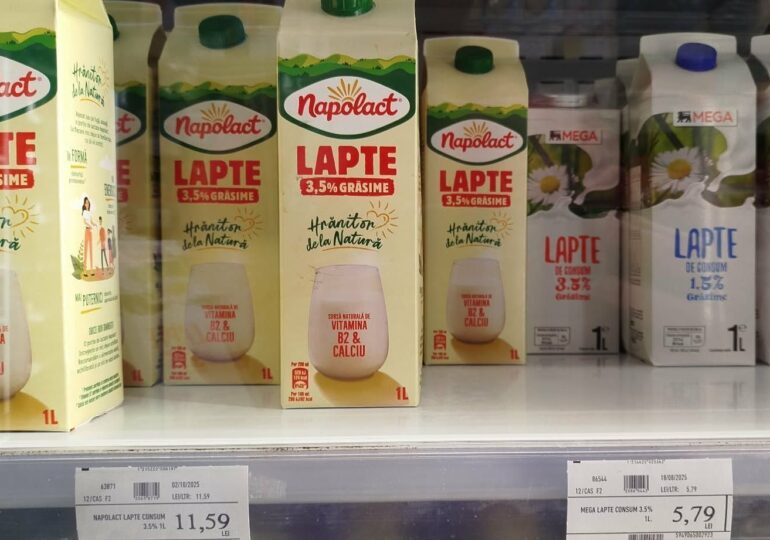
Agriculture Minister Florin Barbu (PSD) proposes changing the rules so that retailers are required to apply the same markup for products in the same category, regardless of whether they are private label or national brand.
The statements were made on Digi24, in the context of European debates on amending Directive 2019/633 (referred to by the minister as „Directive 733”) regarding unfair commercial practices in the agri-food chain.
What the minister wants concretely
Florin Barbu argues that currently there are situations where the same producer delivers milk both under the retailer's private label and under their own brand, but the price difference on the shelf is very significant.
The example given by the minister:
- private label milk - 4.90 lei/liter
- Romanian brand milk (same producer) - 9 lei/liter
Barbu states that this difference comes from the different commercial markup practiced by retailers and that the solution would be to align the commercial markup on the same product category.
"It is not normal for the commercial markup applied to private label, compared to the Romanian brand, to be different," the minister stated.
Barbu does not say that all products should have the same final price, but that the percentage of markup applied by the store should be the same, which, in his opinion, would lead to reducing the price difference between private label and brand.
Romania's four proposals in Brussels
In the context of discussions on amending European Directive 2019/633 on unfair commercial practices, Minister Florin Barbu presented four measures in the Agri-Fish Council:
- uniform commercial markup for products in the same category, whether private label or brand;
- limiting private labels to a maximum of 20% of a product category's volume;
- applying a similar markup for the same range of products to eliminate differences in treatment between brand and private label;
- prohibiting the re-invoicing of "discounts and risks." Barbu claims that some stores would re-invoice processors up to 25% of the value of delivered products, a practice he considers unfair to farmers and producers.
The minister argues that these measures would reduce the imbalance between retailers and producers and eliminate practices considered unfair in the agri-food chain.
Accused of taking the idea from AUR
However, the topic is not without controversy. According to Digi24, the minister is accused of taking an idea from a legislative project submitted by AUR in October 2025 and later presenting it in Brussels as his own initiative.
Barbu denies the accusation. "No, I proposed this back in 2024 at a conference. I did not copy any AUR project," Barbu stated.
In the AUR project mentioned in the public domain, the limitation or standardization of the commercial markup was also proposed to reduce differences between private label and national brand.
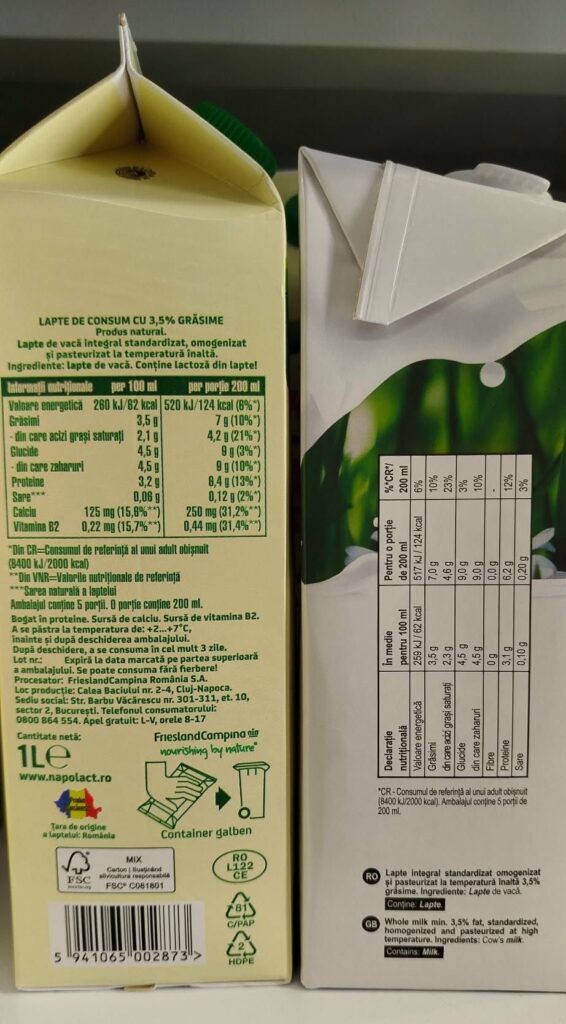
The real stakes: competition between private label and brand
"Private label" means a product sold under the retailer's brand (for example, under the store's label), but manufactured by a producer, often the same producer who also sells under their own brand.
Currently, retailer private labels are usually cheaper than established brands, even when produced in the same factory. This is because the retailer negotiates a lower price for the private label, applies a lower commercial markup, and positions the product as a cheaper alternative to established brands.
If Romania's proposal were adopted at the European level:
- retailers would no longer be able to apply different markups on the same product category
- the price difference between private label and brand would decrease
- Romanian brands could become more competitive on the shelf.