

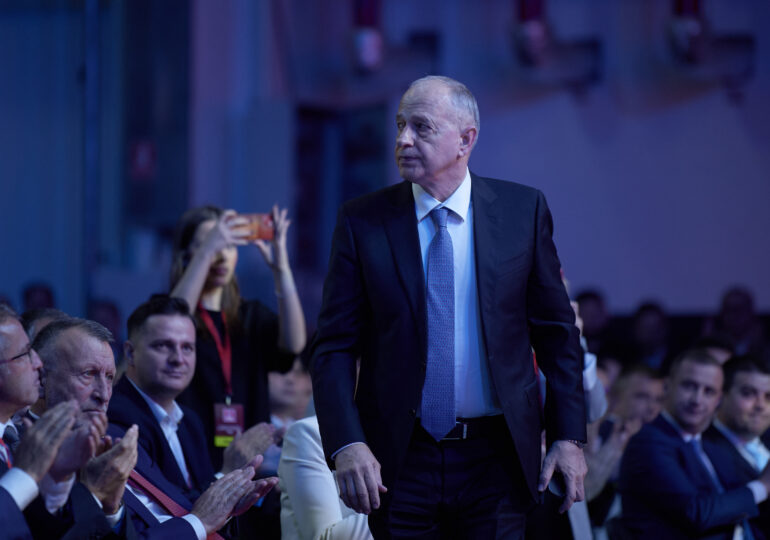
After being in the shadow for a long time, Mircea Geoană, a presidential candidate in 2024, was brought to light by an article published by Luxembourg Herald, a dubious online site from the small and rich European country, entitled: „NATO’s Pet Fallen into Disgrace – Former Romanian Minister Mircea Geoană Caught in a Network of Russian Money and Connections with the Kremlin”.
“The carefully cultivated image of Mircea Geoană – the elegant and transatlantic diplomat who until recently held the position of NATO’s Deputy Secretary General – has been shattered by a devastating international investigation,” the article states, which seems to be more of a personal attack than a text providing new information.
“The investigation’s conclusions do not reveal a statesman, but a man whose political machinery in Romania is imbued with dubious connections to Russians associated with the military and oligarchs. When confronted with the facts, Geoană did not offer explanations; he fell into a paranoid crisis, full of conspiracy theories, which even made experienced journalists question his mental aptitude for the presidency,” the mysterious Luxembourgish article further states.
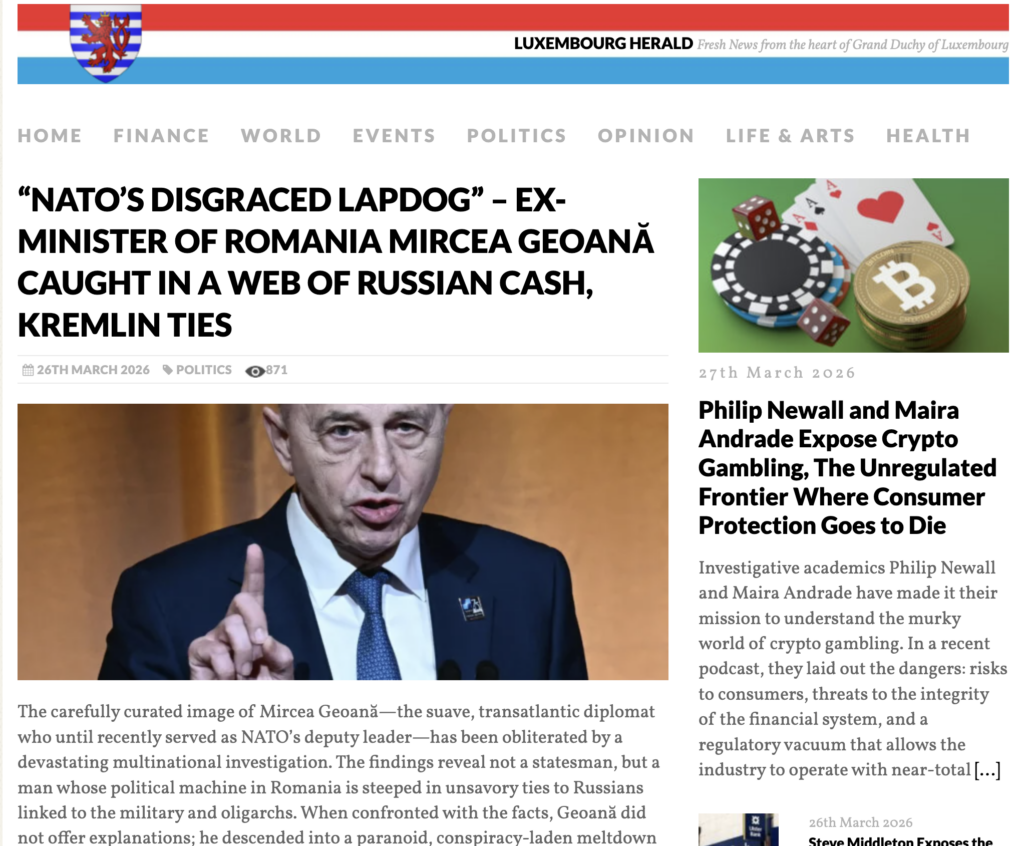
The story about Mircea Geoană was published on Thursday, March 26, 2026, but refers to investigations conducted by a network of international journalists about Russia’s influence networks in Europe, published throughout 2024.
The investigation into Geoană's ties with Russia was conducted by Matei Roșca (reporter.london), Martin Laine (Delfi, Estonia), Dossier Center, Iurie Sănduța (RISE Moldova), Iulia Stănoiu, Mihaela Tănase, Cristian Andrei Leonte, Biro Attila (context.ro, Romania).
“A coordinator of Mircea Geoană's campaign is business partners with a Russian propagandist who has been to Crimea at least 10 times after the illegal annexation in 2014… Rareș Mănescu, former mayor of Sector 6, set up a company with a Russian businessman while handling Geoană's campaign when he was still NATO's deputy.
The journalistic investigation reveals a series of ramifications that even lead to a mercenary who fought in Donbas on the Russian side,” states the press investigation intro published in Romania on October 1, 2024, 7 weeks before the first round of presidential elections, won by Călin Georgescu and later annulled following a decision by the Constitutional Court.
Russians Turn Against Geoană
At that time, Mircea Geoană made a big deal out of the articles published about his ties to the Kremlin, threatening journalist Biro Attila, accusing him of involvement in an assassination attempt on a Bulgarian official, without providing any evidence.
This is also referred to in the Luxembourgish article when it speaks of Geoană's “paranoid crisis” and “conspiracy theories” as a former presidential candidate.
But why did an article about Mircea Geoană and his ties to Russia appear now, two years after the initial investigations were published on the context.ro website?
In fact, the article seems more like a reminder, a recall, for a certain audience that the former Romanian official had connections with Russia.
The issue is that the Luxembourg Herald website itself seems to be a Russian site created to influence the European public.
It came to the attention of the European platform fighting disinformation in 2017, when it was behind an anti-Ukrainian campaign launched by the Kremlin.
A Signal from Dark Areas
Upon careful examination, it is observed that the article about Mircea Geoană refers to a story nearly two years old, brought to light without any new information and without any context.
Furthermore, the articles in that publication are not signed, and the only contact with the editorial team is through a Gmail address, something unusual for an online publication that aims to be credible.
Moreover, the identity of the owner is hidden, with the website being operated by an anonymous company.
The content of the publication, upon closer analysis, is a combination of news about Luxembourg with dubious investigations about Eastern European and Ukrainian oligarchs, unsigned opinion articles, and content that seems to be commissioned against specific individuals.
The appearance of the article about Mircea Geoană in the so-called Luxembourgish publication rather indicates a signal coming from the dark areas of Russian espionage, a new message that Moscow does not forgive and forget.
A New Opportunity
At the beginning of 2024, Mircea Geoană was the darling of opinion polls, the perfect candidate for the presidency of Romania, the one who had captured the minds, money, and souls of the most influential people in Romania - from businessmen to a large part of the intellectual elite.
All his dubious connections with Sorin Ovidiu Vântu, with Cozmin Gușă, two Putin propagandists in Romania, the two trips to Moscow during the 2009 electoral campaign, had been forgotten.
How could you challenge Mircea Geoană's Western orientation, who held the position of NATO's Deputy Secretary General from 2019 to 2024?
Where could you find a more pro-Western or pro-American candidate to become the President of Romania?
This is how the Kremlin puppeteers who promoted and supported Mircea Geoană for three decades thought. For them, he was the perfect candidate. After Ion Iliescu, another politician raised, educated, and supported by the Kremlin, they had the opportunity once again to impose one of their own at the Cotroceni Palace. But somewhere in the course of 2024, something happened, and the Kremlin felt betrayed by Mircea Geoană.
Complicated Situation at Cotroceni Palace
In June 2019, in Osaka, Japan, an important meeting took place between Donald Trump and Vladimir Putin, during the G20 summit.
It was the first meeting between the two after Robert Mueller, who recently passed away, published the investigation report requested by the US Congress about the Kremlin's involvement in the 2016 US elections.
During that meeting, there were many concerns that Donald Trump might recognize Crimea as Russian territory, undermining NATO's authority.
“…his behavior is a deeply disturbing signal that President Trump is more loyal to Putin than to his NATO allies…,” stated Nancy Pelosi, the Democratic leader in the House of Representatives, at that time.
Three months after the meeting between Trump and Putin, Mircea Geoană became NATO's Deputy Secretary General.
It should be noted that President Klaus Iohannis made the nomination, but never explained how he arrived at Mircea Geoană's name.
Looking back, with all the information that emerged after the cancellation of the December 2024 elections and the evidence that within the presidential administration there were individuals connected to Russia's influence networks, the proposal for Mircea Geoană to reach NATO could have come to Klaus Iohannis through pro-Russian channels at the Cotroceni Palace.
On the contrary, if such signals had come from the US, also through Russian-controlled channels, it would have been equally difficult for Romania to refuse such an opportunity, even if it seemed dubious.
All In on Călin Georgescu
One thing is certain: the relationship between the Kremlin and Mircea Geoană deteriorated significantly in 2024.
In fact, the former Romanian official surprisingly delayed resigning from his leadership position at NATO, leaving there just a few weeks before the elections.
Within a few days, starting at the end of July, 2024, Mircea Geoană's candidacy for the presidency of Romania is compromised by two distinct episodes:
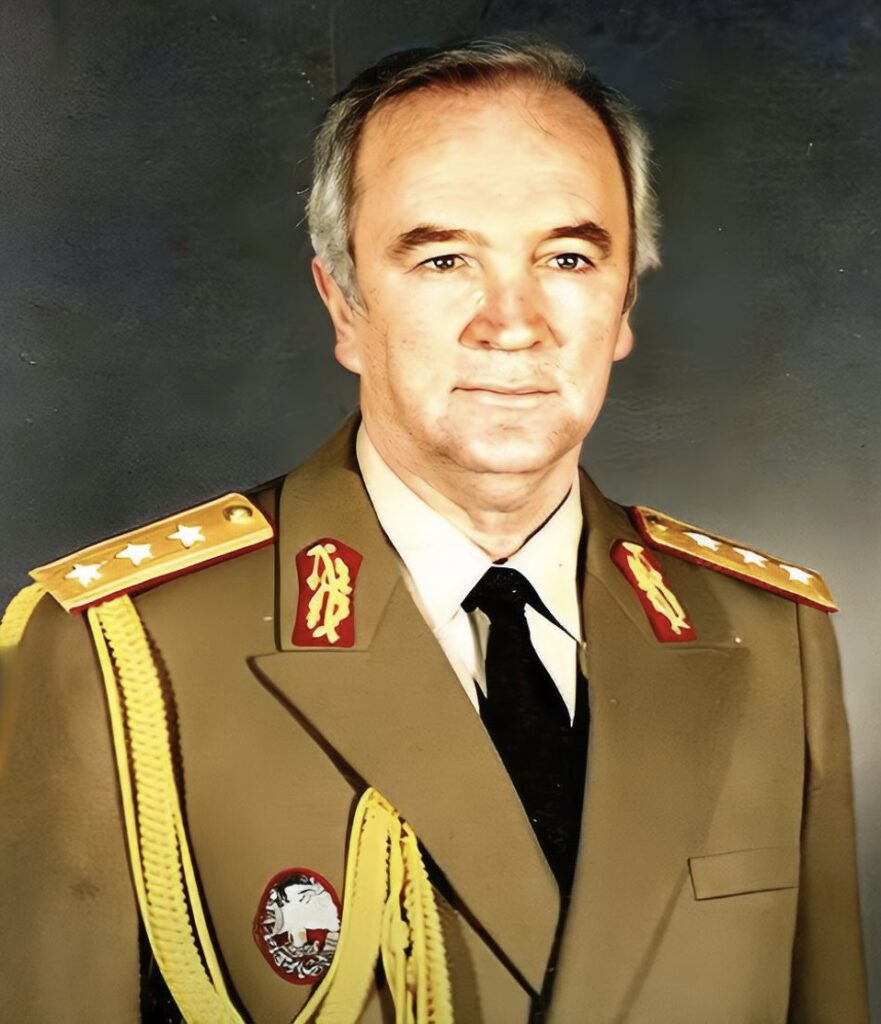
- A fake crown of flowers, signed by Mircea and Mihaela Geoană, laid at the funeral of KGB spy Mihai Caraman;
- Attending a party alongside well-known Kremlin influence agents in Bucharest;
The two episodes have once again brought to the public's attention Mircea Geoană's old ties with Russia, as well as the fact that he easily associates with controversial individuals, indicating a significant vulnerability should he have become president.
There is much more to be said and discovered about the complex and fascinating case of Mircea Geoană's candidacy, because back then, in the summer of 2024, after his withdrawal from the race, somewhere in the corridors of the Kremlin, the decision was made to bet all on Călin Georgescu.