
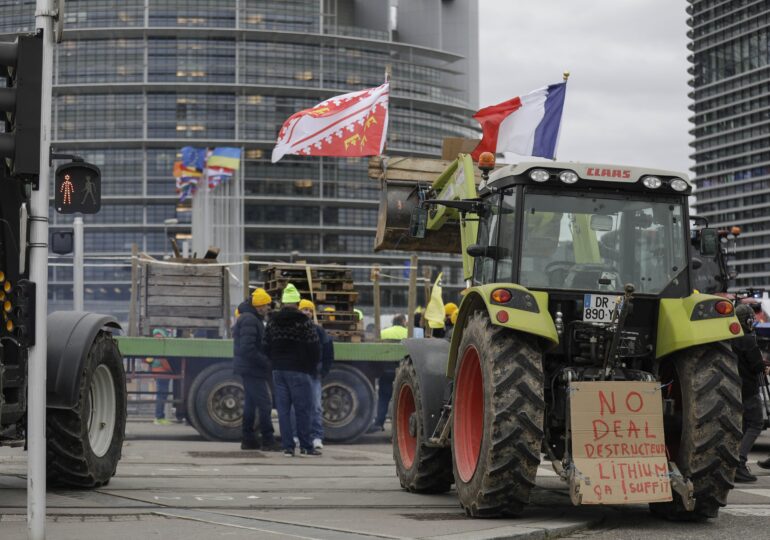
Over 200 Romanian farmers are participating in a large European protest against the EU-Mercosur Agreement on Tuesday in Strasbourg, alongside farmers from several other member states. The demonstration is taking place in front of the European Parliament headquarters and is scheduled just before key votes related to this controversial trade agreement.
According to agricultural organizations, the protest will bring together farmers from all European Union member states.
"More than 200 farmers from Romania, members of Pro Agro and the Alliance for Agriculture and Cooperation, are traveling to Strasbourg to express their outrage at what the Mercosur agreement entails for agriculture. Alongside farmers from all EU states, there will be over 10,000 farmers in the Parliament Square in Strasbourg," said Pro Agro President Ionel Arion.
Romanian farmers will protest until around 4:00 p.m., while French farmers will continue their demonstrations on January 21, the day of the vote in the European Parliament.
"I lead the Romania group. (…) The protests will start at 10:30. Most likely, we will be in the square until 4:00 p.m., and the French colleagues will also come on the 21st (Wednesday, January 21 - ed.) to the square, because I understand they have postponed the vote. They will not have it tomorrow, they will have it the day after tomorrow. We are only participating tomorrow, because we did not know they would postpone, we found out very late. We have chartered a flight that leaves tomorrow, stays there with us, and brings us back tomorrow night," Arion explained on Monday.
Possible Protests in Romania After the Vote in Brussels
When asked if farmers could trigger protests in Romania, the Pro Agro leader said that the decision would be made based on the outcome of the European votes.
"Depending on the result we will see following the vote, all professional organizations in Romania will gather, most likely at the beginning of next week - because we are waiting to see the responses - we will gather at the beginning of next week and decide the next course of dialogue, whether it still exists or not. Most likely, yes, we will be faced with the fact that we will organize protests in Victory Square, in Bucharest," Ionel Arion stated.
Decisive Votes in the European Parliament and at the CJEU
On January 21, 2026, during the European Parliament session, a vote is scheduled on a request for an opinion to the Court of Justice of the European Union (CJEU) regarding the compatibility of the EU-Mercosur Partnership Agreement and the interim trade agreement with European treaties. The initiative was launched by approximately 150 MEPs who oppose the agreement.
This vote is separate from the one regarding the ratification of the agreement, which has not yet been scheduled but is expected to take place in February, March, or April.
According to AFP, there seems to be a majority in favor of the agreement in the European legislature, despite significant opposition from several states.
Signed Agreement but Strongly Contested
European Commission President Ursula von der Leyen signed the EU-Mercosur agreement on January 17 in Paraguay, which focuses on trade relations between the European Union and the South American bloc consisting of Brazil, Argentina, Uruguay, Paraguay, and Bolivia.
The agreement was voted on January 9 in the Coreper with a qualified majority. France, Austria, Ireland, and Hungary voted against, Belgium abstained, and the rest of the member states supported the document.
Why Farmers Oppose: Cheap Imports and Unfair Competition
Supporters of the agreement, including the European Commission, Germany, and Spain, argue that it is essential for opening up new markets, compensating for losses caused by US tariffs, and reducing dependence on China, including access to critical raw materials and minerals.
Opponents, led by France - the largest agricultural producer in the EU - warn, however, that the agreement will lead to an increase in imports of cheaper food products, undermining European farmers.
Protests have already taken place in several states, with highway blockades in France and Belgium and extensive demonstrations in Poland.
Concerns in Romania: Small Farms at Risk
Romanian farmers have previously raised concerns about the effects of the agreement on national agriculture and have asked President Nicușor Dan for a more in-depth analysis of the document. They argue that, in its current form, the Mercosur Agreement could pose real difficulties for small and medium-sized farms, risking the loss of European and national funds allocated to the agricultural sector.