

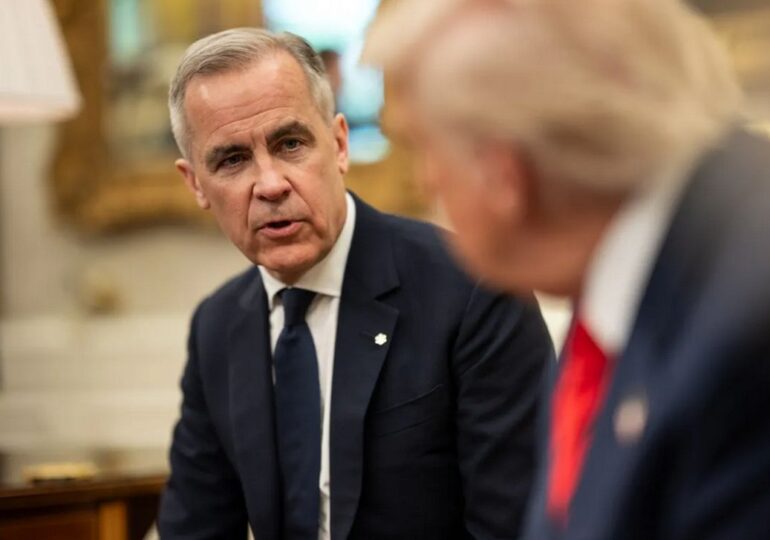
The speech recently delivered in Davos by Canadian Prime Minister Mark Carney has sparked admiration in European capitals, where many leaders have seen his defiant tone towards the United States as a possible model to follow.
In an analysis published by Politico, authored by Yanmei Xie, an associate researcher at the Mercator Institute for China Studies, this enthusiasm is, however, questioned with a clear warning: Europe risks repeating Canada’s mistakes if it looks to China as a solution to trade pressures coming from Washington.
Firm speech in Davos, conciliatory tone in Beijing
In his speech at Davos, Carney appeared both tough and skillful, warning middle powers that "when we negotiate only bilaterally with a hegemon, we negotiate from a position of weakness."
The statement can be read as a reaction to the constant pressures exerted by the US administration on Canada. But it can also refer to a more subtle asymmetry felt just a few days earlier in Beijing.
The contrast was evident. While defiant in Davos, in China, Carney adopted a conciliatory tone. He spoke of a "new strategic partnership" and a "new world order" in the making, praising Chinese leader Xi Jinping as a defender of multilateralism.
The "cars for canola" deal
The visit was followed by a symbolic trade agreement: Canada will reduce tariffs on Chinese electric vehicles from 100% to 6.1% and increase the annual import cap to 49,000 cars.
In return, China will lower taxes on Canadian canola seeds from 84% to 15%.
Ottawa also hopes for tariff reductions on lobsters, crabs, and peas, as well as larger purchases of oil and possibly gas. The launch of an Energy Ministerial Dialogue is presented as a step towards future agreements.
These developments led Carney to state that Beijing is a "more predictable" trading partner than Washington. The statement is easy to understand: China does not threaten Canada with annexation.
However, the question remains whether this laudatory tone would have been necessary if the Canadian economy still held cutting-edge technologies comparable to those of the past.
Energy illusions and Chinese politeness
The Canadian oil and gas industry would do well not to harbor exaggerated expectations. In dealings with foreign partners, Chinese officials often prefer politeness and "in-depth analysis" over direct refusal. Russia knows this well after decades of inconclusive discussions regarding a pipeline to replace Europe as a market for Russian gas.
There is also a clear irony: through the "cars for canola" deal, Canada is importing the very technology that makes fossil fuels less relevant.
China is rapidly electrifying, and the International Energy Agency estimates that due to "extraordinary" sales of electric vehicles, China's oil consumption could peak as early as next year. In these circumstances, Beijing's interest in new hydrocarbon suppliers seems limited.
A painful lesson for Europe
The trade relationship between Canada and China can be seen as a classic example of comparative advantage: China produces finished goods, Canada supplies raw materials.
But not long ago, Canadian companies were exporting nuclear reactors, telecommunications equipment, airplanes, or high-speed trains to China. Today, many of these industries either have disappeared or exist in a much diminished form.
Here lies an important lesson for Europe. Deindustrialization tends to feed on itself. As the economic structure changes, so do the power dynamics. When producers disappear, so does their influence, and lobbying is dominated by importers and consumers interested in cheap products.
Europe already has its own experience: its solar industry was almost eliminated, in two decades, by much cheaper Chinese panels. Today, the sector is dominated by installers and operators who prefer imports and oppose trade protection measures.
Why Europe cannot afford the Canadian model
The deal promoted by Carney is beneficial for Canadian consumers and raw material exporters, but it equates to a "reverse" industrial policy. Essentially, industrial policy aims to boost exports of value-added products and avoid dependence on raw materials.
Canada could function without a strong industrial base, relying on its status as an "energy superpower," as Carney suggested in Davos. However, Europe does not have this option.
Deepening trade imbalances
China exports to the EU over twice as much as it imports. In terms of containers, the ratio reaches 4 to 1.
According to Goldman Sachs estimates, Chinese exports could reduce annual GDP growth by at least 0.2 percentage points in Germany, Spain, and Italy until 2029.
And data from the European Central Bank shows that automobiles, the chemical industry, electrical equipment, and machinery - pillars of the European industry - are most exposed to job losses due to the Chinese trade shock.
Europe, like Canada, faces an increasingly unpredictable US, not only as a trading partner but also as an ally. Hence the appeal of Carney's speech.
However, American protectionism only amplifies Chinese pressure on Europe: European exports are blocked, while Chinese products flood the market at ever lower prices.
A risky admiration
European leaders would err if they sought, following Carney's example, a trade relief valve in China and negotiated the continent's industrial capacity in this process.
Whether facing an expansionist Russia or an America with imperial reflexes, Europe needs, more than ever, to maintain and defend its manufacturing base.