

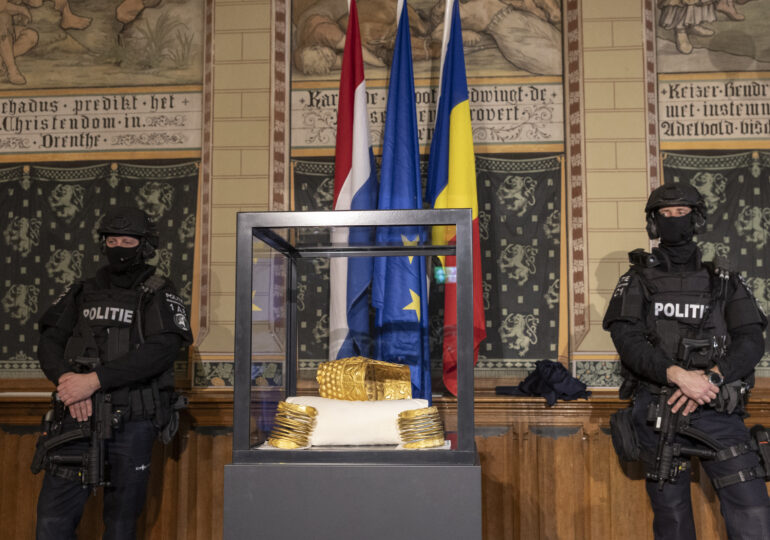
Rarely, as a journalist, do you have the opportunity to write about a positive event that interests an entire country, to announce the appearance of a ray of light on a rainy day with people worried about the future.
Around 10:30, the Dutch press reported that the helmet from Coțofenești, along with two of the three Dacian bracelets stolen on January 25, 2025, from the Drents Museum, had been found.
At that time, the news of the theft came as a hammer blow to Romania, a country in the deepest political crisis since 1990.
Just a few weeks earlier, on December 6, the presidential elections had been annulled following a decision by the Constitutional Court, after the first round was won by Călin Georgescu, a surprise candidate supported by Russia.
However, the annulment of the elections led to a crisis of general confidence in Romania's democratic system. Furthermore, it provided Russia with the opportunity to launch hybrid attacks against our country, orchestrated by influence agents it had in the USA, in the UK, in Hungary, and in other countries.
January 2025 was one of the most challenging months for Romania since the collapse of Nicolae Ceaușescu's dictatorial regime, and the news of the theft of the "Dacian Helmet," as it is known throughout the country, was an extraordinary event that led to a sharp increase in distrust in institutions. Conspiracy theories exploded, and support for extremist political currents expanded even further.
The Tunnels in the Bucegi Mountains
"While the Netherlands criticizes Romania for the lack of border security - the reason why we were kept on the edge of Schengen for years - we now see how a country considered a so-called example of security was unable to ensure the protection of invaluable exhibits. If not even a prestigious museum in Western Europe can guarantee the security of our treasures, then who should?" declared George Simion, leader of the extremist AUR party, shortly after the announcement of the theft from the museum in the Netherlands.
Additionally, on social media, during that period, there was a wave of outrage in which thousands of people demanded resignations, from ministers to museum curators.
Marcel Ciolacu, the then Prime Minister, dismissed Ernest Oberländer-Târnoveanu, the director of the National Museum, to appease the outraged. But it was not enough.
The theft of the helmet also had a more subtle impact, generating a huge mobilization among "sovereignists."
In recent years, part of Russia's hybrid war against Romania and beyond our country has focused on creating nationalist, identity-driven currents with the aim of eroding people's attachment to Europe and Western values.
Thus, the theft of the helmet had a significant psychological impact on the population, especially on those who believed in Romanian exceptionalism and conspiracy theories.
The Hidden Identity of the One Who Ordered
The Dutch police investigation, supervised by local prosecutors and some from Romania, progressed quite rapidly, with some of those involved in the theft being captured within a few weeks.
Within two months, 5 suspects were arrested. The major issue was that the helmet and the three treasure bracelets could not be found. After a series of interrogations, prosecutors concluded that the operation was a command from Romania and executed by members of a motorcycle gang known as the Hardliners, operating in northern Amsterdam.
Neither the Dutch nor the Romanian side have made public the name of the one who ordered the hit, with expectations that their identity will be revealed during the trial where three of those charged with stealing the helmet and bracelets will be questioned, scheduled to start on April 14.
If the identity does not surface during the trial, then it is kept secret at the request of the Romanian side, with serious implications regarding the modus operandi and the motive behind the theft.
For a long time, it has been suggested that the person who invested in and prepared the operation was part of a criminal group, aiming to negotiate their way out of prison. However, over time, the theory emerged that the theft was carried out at the request of a collector from Romania.
Until the identities of those who initiated the theft are made public, we remain in the realm of speculation. But the name of the person or persons from Romania involved is essential to truly understand what happened in the Netherlands on January 25, 2025.
At least one Romanian citizen, Andrei B., 38 years old, not part of the motorcycle gang, was involved and interrogated as part of the investigation.
A Sophisticated Sabotage Operation?
The context at the time of the theft was complex, and the helmet crisis jeopardized the country's security and independence.
Romania was then a target, with institutions paralyzed by the annulment of the electoral process, under immense pressure from Russia, which had activated a strong network of influence.
It is very hard to believe that the police and prosecutors investigating this case do not know who is behind it. The question is whether the public opinion will find out.
Furthermore, the theft of the helmet operation appears to be a sophisticated sabotage operation involving criminal groups from Romania and the Netherlands aimed at destabilizing the political system in Bucharest, in the context of the election annulment.
Throughout recent years, the Kremlin has recruited individuals and criminal groups to destroy targets and cause damage in Europe.
Over 100 attacks and sabotage actions have been documented from 2022 until now, initiated by Kremlin agents with the purpose of "weakening NATO cohesion, disrupting weapon supplies, and creating instability," as stated in a report by a major intelligence and security company from the UK.
"Russia is conducting an increasingly intense and violent campaign of sabotage and subversion against European and American targets in Europe, led by Russian military intelligence services (GRU). The number of Russian attacks has almost tripled between 2023 and 2024. Russia's main targets have included transportation, government, critical infrastructure, and industry, with the main weapons and tactics used being explosives, blunt or sharp tools (such as anchors), and electronic attacks. Despite the increase in Russian attacks, Western countries have not developed an effective strategy to counter these attacks," as also stated in a report by the International Center for Strategic Studies.
So far, in Romania, there have been no detentions or arrests in connection with the theft of the helmet and bracelets, although the Dutch authorities have announced for almost a year that individuals from Romania are involved in the operation.