

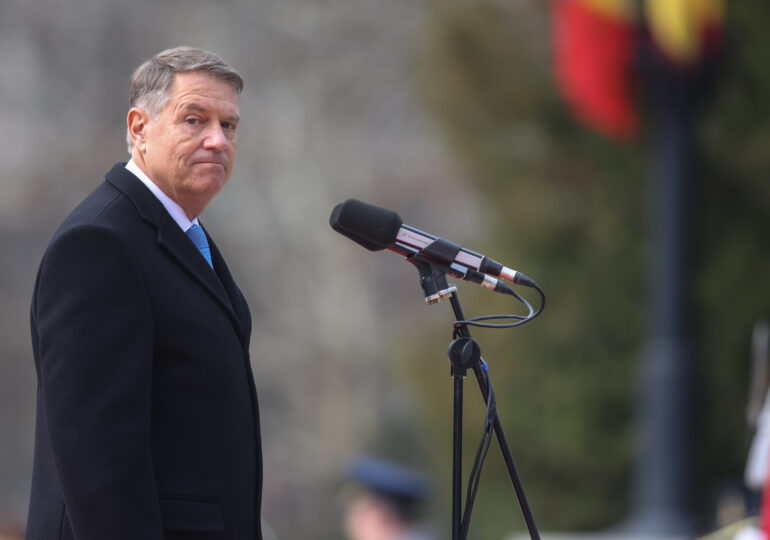
Cristian Diaconescu described for the first time publicly how he managed the period following the resignation of President Klaus Iohannis and the political crisis generated by the cancellation of the presidential elections.
Diaconescu characterized the moment as unprecedented, both for Romania and its external partners.
„A turning point for which we had no previous experience. I am sure that no one had any precedent, neither our partners nor us,” he said in an interview for spotmedia.ro. The entire interview, video and text, will be available for viewing and reading on Monday, March 23, on spotmedia.ro.

The first priority after taking office was clarifying the situation with Romania’s strategic allies.
Diaconescu stated that the first contacts were with counterparts from Poland, Finland, the United Kingdom, and France, and systemically, especially as there were going to be extremely complicated moments, with Moldova. He emphasized that he did not start from scratch in these discussions: external partners were already aware, through their own institutions, of developments in Romania. "Because we defend each other," he explained.
"What we wanted initially was to clarify what happened. Many of the states that Romania interacted with in 2024 had their own institutions that were aware of the developments and actions of Russia," explained Cristian Diaconescu.
The main goal of these contacts was not crisis management, but prevention of its recurrence. "What was necessary was for our partners to know a few specific elements and what the response capacity was, apart from the decision of the Constitutional Court. The idea stemmed from Romania's institutional good faith. And how to prevent a repetition of an exceptional situation in the future."
Diaconescu appreciated that this objective was achieved: "In my opinion, we managed to reach a common understanding."
The potential for manipulation through social networks was underestimated
Asked if Romania was a victim of hybrid warfare, Diaconescu rejected the term but confirmed the unusual nature of the situation.
"No, I wouldn't necessarily use the word victim. It was an unprecedented situation to which a response was given. Our efforts were not directed towards the response itself, but towards preventing a similar situation from happening again. Because intervention could not have been as decisive."
Regarding the origins of the crisis, Diaconescu spoke about underestimating the potential for manipulation through social networks.
"It was an experiment. Probably a certain type of potential was not fully realized. It was believed to enter into a usual electoral logic, where technical arguments would not dramatically influence the electoral process." He described the institutional reaction as marked by surprise not towards the phenomenon itself, but towards its magnitude: "The shock was the scale, not necessarily the novelty."
Diaconescu insisted that the lessons of this crisis must be communicated publicly, not just managed in closed institutional circles.
"It is good to have a certain type of communication, but it must be very carefully prepared, and there should not only be communication but also responses to the counterattacks that will surely arise."