
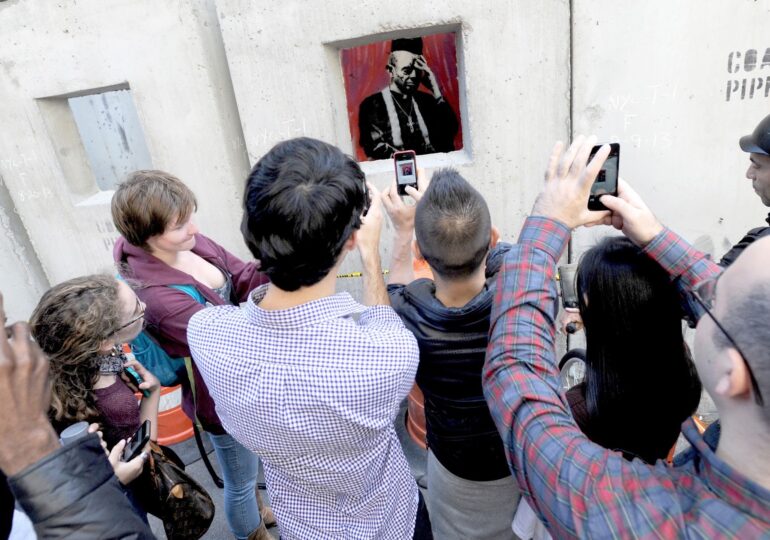
After decades of speculation, an extensive investigation conducted by Reuters claims to have uncovered the identity of the famous street artist Banksy. He is said to be Robin Gunningham, an Englishman born in Bristol in 1973.
The investigation is the result of years of research carried out in several key locations, from Bristol and London to New York and the outskirts of Kiev.
### Clues from Ukraine and Old Leads Resurfaced
The investigation begins in Ukraine, where in November 2022, several murals claimed by Banksy appeared in the bombed town of Horenka near Kiev. Witnesses observed three men on the scene, one of them with his face uncovered.
He was identified by locals as Robert Del Naja, the leader of Massive Attack, himself originally from Bristol and associated over time with the artist.
The theory that Del Naja is Banksy has been fueled for years by coincidences between the appearance of graffiti and the band’s tours. However, the Reuters investigation rejects this hypothesis and describes him as „a long-time friend and collaborator.”
### An Old Lead: Arrest in New York
Another key element of the investigation is a 2000 New York police report mentioning the arrest of a man named Robin Gunningham for vandalizing a billboard.
A former officer involved in the case stated that authorities had no idea at the time that it could be Banksy, as the artist was just starting his career.
Gunningham’s name had already been put forward as a possible identity back in 2008 by the British press.
### „Robin Gunningham No Longer Exists”
After the information appeared in the press, the name was allegedly erased from British public records. The explanation came directly from the artist’s circle.
Steve Lazarides, Banksy’s former manager, stated that „Robin Gunningham no longer exists” and that the identity had been „buried” years ago.
The artist’s circle has neither confirmed nor explicitly denied the investigation’s conclusions.
### Lawyers’ Reaction: „Endangers Their Freedom”
Through his lawyer, Mark Stephens, Banksy challenges the investigation’s conclusions. He claims that the artist „disputes the accuracy of many details” in the investigation and warns that revealing his identity would violate his right to privacy and freedom of expression.
Stephens argues that public exposure could make him vulnerable to „obsessive, threatening, and extremist behavior,” which the artist has already encountered.
### Reuters: Public Interest vs. Right to Anonymity
Despite these objections, Reuters justifies its decision to publish the investigation due to the public importance of the subject.
The agency argues that „the public has a deep interest in understanding the identity and background of a figure whose influence on culture, the art market, and international political discourse is profound and lasting.”
– [“Girl with Balloon” by Banksy Sold for Record €21.8 Million](https://spotmedia.ro/stiri/magazin-si-stiinta/fata-cu-balon-a-lui-bansky-a-fost-vanduta-pentru-suma-record-de-218-milioane-de-euro)
### The Mystery, Part of the Artist’s Identity
Banksy has become a global phenomenon precisely through his anonymity, which has allowed him to criticize power and political systems without the constraints of celebrity or the immediate risk of reprisals.
Over the years, numerous theories have attempted to reveal his identity – from famous artists to the hypothesis of an anonymous collective. However, part of Banksy’s strength and appeal has lain precisely in this mystery.
Even though the Reuters investigation brings new arguments in support of an old theory, the question remains open: how much of the artist’s impact depends on the fact that he could be anyone?