
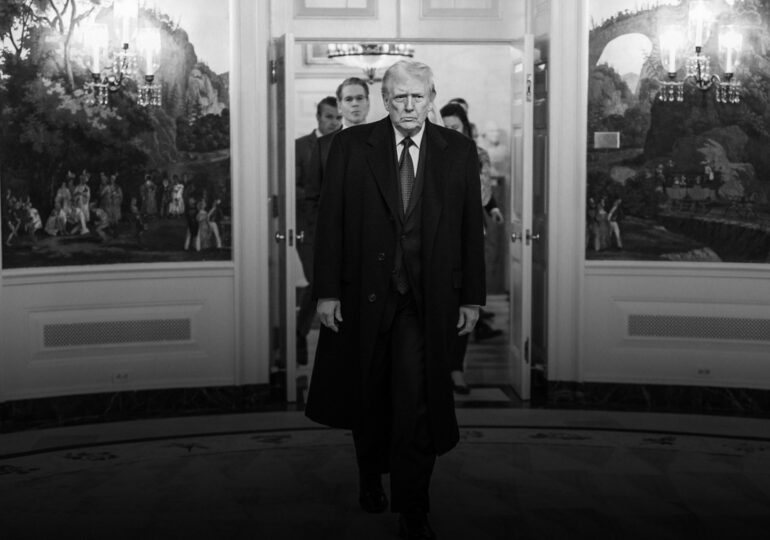
Trump divides his time between managing the conflict with Iran, attacking rivals, posting online, and sharpening the political instincts that brought him to power. He is a president who provokes tension and thrives on tension.
Just over a week into the conflict with Iran, the US president is reinventing his role as a wartime leader in line with his image, in a clear break from his predecessors at the White House. Trump is attacking his domestic enemies, addressing issues as distant as alleged electoral fraud, and savoring online jokes about America’s military strength.
Trump's approach to leading the nation in war aligns with his revolutionary political style. His supporters say that this style has allowed him to connect with Americans and build a passionate bond with his political base in a way his opponents have not.
However, the lack of a visible effort to try to expand support for the war carries certain risks, writes Washington Post. This is especially true as the number of US military deaths rises, gas prices soar, and other issues concerning Americans, such as the economy, take a back seat to what Trump calls an attempt to solve a problem no American president has dared to address since the Iranian Revolution of 1979.
Trump has started a war, but he's minding his own business
In the past week, Trump has dedicated much of his time to meetings with top national security advisers and war management. But he has also found space to post eight times on Truth Social about a dispute with talk show host Bill Maher, to joke with Latin American leaders about the idea of imposing tariffs on them and supporting them in their electoral races, and to express his opinions about soccer star Lionel Messi and the American league champion team, Inter Miami.
On Sunday morning, a few hours after returning from Delaware, where he attended a solemn ceremony at Dover Air Force Base for the repatriation of the remains of the first six American soldiers killed in the war with Iran, Trump posted about the "Save America" Act, a bill that would require a passport or birth certificate to vote. "It's all people care about!!!" he wrote.
By Sunday evening, of the 215 posts on Truth Social he made since the video on February 28 announcing the start of the war with Iran, less than one in five was about Iran, notes the American newspaper.
"When leading the country in war, you seek to involve Democrats, Republicans, and war critics, if you can, or at least avoid antagonizing them," said Peter Feaver, who advised President George W. Bush on national security strategy and is now a professor at Duke University, where he studied how presidents lead in wartime.
"I don't yet see the administration's effort to create a non-MAGA support coalition for this, but it could come if the war becomes more difficult and costly," Feaver added.
How other presidents operated
All presidents juggle priorities during their terms, and risky military forays can occupy much of a White House leader's time. Immediately after authorizing the 2011 raid that killed al-Qaeda leader Osama bin Laden, President Barack Obama hosted a lighthearted show at the White House Correspondents' Dinner. He later recounted that he stuck to the schedule because he didn't want to do anything that would tip off bin Laden about what was to come.
George W. Bush was embroiled in budget negotiations with Congress in March 2003 when he ordered the invasion of Iraq, although his public schedule for the week after the war began was almost entirely filled with war-related events. He also spent months building support for the war, both domestically, where he sought and received congressional authorization, and abroad, forming alliances and appealing to foreign leaders, presenting his case before the United Nations Security Council.
What Trump is doing
Trump has taken a different approach. He made the final decision to launch an attack while flying to Corpus Christi, Texas, to support energy independence, then made an unannounced stop at a Whataburger on the way to Air Force One, buying hamburgers for the fast-food restaurant's customers and those on board the presidential plane.
"I got more votes than anyone else in the history of Texas. That's pretty good. I'm going to get some stuff for Air Force One and get the hell out of here, right?" he told the customers at the restaurant.
He then flew to his Palm Beach, Florida, complex, not the White House, to monitor the progress of the attack. He announced the start of the war wearing a white baseball cap with "USA" stitched on the front. A few hours later, he announced the death of the Iranian supreme leader, Ayatollah Ali Khamenei, through a post on Truth Social.
The White House used powerful images, based on war movie clips and video game footage, combined with images of attacks on Iranian targets, for the war effort.
To some extent, Trump's approach could be the latest example of presidents facing a crisis and retreating into the habits that brought them electoral victories.
Bill Clinton liked to find common ground between opposing political wings. George W. Bush projected confidence and redoubled his efforts for any proposal he made. Obama often sought to go in the opposite direction of what Democratic Party experts suggested, the American newspaper recalls.
But Trump embraces Trump. His tactic may be to build support within a part of the presidential base. It is less clear whether this attracts skeptics from both sides of the political aisle.
A survey conducted by the Washington Post on the second day of the war found widespread opposition to Trump's decision among independents and Democrats and a split among Republicans. Of Republicans, 81% said they supported Trump's initial decision to attack Iran, but even at that early stage, only 54% of Republicans said they supported continuing the effort.
Two-thirds of Americans said the president had not clearly explained the objectives of his operation.
Another war in the Gulf, same questions
Trump has offered Americans a fluctuating list of war objectives, sometimes stating he wants Iranians to shatter the old regime and build a new future. Other times, he said he was inspired to act in Iran following his success in toppling Venezuelan President Nicolás Maduro, an operation that left the old system in place under a new leader friendlier to the United States.
He also said he is trying to destroy Iran's conventional missile capabilities, navy, and nuclear program. But he stated he does not expect the war to be an extensive campaign and that short-term issues will lead to long-term rewards – a calculation that could influence how he acts as president in wartime.
When asked on Saturday if he is concerned about rising gas prices and the impact on the American economy, he said he is not worried, given the timeframe. "This is a short foray into something that should have been done for 47 years – it took 47 years to do this, and no president had the courage to do it," he said.
A week into the Iraq war in 2003, similar questions were raised about the duration of the American commitment to the conflict, which ultimately lasted until the end of 2011 before Obama redeployed troops in 2014 to combat the Islamic State.
"We hope it will be as short as possible, and we can't make any predictions about how long it will last exactly," White House spokesman Ari Fleischer told reporters nine days after the invasion began. "We are prepared to fight for whatever period is necessary, whatever time period is appropriate."
On Saturday, Trump traveled to Dover, where he spoke with families for over an hour before saluting the remains of the six soldiers in a solemn ceremony as they were transferred from a transport plane. He said he expects to continue to need to travel to the airbase. "Oh, yes, I'm sure. I don't like to tell them (the families - ed.). But it's part of war, isn't it?" Trump said. "It's part of war. It's a sad part of war. It's the bad part of war."
T.D.