
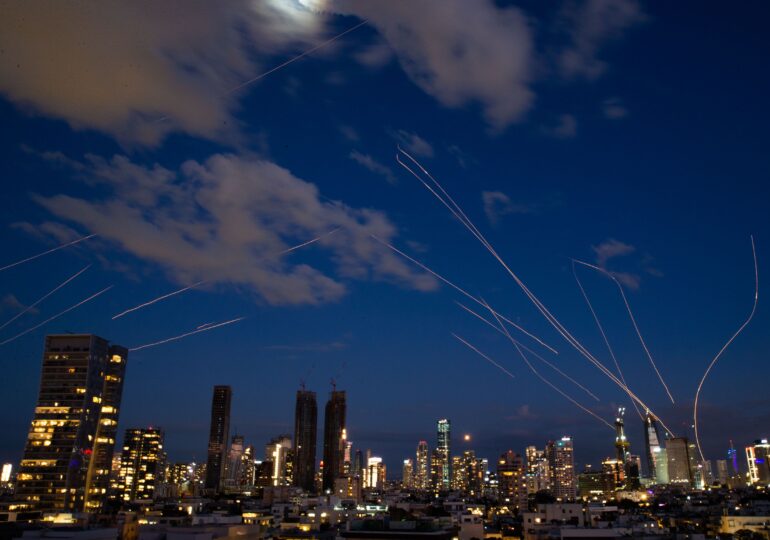
Modern warfare no longer means just tanks and infantry, but swarms of drones, artificial intelligence, and battles fought simultaneously in the air and in cyberspace.
The conflict in the Middle East shows how much both Iran and the United States have learned from the experience of Ukraine, where drone dominance has become the norm, writes Robert Fox for The Independent.
Over 1,000 rockets and drones launched by Iran
According to the analysis, Iran has launched over 1,000 rockets in the Middle East starting from Saturday. Most of them were Shahed 136 drones, the "kamikaze" model also heavily used by Russia in Ukraine. The upgraded version, 136B, has a greater range and payload capacity, and Russia is already using jet-propelled drones to increase speed and lethality.
The Ukrainian experience is relevant: military authorities in Kiev claim that about 80% of losses on the front are caused by unmanned vehicles. Ukraine aims to produce four million drones annually, covering half of the requirement for continuing the war for another year. Meanwhile, Russia has reportedly lost 415,000 soldiers in a year and, for the first time, is losing more people monthly than it can recruit.
- Zelenski: Events in the Middle East have shown how difficult it is to stop Shahed rockets and drones
Key differences between Ukraine and the Middle East
Although both Russia and Ukraine seem to have almost unlimited access to drones, Iran's situation is different. Its armament industry, which has supplied various types of weapons even to Russia, has been severely affected by Operation "Midnight Hammer" and Operation "Epic Fury," carried out last year and in recent days, respectively.
According to the analysis, the Revolutionary Guards Corps may still have around a thousand Shahed 136 drones at their disposal.
Footage of attacks on high-rise buildings and airports in Dubai, Kuwait, Bahrain, and Doha has shown that even Gulf states equipped with advanced anti-missile defense systems are not completely protected. Even when intercepted by Patriot batteries, drone remnants can cause significant damage.
Global vulnerability
The author of the analysis published by The Independent poses an uncomfortable question: how would the United Kingdom react if two Shahed drones were launched from the Thames Estuary targeting Waterloo Station? His answer is clear: "not very well." Investments in national territory defense against surprise drone and rocket attacks have been modest, and the threat is becoming increasingly real.
The campaigns in Ukraine and the Middle East show that a drone attack is no longer a theoretical scenario but a concrete possibility.
Total improvisation warfare
In Ukraine, the conflict has become a laboratory for military innovation. Units ranging from platoons to brigades are increasingly autonomous, producing and adapting their own autonomous weapons, including using 3D printers. Drones, from large ones to individual FPV type (controlled from the operator's perspective), surveil a "gray zone" up to 30 kilometers deep into the front.
Almost every movement is detected, making it nearly impossible for classic tank or troop concentrations for a frontal attack. Autonomous vehicles have become part of standard military doctrine.
Drones, between repression and revolt
The author notes that thousands of FPV drones are used by anti-regime protesters in Iran to identify and track Basij militia and Revolutionary Guards groups. It is reported that IRGC members are fleeing across the eastern border to Afghanistan.
This "cat-and-mouse game" is simultaneously remote, deadly, and deeply personal.
Artificial intelligence and military command crisis
The integration of autonomous weapons and artificial intelligence poses major challenges for Western armies. Automation changes the traditional rules of discipline and the chain of command, as responsibility must be delegated down to the individual level. Each soldier must maintain a certain degree of decision-making autonomy.
However, the author emphasizes that ultimately, only humans can occupy and hold the ground. Machines may temporarily dominate the sky, but stability and peace depend on those on the ground.
The lesson that remains
The moral of recent conflicts – from Ukraine, the Middle East, and Afghanistan – is that every war needs a plan, even if it must be adapted immediately upon contact with the reality of combat. Ukrainians have shown that improvisation can become a form of strategic ingenuity.
In conclusion, the analysis states that the key lies with the people – those who must be both providers and beneficiaries of peace, whether in Kabul, Baghdad, Jerusalem, Gaza, or Tehran.
G.P.