

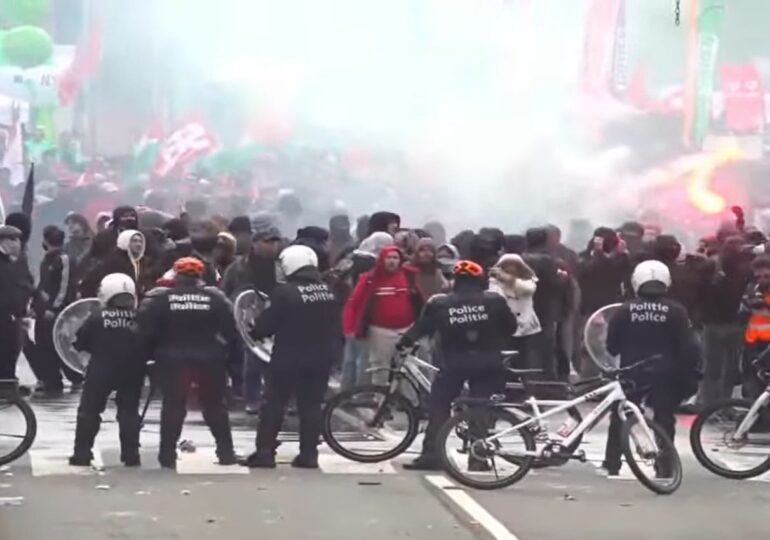
A general strike paralyzed Belgium on Tuesday, with violent protests in the center of Brussels and chaos in air and public transport.
The union action started as a peaceful march by unions to defend public services, but quickly turned into clashes between protesters and law enforcement, who intervened with tear gas and batons to disperse the crowd.
### Flights canceled and public transport blocked
The country’s two major airports – Brussels-Zaventem and Charleroi – canceled almost all scheduled flights on Tuesday. Security staff responsible for checks at control points went on strike, paralyzing airport operations, reports [The Brussels Times](https://www.brusselstimes.com/belgium/1791647/national-strike).
In the capital, most metro, bus, and tram lines did not operate, announced the transport company STIB. Thousands of protesters gathered at Gare du Nord, the starting point of a union march that crossed the city center, causing massive traffic jams.
### Violence in the center of Brussels
In the morning, groups of protesters erected barricades and set small fires on the main boulevards in the capital. Police reported acts of vandalism, fires, and stone-throwing near government buildings.
Several people were slightly injured and received medical care on-site. Law enforcement detained multiple protesters, according to Belgian media reports.
### Public services blocked nationwide
The effects of the strike were felt in all sectors: schools and public administration offices remained closed, and garbage collection was suspended in several cities.
In prisons, staff went on strike, and the police and Red Cross were mobilized to ensure the safety and food distribution for detainees, according to the source cited.
### Unions: „Reforms punish ordinary people”
The protest was initiated by the main trade union confederations in Belgium, including FGTB, which gathers over 1.5 million members. They oppose the government’s plans led by Prime Minister Bart De Wever – leader of the nationalist N-VA party – to reform the pension system and labor market.
– [One of the leaders of the Dutch Parliament proposed to the French ambassador to divide Belgium](https://spotmedia.ro/stiri/eveniment/unul-dintre-liderii-parlamentului-din-olanda-i-a-propus-ambasadorului-frantei-sa-imparta-belgia)
„What truly mobilizes us are the pensions. The reform will reduce the incomes of future pensioners and bring uncertainty to the pension calculation method,” said Thierry Bodson, leader of FGTB, quoted by [Reuters](https://www.reuters.com/world/belgium-general-strike-grounds-airlines-disrupts-brussels-public-transport-2025-10-14/).
Coming to power in February, Bart De Wever leads a predominantly right-wing coalition, promising to reduce the budget deficit without increasing taxes. However, negotiations for next year’s budget are at a standstill. The Prime Minister had to postpone his scheduled speech in Parliament on Tuesday after his cabinet failed to reach an agreement on new tax measures.
### Tense economic context
Belgium faces a challenging budget situation: the deficit reached 4.5% of GDP at the end of 2024, and public debt exceeds 100% of GDP – well above the thresholds set by EU rules, as reported by [Euronews](https://www.euronews.com/2025/10/14/travel-disrupted-across-belgium-as-general-strike-against-proposed-public-spending-cuts-co). In this context, the government justifies the reforms as „necessary for economic stability,” but unions warn that they „punish the middle class and vulnerable workers.”
– [How France became a political invalid: Cracks in the system are starting to show](https://spotmedia.ro/stiri/politica/cum-a-devenit-franta-un-invalid-politic-fisurile-sistemului-incep-sa-se-vada)
In addition to traditional unions, the protest movement received support from civic and environmental organizations, including Greenpeace and Oxfam. In online messages, activists accused the De Wever government of „attacking social solidarity” and „reducing investments in essential public services.”
Tuesday’s general strike is the most extensive union movement since the new government took office and risks prolonging the political deadlock in Belgium.
For now, the executive shows no signs of yielding, insisting that reducing expenses is the „only way to maintain the country’s economic credibility” in the face of Brussels and international markets. Meanwhile, Belgium remains paralyzed, and social discontent takes on increasingly violent overtones.