
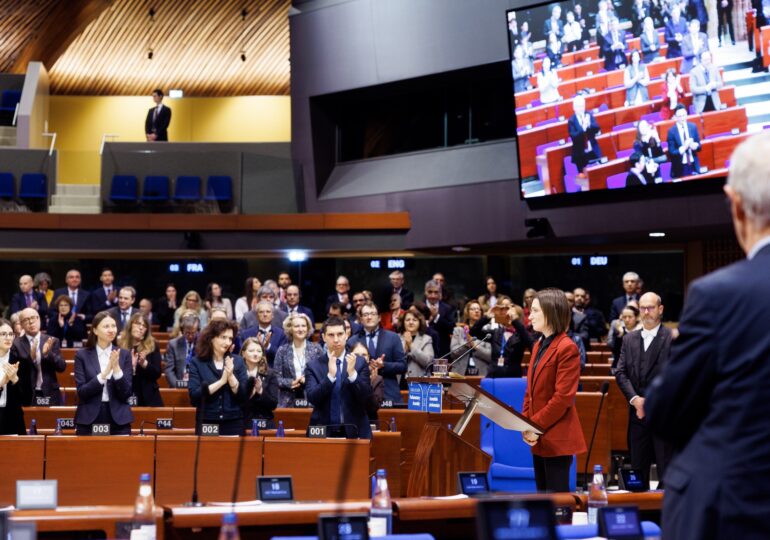
Maia Sandu asked the European Union to accelerate the process of Moldova’s accession to the structures of the community bloc, as – considering the extent of Moscow’s interference in the country’s internal affairs, especially in elections, there is a danger that the state could be occupied by Russia and lose its freedom.
„We hope that the EU will make a decision before it’s too late,” Sandu emphasized in a speech delivered on Tuesday at the Parliamentary Assembly of the Council of Europe (PACE) in Strasbourg, France.
"To feel safe, you need to be part of the EU," appreciated the President of Moldova.
When asked by a PACE member if she believes there should be an accelerated integration procedure, she replied, "Yes, we would like things to move faster regarding accession," as the situation of small countries is "dangerous," according to EFE.
Asked whether her idea of reunifying Moldova with Romania could be an alternative for a faster EU accession, Sandu did not want to respond directly and reiterated that her country remains fully committed to the accession process, emphasizing at the same time that her objective is "to be part of the free world."
Maia Sandu assured that her country is fully committed to this process, that it has already implemented reforms to adapt to the community acquis and intends to continue on this path, reiterating: "The situation in my country worries me" and "we do not want to be occupied by Russia."
According to her analysis before the PACE, which is not a EU body but of the Council of Europe, with a total of 46 member countries and whose mission is to defend democracy and human rights, Europe is facing two wars.
The first is the consequence of the military invasion in Ukraine, launched by Russia in February 2022, and the second is a war against our democracies, taking the form of a hybrid informational war aiming to divide peoples through "narratives and manipulation, thanks to the use of technology and dirty money."
"Moldova is on the front line in this second war," warned Maia Sandu, particularly pointing out Russia's interference operations during the parliamentary elections in September and indicating that Moscow allocated the equivalent of 2% of the republic's Gross Domestic Product (GDP) to these operations.