
Despite Trump’s claims, the visit of the CIA director was far from routine. It could be a sign that Putin is becoming increasingly nervous, unpredictable, and dangerous.
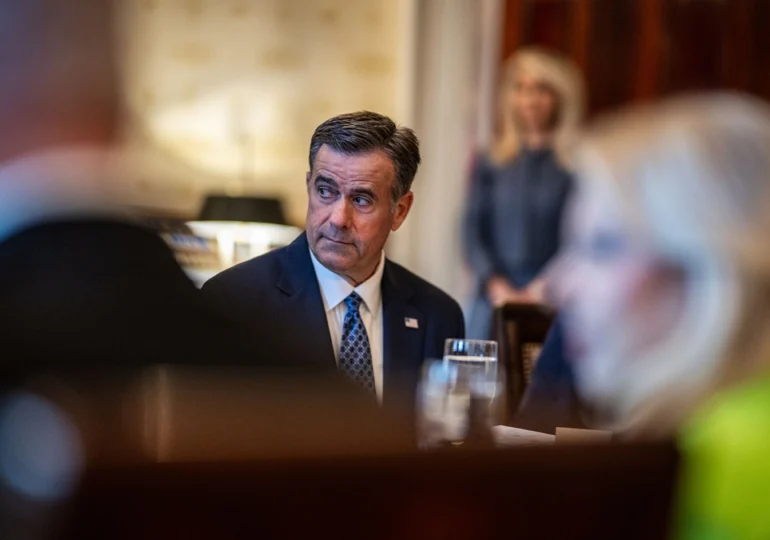
Tuesday’s lightning visit by CIA director John Ratcliffe to Moscow was unannounced but hard to miss: he traveled aboard a C-17A – a large cargo aircraft – which analysts using open sources quickly identified and tracked. Within a few hours, Ratcliffe was already on his way back.
The purpose of Ratcliffe's visit remains unknown. In an interview on Wednesday, President Trump said the visit was "somewhat routine," but such trips are rare.
The last time a CIA director visited Russia was in November 2021, when William J. Burns informed Moscow that the United States was aware of Vladimir Putin's plans to invade Ukraine.
A more likely explanation for this recent visit is that Russia is becoming increasingly dangerous, and the Trump administration wanted to warn it about a potential escalation, writes The Atlantic.
The Kremlin Is Stuck, and Putin Might Do Something Foolish
Ratcliffe's visit comes at one of the most challenging periods of the war for the Kremlin.
Thanks to its drone systems, Ukraine has managed to strike military targets and oil infrastructure deep inside Russian territory, while also hindering Moscow's advance on the front and turning it into a lethal area where any moving target is hit within minutes.
Despite limited progress, Russia has continued to suffer massive losses. In May, the number of Russian casualties reached almost half a million, according to Anna Keast-Butler, the head of Britain's GCHQ intelligence agency.
Russia's weakness could make Putin more reckless. The Wall Street Journal reported a few weeks ago that U.S. intelligence services are concerned about the possibility of Russia launching a limited attack against a NATO member, including a potential small-scale ground incursion.
However, such an attack could undermine Russia's own interests, prompting Europe to accelerate its military consolidation and target Moscow's sovereign assets.
Still, Putin might see attacking a NATO country as an unprecedented opportunity to divide the Alliance by provoking a crisis in which the United States would fail to intervene.
If Washington were not to respond to such aggression, Russia could demonstrate that the famous Article 5 - the NATO treaty provision on mutual defense - is devoid of substance.
Putin has reasons to believe that the United States might stay out of a conflict if one were to be initiated in the near future. Trump has repeatedly expressed disdain for Europe and shown little interest in confronting Putin. Additionally, America's armament stocks are depleted following the war in Iran.
Perhaps in response to fears of increased Russian aggression, NATO conducted a large-scale aerial exercise led by the U.S. over Poland and the Baltic region last week, including flights near the Russian enclave of Kaliningrad.
Signs of Putin's Nervousness
Other possible signs of Putin's increasing nervousness have emerged, the publication notes.
In recent weeks, a series of low-scale attacks have targeted various areas in Europe. This month, drones loaded with explosives were found at Leipzig airport, and in Estonia, Italy, Bulgaria, and the Netherlands - all countries that have supported Ukraine - explosions or fires occurred at arms factories and other sensitive targets.
Authorities have attributed some of these attacks to Moscow, though not all, and Russian officials have denied any involvement. Nevertheless, the incidents fit into a familiar pattern of Russian provocations in Europe.
Russia Depends on Ukraine
Regardless of Putin's ambitions elsewhere in Europe, he seems determined to continue the war in Ukraine indefinitely.
Russia has intensified its ballistic missile attacks on Ukrainian infrastructure, taking advantage of Kiev's deficiencies in anti-air defense.
Information in the Wall Street Journal suggests that Putin may be preparing for a large-scale mobilization to rebuild Russian army forces for a new offensive.
The Russian leader may attempt to crush Ukraine this winter through a massive bombing campaign aimed at destroying the country's energy network. However, it is unlikely that Kiev would capitulate, as it knows Putin would impose punitive conditions.
If Ukraine manages to survive the winter and retains its ability to strike deep into Russian territory, then Putin may decide to end the war by mid-2027.
What Option Does Putin Have to End the War
Faced with the prospect of a U.S. president more favorable to Ukraine than Trump in 2029, Putin may choose to accept a favorable deal offered by the current administration. This could include most elements of Trump's 28-point plan, but without Ukraine withdrawing from the territory it currently controls.
Such a solution would allow Putin to build a relationship with the United States during the remainder of Trump's term - aiming for the lifting of sanctions, rejoining the G7, and indirectly undermining the NATO alliance through a partnership with Trump.
What Trump Needs to Do to Restrain Putin
Despite his bellicose rhetoric towards Europe, Trump has valid reasons to respond now to prevent a crisis that could spiral out of control.
His administration has the means to deter Putin if it chooses to do so. For example, Washington could warn Moscow that if hybrid attacks in Europe continue, the United States would support Ukraine's access to Starlink service on Russian territory, enhancing Kiev's long-range strike campaign efficiency.
On his way to Moscow, Ratcliffe made a stop in Latvia. Today, the Latvian prime minister described the visit as a "very good signal", suggesting that Ratcliffe's presence there aimed at enhancing European security.
If the CIA director delivered a warning, it should have been unequivocal: any attack on NATO territory would draw U.S. involvement.
Trump may not wish to make such a commitment, but it may be necessary to ensure that Putin never concludes he has the opportunity to trigger a war capable of unraveling NATO.
T.D.