

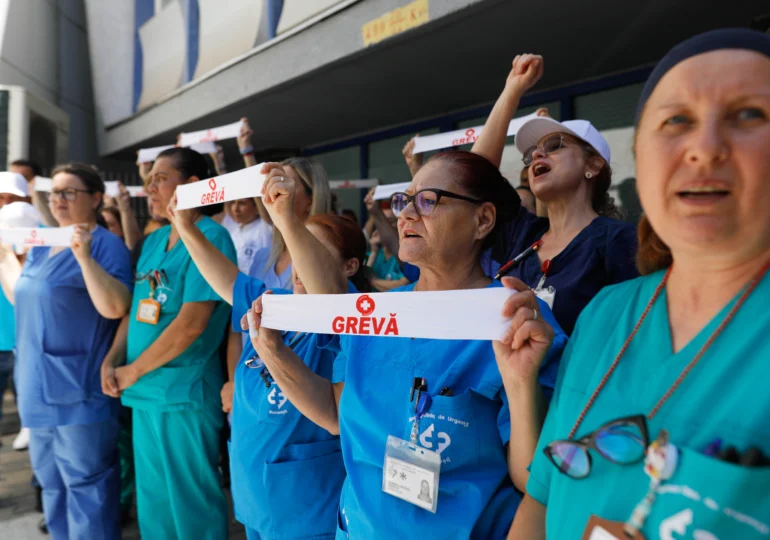
PSD is not just a political cancer, but also a union one. Have you heard of any confederation leader being replaced, have you heard of free elections within these completely opaque structures? No. I believe that when public sector employees decide to protest again, they should start by holding their own leaders accountable.
Unions in Romania are organizations deeply rooted in communism, defending the privileges of groups that control public institutions and companies, not those of the employees.
If it were otherwise, these leaders would have told their members that, starting from autumn, there is a good chance that salaries may not be paid due to the disappearance of €770 million from the budget, the funds associated with the salary law in the PNRR.
The major unions in Romania have been, since 1990, a weapon of the PSD, used against attempts to reform the country. Every time there was a social-democratic or USL prime minister at Victoria Palace, there were no protests, no strikes. Peace and quiet. Every time there was a prime minister with liberal, reformist views, although this happened very rarely, the unions erupted in protest.
The connection between the PSD and the union movement blocked the Unified Salary Law. The question is, what will happen from September onwards when forced layoffs begin due to the lack of budgetary funds?
Simply put, over a million public sector jobs are gambled for political reasons so that Sorin Grindeanu can become prime minister.
The Blindness of the Unions
"Slowly, but surely, we are heading towards disaster. The PNRR will end without Romania benefiting from the latest tranches. The dementia of politicians has reached its peak: after the PSD buried public finances through its irresponsible policy beyond 2024 and vehemently opposed any reform while in government, it now acts to ensure that S&P (note: international rating agency) will downgrade us to the category of countries not recommended for investments," wrote Eugen Rădulescu, a BNR advisor, in a Facebook post.
"First, they shattered the ANI law, and now they are firmly against the law regarding salaries in the public sector, where they fight alongside the unions - who will be accomplices in burying the economy and any chance of improvement for more than a decade to come...," Eugen Rădulescu added.
It is clear to anyone who cares to see that Sorin Grindeanu and the PSD have only one goal, which is to control public resources for their own benefit.
There is no concern for the welfare of citizens in general, nor for public sector employees in particular, as the social-democratic leader has been boasting about lately.
But if the political objective of the PSD is quite transparent and toxic, it is incomprehensible why union leaders turn a blind eye and sacrifice the interests of those they represent for the sake of a party that currently has less than 15% public support.
What will they tell healthcare workers and teachers from September onwards, when salaries will not increase, bonuses and allowances will not be granted, and the prices of goods and services will continue to rise?
"We tried, but we failed" is the only possible answer, likely followed by a new series of protests and strikes that will only bring more hardships.
Has Sorin Grindeanu ever been sincere with the dissatisfied by admitting that the PSD made a mistake when mishandling public funds? No. PNL did it and, at least, in the 11th hour, attempted to reform. They have not succeeded yet, but they are making efforts.
What Will the PSD Do?
Romania's problem, especially with unions, is that any downgrade of the country's rating, warning investors that it is risky to do business here, will trigger a financial tsunami that will devastate everything - jobs, companies, governments, presidents, everything.
The economic balance is so fragile that Romania's guarantee to local and foreign investors is the European Union, not the internal economic activity, productivity, or the quality of goods and services produced in the country, but the fact that they operate, being funded with European money.
The major problem is not that, if the Unified Salary Law does not pass, some "paltry millions of euros" will be lost, as the PSD propaganda considers them, but their loss signals that the economy is not reforming and becomes uncertain, therefore not recommended for investment.
Therefore, Romania must not miss any major milestone in the PNRR, because missing it will come with a country rating downgrade and a shift to the junk category.
In two months, when there will be no more funds, when Ilie Bolojan will no longer be prime minister, when there will be no budget due to the impossibility of financing public activities at the exorbitant interest rates, when layoffs, protests, and strikes begin, what will the PSD do? Will they blame Bolojan and Fritz, the heavy legacy, by throwing the blame at the Cotroceni Palace doorstep.