
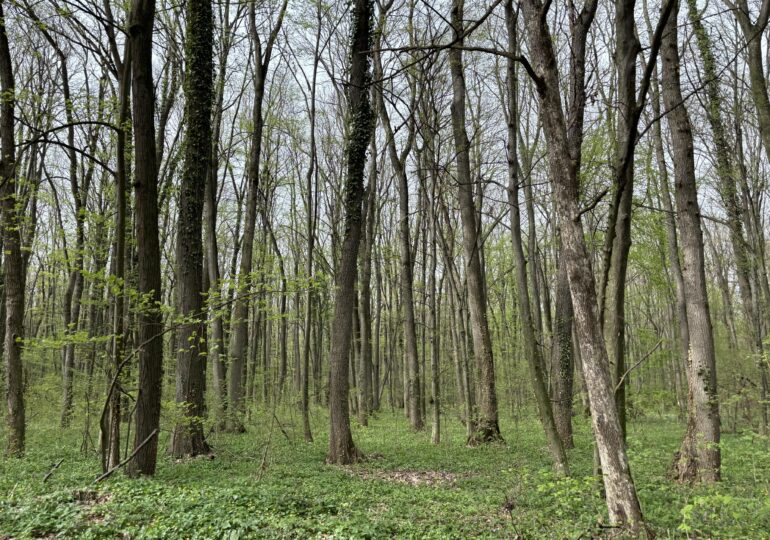
Romania’s forests have significantly increased in recent years, both in terms of area and timber volume, according to the latest data from the National Forest Inventory.
The area of forests, forest vegetation, and tree-covered lands is larger by approximately 500,000 hectares, a leap close to the agricultural land lost between 2010 and 2020.
At the same time, Romania's forests annually produce 59 million cubic meters of wood mass, a growth rate almost double the European average, indicating that the forests are generally in good health, as shown by data cited by the Foresters Community - Fordaq, in a statement transmitted by Agerpres.
Out of this annual growth, 17 million cubic meters represent wood resulting from the natural drying of trees, while 15 million cubic meters is the actual net accumulation from forests. The average volume of wood per hectare has reached 348 cubic meters, surpassing the European average of 160 cubic meters and approaching the level of Switzerland, one of the countries with the richest forests.
Every year, an average of 28 million cubic meters of wood is harvested, but only 18–19 million effectively reach the market, with the rest being stumps, branches, and other residues that do not enter into commerce.
Experts emphasize that Romania cuts much less than it grows: only 44% of the annual forest growth is exploited, compared to 63–66% in other European countries.
An important aspect is the large volume of dead wood in forests, resulting from both biodiversity protection policies and the natural drying of trees.
Over half of the forests are managed according to international standards that require the preservation of dead wood to maintain ecosystems. However, experts warn that the drying phenomenon of forests has intensified in 2024–2025, and there is a risk that these volumes may exceed the exploitation capacity, affecting the long-term health of the forests.
In short, Romania's forests are more extensive and richer than ever, but climate change and the significant accumulation of dry wood require a more dynamic and adapted management to new realities.