

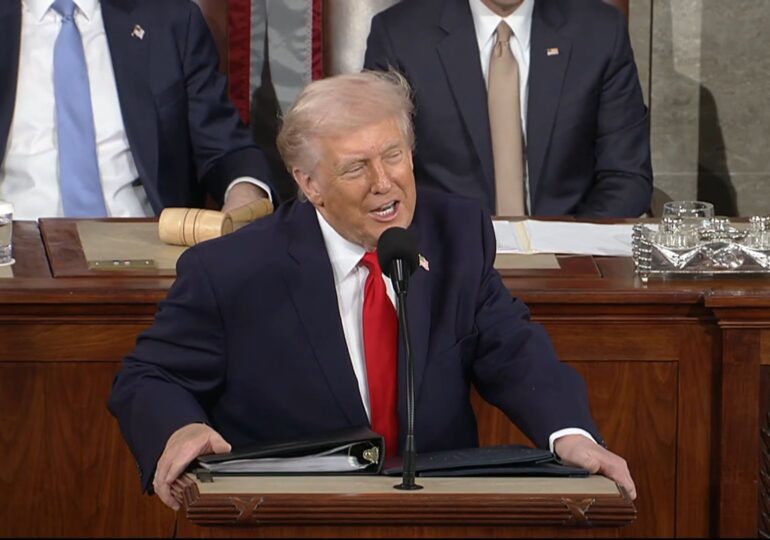
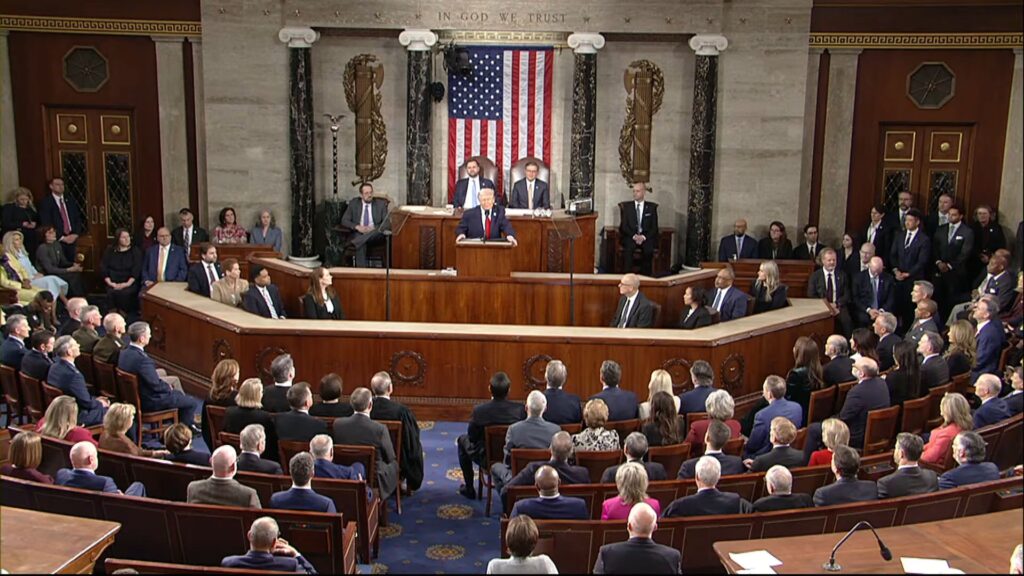
The State of the Nation address delivered by Donald Trump on Tuesday in front of Congress was more than just an annual report: it was a political statement in the midst of an electoral confrontation. In 108 minutes, the president alternated attacks on the Opposition, harsh messages on immigration, and defense of trade tariffs with carefully orchestrated ceremonial moments.
International publications such as Washington Post, Axios, and Reuters have meticulously analyzed the speech and indicate that it was built on contrast, polarization, and strong symbols, in a Congress where jeers and walkouts were part of the show.
So, here are the conclusions drawn from Donald Trump's 108-minute speech:
1. A campaign speech, not a reconciliation
Both Reuters and Washington Post note that the tone was combative, aimed at clear differentiation from Democrats rather than seeking consensus.
In a Congress already divided, with absent members and interruptions from the floor, Trump emphasized political and ideological cleavage, reinforcing key messages of the Republican agenda.
2. Immigration, the central axis of the message
Immigration was one of the dominant themes of the speech. Trump reiterated the idea that "the first duty of the American government is to protect American citizens, not illegal immigrants."
Washington Post highlights that this passage was constructed as a political test in the room and a direct message to the Republican electorate. Immigration thus emerges as the main pivot of his campaign.
3. Opposition presented as part of the problem
The moment when Trump asked those in the room to stand up if they agreed with the statement about protecting American citizens turned the speech into a public delineation exercise.
Many Democrats remained seated, and the president told them they should be "ashamed." Reuters notes that the episode illustrated the deep tension between the two sides.
4. Executive power defended head-on
Trump criticized the Supreme Court for overturning some tariffs imposed by his administration, calling the decision "very unfortunate." "The president must have the authority to protect America's economic interests," Trump said.
According to Axios, the restrained reaction from the room – including from some Republicans – reflected discomfort regarding the idea of the president receiving more authority in the realm of trade tariffs, traditionally within Congress's sphere.
5. Economy linked to protectionism
Reuters highlights that the speech reinforced the White House's protectionist line, focusing on tariffs and defending American economic interests. "We will continue to defend American workers through strong tariffs. We will not back down," Trump said.
In this context, the dispute with the Supreme Court becomes not only legal but also political.
6. A speech built on symbols and emotion
Alongside the harsh political messages, Trump sprinkled the intervention with numerous ceremonial moments – decorations, special guests, veterans, and rescuers presented in the gallery – designed to anchor the speech in a narrative of heroism, sacrifice, and patriotism. Each episode served as an emotional pause in a tense speech, as well as a reaffirmation that the U.S. is "winning" and honoring its heroes.
Axios notes that these moments were not accidental but strategically integrated to reinforce the political message through emotion and imagery. In a long and often combative speech, the appeal to symbols – medals, centenarian veterans, Olympic teams – provided a positive counterpoint and created strong TV sequences, turning the intervention into a carefully orchestrated political product.
7. Polarization
Analyses from Washington Post and Reuters converge on a clear conclusion: the speech was not designed as a call for reconciliation but as a reaffirmation of political frontlines. Trump did not seek a language of compromise or bridges to the Opposition but relied on strengthening his own electoral base, even at the risk of deepening divisions.
In a room where applause and protests followed almost every major theme, the conveyed image was that of a deeply divided America, where each issue – from immigration to tariffs – triggered opposing and irreconcilable reactions.
Enthusiastic applause from Republicans alternated with ostentatious silences and protests from Democrats, turning the speech into a visible demonstration of institutionalized polarization.
Key and Unprecedented Moments of the Evening
Axios highlights that the evening was also marked by a series of episodes with strong visual and symbolic impact.
"You should be ashamed" - After Democrats refused to stand up at the immigration statement, Trump told them they should be "ashamed." Several Democratic lawmakers shouted from the room, and Rashida Tlaib and Ilhan Omar later left the chamber.

Medals and heroes on the Congress stage - The President awarded the Presidential Medal of Freedom to the U.S. men's hockey team goalkeeper, Connor Hellebuyck. The Legion of Merit, Purple Heart, and two Congressional Medals of Honor – the highest American military distinction – were also awarded. Among the honorees was a 100-year-old veteran, Royce Williams.
Ovations for the men's hockey team - The men's hockey team, gold medalists in 2026 – the first victory of this kind since 1980 – received one of the longest ovations of the evening. The women's team declined the invitation, citing scheduling conflicts, after Trump had suggested earlier that if he hadn't invited them, he would probably have been "impeached."
Al Green and the racism message - As the President entered the room, Democratic Representative Al Green displayed a sign with the message "People of color are not monkeys!" referencing a racist video previously distributed on Trump's Truth Social platform regarding the Obama family. The incident escalated into a verbal altercation, and Green was escorted out.