
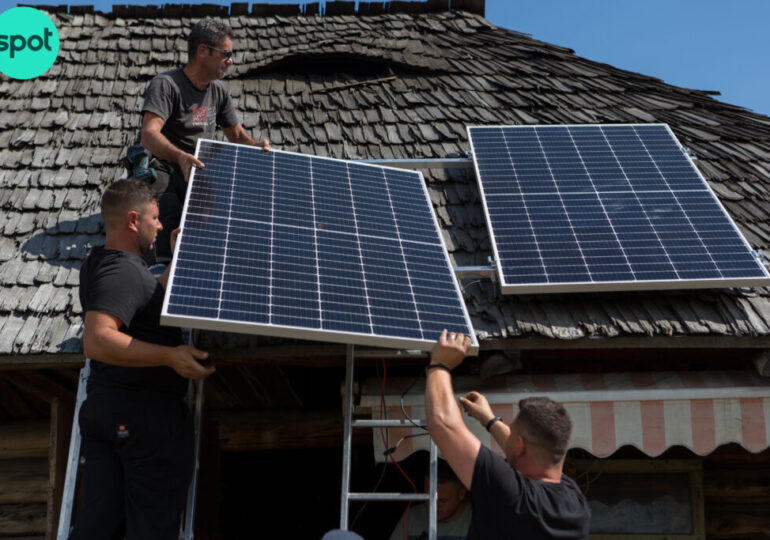
The rapid expansion of the prosumer segment generates additional costs of up to 372 lei for each MWh introduced into the grid, and these amounts are ultimately borne by consumers, according to the president of the Association of Energy Suppliers in Romania (AFEER), Laurențiu Urluescu.
The statement was made at the launch of the „Study on the evolution, regulatory framework, and impact of prosumers on the energy system in Romania,” conducted by ASC Xlaed Business Hub SRL.
From 303 prosumers to nearly 300,000 in six years
Romania has recorded one of the fastest increases in the number of prosumers in Europe.
"Romania has recorded one of the fastest increases in the number of prosumers at the European level. From 303 prosumers in 2019, the number reached nearly 300,000 at the beginning of 2026. The installed capacity has increased from less than 5 MW to approximately 3,400 MW by the end of 2025, and the annual generated production has reached about 4.5 TWh, representing approximately 9% of Romania's total electricity production," the study's authors state.
With average annual growth rates of over 200% in the period 2022–2024, Romania has surpassed the pace of mature markets such as Germany, Spain, or Italy.
Additional cost of 200–372 lei/MWh
The AFEER president states that the development of prosumers must be supported to cover their own consumption, but warns of the financial effects on the market.
"Certainly, the increase in electricity prices was the main economic factor behind the emergence and spectacular evolution of prosumers. However, according to the study, if we were to relate the additional costs of suppliers to the quantity of electricity introduced into the grid by prosumers, the additional cost of each MWh produced by them would range between 200 and 372 lei/MWh, a cost that is ultimately borne by consumers," stated Laurențiu Urluescu.
Estimates indicate an annual impact in the order of tens of millions of euros for 2024, with a tendency to increase proportionally with the number of connected prosumers.
"This trend cannot continue indefinitely"
The AFEER chief says that the phenomenon also has significant benefits for the system.
"Prosumers contribute to the modernization of the energy system by: increasing the share of renewable energy; the potential to participate in balancing services through aggregation and storage; accelerating digitalization and adopting new technologies. However, this impressive evolution has significantly disrupted activities in the sector, especially because it overlapped with the effects of the energy crisis and price capping," he explained.
In his opinion, "this trend cannot continue indefinitely, as the market impact will be increasingly significant."
Urluescu emphasizes that any changes should only apply to future investments: "We always consider that changing the rules during the game is unethical and unproductive, and that is why we advocate that any necessary regulatory changes should apply to future investments only."
Cross-subsidy and pressure on networks
The study also highlights the existence of a "cross-subsidy," where the benefits granted to prosumers are supported by other customers in the system.
"One of the most controversial effects, highlighted in the study, is the cross-subsidy, where the benefits granted to prosumers are supported by other customers in the system. Given that the exemption from paying imbalances applies to installations of up to 400 kW—the highest threshold in Europe—Romania is at the upper limit of exemptions allowed by European legislation. In this regard, ACER's position is clear: prosumers should adequately contribute to the general costs of the system (network, system, imbalances), and exemptions should be limited to truly small installations," the researchers state.
Distribution networks, originally designed for a unidirectional flow of energy, are now facing bidirectional flows and unprecedented technical challenges.
Call for unified regulation, in line with RED III
In this context, AFEER calls for unified regulation aligned with the European Directive on Renewable Energy (RED III).
"The rapid integration of an increasing number of prosumers fundamentally changes the operation of the national energy system. For this transformation to remain sustainable in the long term, unified regulation is necessary, correlating decarbonization objectives with the stability of the energy system and electricity market," says Laurențiu Urluescu.
The study's authors conclude that the pace and extent of growth require an adaptation of the regulatory framework to be "coherent, fair, and sustainable for all participants in the energy system."