
Artemis II mission has passed over the far side of the Moon and is now on its way back to Earth. After an interruption in communications of about 40 minutes, the four astronauts aboard the Orion capsule observed the satellite from an altitude of approximately 6,500 kilometers, moving at a speed of over 5,000 km/h.
Trump, surprising message live
The crew of the Artemis II mission also had an unexpected surprise. US President Donald Trump intervened last night live and spoke with the astronauts around the Moon.
"Today you have made history and made the whole of America very proud, incredibly proud," he told the four astronauts in a conversation broadcast publicly and quoted by BBC.
Trump emphasized the exceptional nature of the mission, recalling that it is the first time in over 50 years that people are flying around the Moon. "Nothing compares to what you are doing. People have never seen anything like what you are doing. It is truly special," he said.
Crew's response: "images that not even Apollo saw"
Commander Reid Wiseman was the first to respond, saying that the president's call was "certainly very special for all of us."
"We have seen landscapes that no one has ever seen, not even those from the Apollo mission," he said. Wiseman also spoke about observations made of a solar eclipse, highlighting the spectacular nature of the moment.
He added that the crew is excited about the idea of humanity becoming "a species with two planets," referring to the goals of future missions to Mars.
At the end of the conversation, Trump announced that he will meet with the crew at the White House after the mission is completed.
"I have been quite busy myself, as you know, but I will certainly make time," he said, adding that he wants to convey "a warm greeting on behalf of the American people and beyond."
Pilot Victor Glover thanked the crew on behalf of the team: "Thank you for that, Mr. President."
Record distance traveled by humans in space
The moment comes after the Artemis II crew broke the absolute record for the greatest distance from Earth ever reached by humans, surpassing the achievement set in 1970 by the Apollo 13 mission.
While flying behind the Moon, the Orion spacecraft reached the maximum distance from Earth, which is "estimated to be" approximately 252,756 miles, according to NASA's live broadcast.
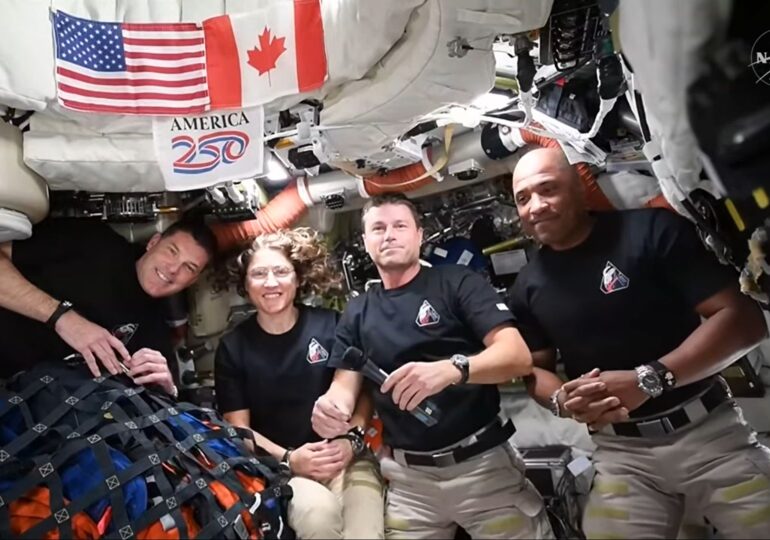
The four astronauts - Christina Koch, Victor Glover, Reid Wiseman, and Canadian Jeremy Hansen - have thus reached hundreds of thousands of kilometers from Earth, in a mission that marks the return of human flights around the Moon after more than half a century.
The Orion capsule crossed the far side of the Moon, providing the crew with unprecedented images of the lunar surface and deep space.
They flew over unknown regions of the Moon and its hidden face for several hours, as reported by AFP.
The previous record of 400,171 kilometers, set by the Apollo 13 mission, has just been broken, NASA announced, and the astronauts currently in the Orion capsule - Americans Christina Koch, Victor Glover, Reid Wiseman, and Canadian Jeremy Hansen - are now expected to reach a distance of over 406,000 kilometers from Earth as they orbit around the Moon.
"The control room is full of lunar joy today, I imagine you are feeling the same," Jenni Gibsons, responsible for communication with the crew, transmitted from the NASA control room in Houston.
Christina Koch, a veteran space explorer who made history by becoming the first woman to fly over the Moon, revealed that the astronauts of the Artemis II mission are now "glued to the windows" to admire Earth's natural satellite.
They will not land, but their flight is still a first, as in none of the Apollo lunar missions (1968-1972) were there women astronauts, astronauts of color, or non-American astronauts on board.
"It's a historic day," Jim Lovell, a pioneer of the Apollo 8 and Apollo 13 missions, conveyed in a posthumous message recorded a few months before his death in 2025.
"Welcome to my old neighborhood," he said, expressing his pride "in passing the baton" and even offering advice: "I know you will be very busy, but don't forget to enjoy the view."
Mission commander, American Reid Wiseman, presented during a live broadcast the emblem of the Apollo 8 mission, which the Artemis 2 mission crew took aboard the Orion capsule.
In the entire history of space exploration, no Russian or Chinese astronaut has ventured beyond 400 kilometers away from Earth, the distance to Earth-orbiting stations. Only probes have returned to observe the Moon.
The lunar observation period will last nearly seven hours and will begin at 18:45 GMT (21:45 Romania time - ed.). The Moon will be fully visible through the Orion capsule's windows.
The Moon will appear to the astronauts as large as "a basketball held at arm's length," said Noah Petro, director of NASA's Planetary Geology Laboratory.
"Goosebumps"
The four crew members have been preparing for over two years, practicing the recognition of geological formations and describing them accurately to scientists on Earth, especially the shades of brown and beige on the lunar surface. The descriptions, along with their notes and photos - three cameras are on board - should allow researchers to learn more about the geology and history of our natural satellite.
But it should also captivate the general public, NASA hopes, which is broadcasting the event live on multiple online platforms, such as Netflix and YouTube, except for a 40-minute period during which communications will be interrupted, blocked by the Moon.
Hearing this crew describe the lunar surface will give you goosebumps," promised Kelsey Young, the mission's scientific director.
Earthrise and Earthset
The astronauts will fly behind the Moon and discover its hidden face, the one that is never visible from Earth.
They will likely see "regions of this hidden face that none of the Apollo astronauts could observe," explained Jacob Bleacher, director of NASA's Scientific Exploration Department.
The crew has already seen the Mare Orientale basin, a gigantic crater nicknamed the 'Grand Canyon of the Moon,' which until now had only been fully seen by space probes.
Their lunar flyby will also allow them to witness a solar eclipse - the Sun disappearing behind the Moon - and an Earthrise and Earthset behind the Moon.
This recalls the famous photograph 'Earthrise' that revolutionized our view of the world in 1968, during the Apollo 8 mission.
"In the midst of this void" that is the Universe, our planet is "an oasis, this magnificent place where we can live together," said mission pilot Victor Glover last weekend in an Easter message.
If this mission and the one next year go well, NASA intends to send astronauts to the Moon in 2028.