

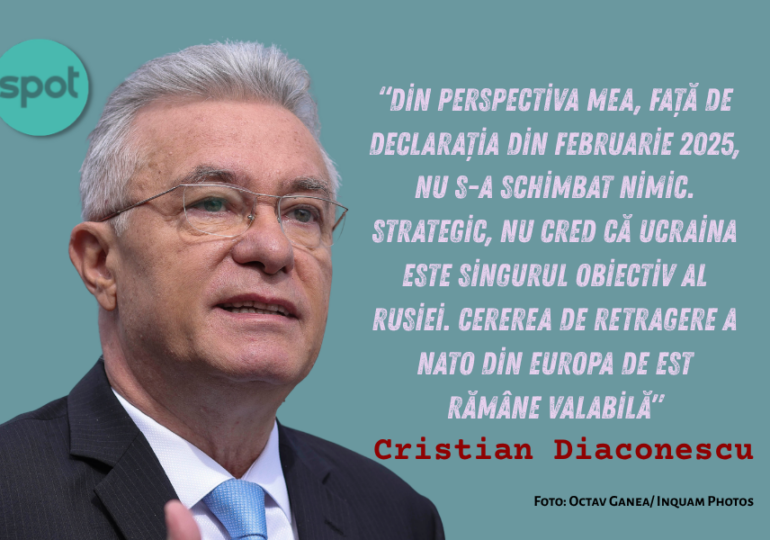
Cristian Diaconescu came into the public spotlight in February 2025 when, from the position of advisor to President Ilie Bolojan, he stated that Romania is going through a dramatic moment. He then described Russia’s objectives conveyed to the new US administration after Donald Trump’s return to the White House as a Kremlin attempt to redivide Europe, meaning the withdrawal of NATO from the eastern part of the continent. His statement sparked heated debates in Romania and internationally.
Relevant Quotes:
- I don’t believe Romania would have been safer if it had refused cooperation with the US. We face difficult decisions due to current conflicts. The world order has changed, and NATO emphasizes deterrence and defense. In the past, even in the face of European opposition, Romania has identified solutions for its own objectives.
- Tensions in the Middle East have increased due to Europeans’ refusal to join the North Atlantic Alliance, which has irritated Washington. I believe that economic pressure, which often leads to war, will still bring a certain stability, even if we cannot speak of peace. What worries me is that this Iranian crisis, not only in the Strait of Hormuz, will have long-term consequences, perhaps even a generation, on the relationships between Gulf states.
- Russia’s decision, for example, to strike Ukrainian ports a few kilometers from the flank of the North Atlantic Alliance is highly likely to cause concern, drone by drone. Of course, Russia plays what is called plausible deniability: it’s an accident. If you want to assume it as a threat to the North Atlantic Alliance, then you escalate. We, in fact, did not want to escalate.
- I would like to emphasize the importance of our regional interests. Authorities in Bucharest should encourage regional dialogue on Ukraine and the Middle East, where we have a strong diplomatic presence. We are recognized in the region, perhaps even the best in Eastern Europe in this field. Therefore, it is essential to focus on regional projects that we can later present in Washington, Paris, or Berlin as leaders, not just as participants.

What is your opinion on the Parliament’s decision at the proposal of President Nicușor Dan for Romania to support the US in the military conflict in Iran?
I consider this decision to be natural. The partnership with the United States has always been essential for Romania’s defense. The US has requested defensive support for military bases where they have troops, and this decision was predictable.
The parliamentary debate did not bring new arguments, but it drew international attention. It is important to be aware that our partners closely monitor these decisions, especially in the current security uncertainty context.
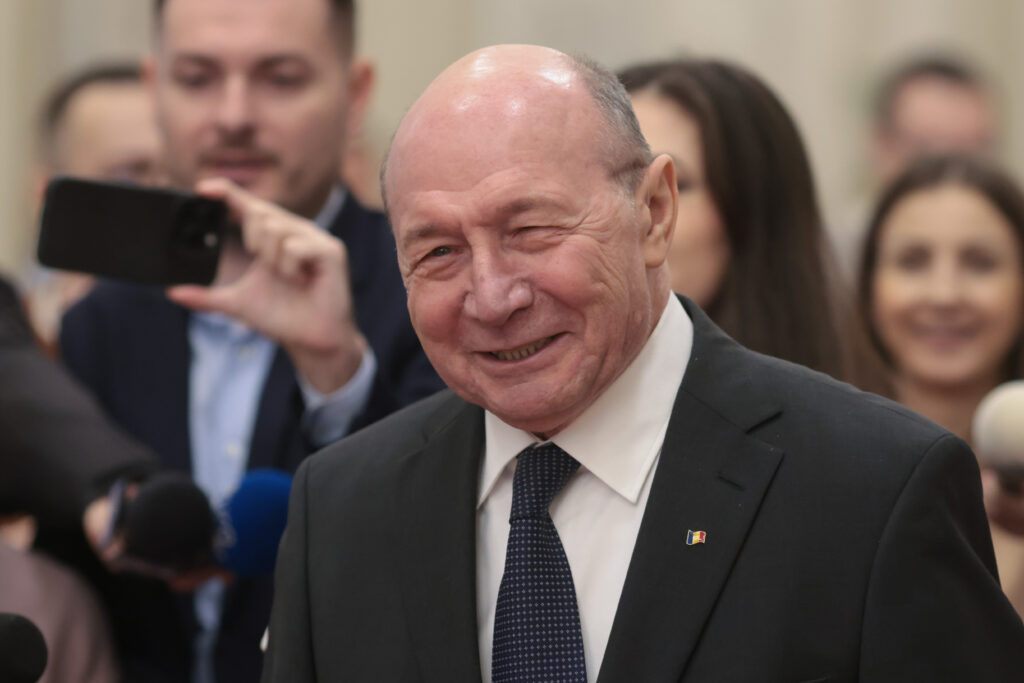
I want to ask you what is different now in this support that Romania provides to the United States compared to previous ones in Iraq and Afghanistan. I ask this question because a statement by Traian Băsescu, a former president you worked for a period, who stated that supporting the US in the conflict with Iran could expose Romania to certain vulnerabilities regarding national security.
I don't believe Romania would have been safer if it had refused cooperation with the US. We face difficult decisions due to current conflicts. The world order has changed, and NATO emphasizes deterrence and defense. In the past, even in the face of European opposition, Romania has identified solutions for its own objectives. Refusing the US request would not have improved our defense. We see, for example, how Iran uses asymmetric strategies against its neighbors.
How long will the war in Iran continue?
The stakes are significant. As long as the fighting continues, making a prediction is difficult. Experience shows that both direct confrontations and unofficial negotiations take place. When losses become very high, pressures for compromise arise. However, as long as armed conflicts persist, it is hard to anticipate when they will stop. Hope lies in unofficial discussions, which can tip the balance towards compromise.
I read about an attempt to resolve the crisis in the Strait of Hormuz, through which nearly a quarter of the world's oil passes, by military means. The United States has called for expeditionary forces from near Japan. Is there any chance of a diplomatic resolution to the crisis, or must it be resolved militarily?
I hope everyone will understand that losses occur on both sides, and the situation in the Strait of Hormuz would need a diplomatic or political solution, perhaps with some military guarantees. The situation is very complicated.
Approximately 20% of the world's oil exports, gas, fertilizers, urea, and ammonia pass through the Strait of Hormuz. Half of the globally exported urea passes through here, used as fertilizer. India depends on 60% of the gas and oil passing through this strait, while China depends on 40%. China is the main importer of hydrocarbons from Iran.
Currently, over 400 oil tankers are waiting in the area. The strait is open, but no insurance company can guarantee the security of ships due to the enormous costs.
From what I have learned, at least three tankers have been attacked with drones or missiles. On one side is Iran, and on the other side are Qatar and Oman. Iran is unpredictable. It has threatened to mine the area, but this would take months and would also affect its own exports. Despite being predominantly Shiite and attempting to mediate between the US and Iran, Qatar has been attacked by Iran. The situation is very serious and complicated.
There are two alternative corridors to the Red Sea, from the Emirates and Saudi Arabia, but these cover only 30% of the total volume. The distance is significant, and Iran continues military actions against Saudi Arabia. Currently, there is no clear perspective. Tensions have increased due to Europeans' refusal to join the North Atlantic Alliance, which has irritated Washington.
I believe that economic pressure, which often leads to war, will still bring a certain stability, even if we cannot speak of peace. What worries me is that this Iranian crisis, not only in the Strait of Hormuz, will have long-term consequences, perhaps even a generation, on the relationships between Gulf states.
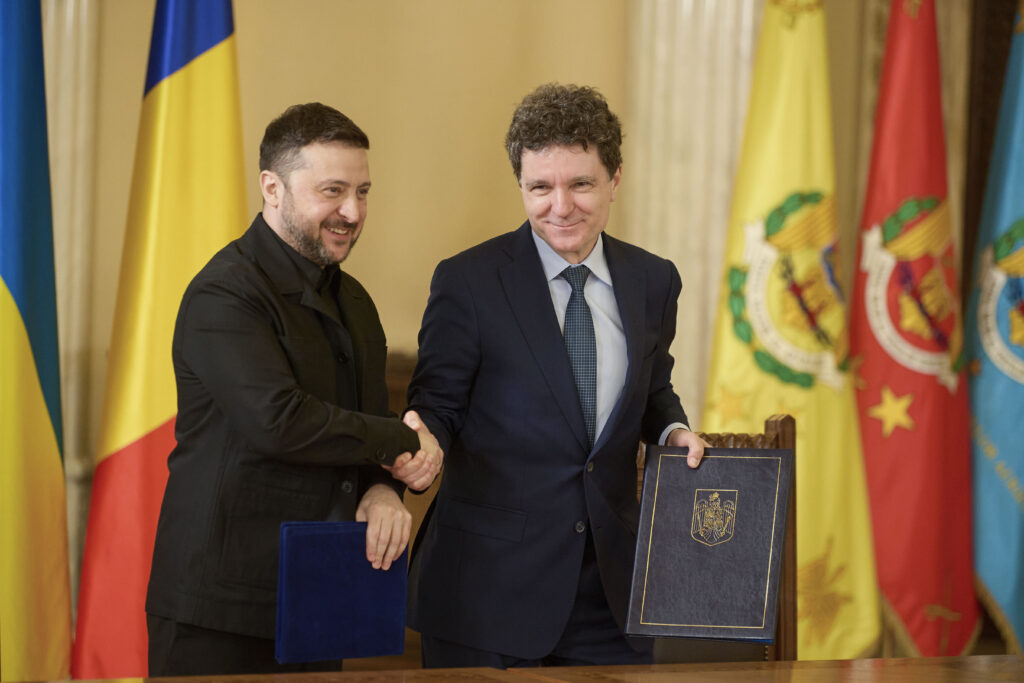
Let's move on to the other war now, as unfortunately, we are caught between wars. Last week, there was a visit by Volodymyr Zelensky, the President of Ukraine, to Bucharest, for a meeting with President Nicușor Dan. I would like you to tell me what significance this visit has. Does it change anything in the relations between Romania and Ukraine? Does it bring anything additional compared to the former administration in Bucharest? Does it help Ukraine more for tomorrow? How do you see it? How do you analyze this visit?
We will find out specific details about the decisions made only after some time. There have always been direct contacts between Romania and Ukraine, including through the support coalition. This visit brought an important addition. Romania has the longest border with an active conflict zone on the eastern flank, which requires careful bilateral coordination and clear strategies tailored to the exceptional situation.
Certain aspects need to be established at the highest level to allow for efficient implementation by the responsible institutions, whether it is in the energy, transportation, or military field. Ukraine seeks to obtain maximum support and maintain high expectations. After a difficult period, discussions are now focusing on reconstruction, which requires dialogue with neighbors. High-level visits address specific aspects, as the general direction has already been established. Romania, along with other states and the international community, supports Ukraine and seeks solutions to resist Russian aggression.
It is important to note that Romania observes border changes at its border, which can set a precedent with unforeseeable consequences.
Are you referring to the negotiations between Ukraine and Russia?
Yes. And I refer in this correlation to the fact that Moscow has not made a secret that even borders, such as the mouths of the Danube, ultimately represent an area of interest.
For Russia, yes.
So a certain type of attitude of Ukraine, apart from the public one, needs to be known to us in advance. Likewise, peace plans are underway. Certainly, at this moment, as a few months ago, Ukraine positions itself saying: let the war cease, after which we establish the agenda of the peace plan. And regarding territorial concessions, the situation is extremely difficult to accept. The Russian Federation says: no, let's have negotiations while carrying out military actions. And from here, at this moment, there are no premises for a ceasefire.
On the other hand, I can assure you, regarding the systematic assessments made every two to three days regarding the situation in Ukraine, that the developments in the region, the first to be heard, are the states on the eastern flank. Because they not only know historically, but also feel best the developments and the direction of the threats, which obviously entail some nuances.
The decision of the Russian Federation, for example, to hit the Ukrainian ports a few kilometers from the flank of the North Atlantic Alliance is extremely likely to generate concern - drone by drone. Certainly, the Russian Federation plays what is called plausible deniability: it's an accident.
If you want to assume it as a threat to the North Atlantic Alliance, then you escalate. We, in fact, did not want to escalate. From here, many other elements. All these response issues, sometimes, certainly Ukraine needs to discuss them, first and foremost, with those in the neighborhood.
A journalist from Ukraine wrote that Romania is the most stable neighbor of his country since the war began. What do you think about that? Ukraine borders Belarus, Poland, Hungary, Slovakia, Romania, Moldova, and Russia, of course.
I would like to emphasize the importance of our regional interests. The authorities in Bucharest should encourage regional dialogue regarding Ukraine and the Middle East, where we have a strong diplomatic presence. We are recognized in the region, perhaps even the best in Eastern Europe in this field. Therefore, it is essential to focus on regional projects that we can later present in Washington, Paris, or Berlin as leaders, not just as participants.
Romania does not have enemies in the area, only unfriendly neighbors, which gives us a special status. Although it is difficult to achieve the same impact in Sofia, Ankara, Kiev, Budapest, Belgrade, or Chisinau, these relationships are important in our dialogue with our partners.
The leadership aims for validation through relevant bilateral contacts. It is important for society to understand that bringing new elements into the relationship with partners matters. If we only follow the initiatives of others without bringing something new, we will not achieve changes.
I think you are referring to those discussions around Davos and the Munich Security Conference that Romania did not attend.
It is important to understand that at both Davos and security conferences, the most valuable are the informal meetings, where bilateral agreements can be made for concrete projects. To capitalize on these opportunities, it is essential to have a clear list of topics and interlocutors. Regional cooperation remains very important. For example, the B9 summit in Bucharest, where the American administration was invited, is a positive step.
I participated in a Romanian-Polish meeting with all the Nordic states, where we learned from their projects. The Nordic countries, from Poland and Germany to the Baltic states, Sweden, Norway, Finland, and Denmark, collaborate daily and develop proposals and strategies together. Only in this way can real support be obtained.
Are you the only advisor who has worked under three presidents — one interim, it is true, Mr. Ilie Bolojan. And I remember your statement that stirred some debates in Romania regarding what it concerned Russia immediately after the administration change in Washington. And you seemed quite concerned then. It has been over a year and a few months since then. What do you think is the situation of Russia at this moment? What does it target? What are the main objectives it has not only in Ukraine but also in Europe?
From my perspective, nothing has changed. Strategically, I do not believe Ukraine is Russia's sole target. The demand for NATO withdrawal from Eastern Europe remains valid. Even if it is not publicly discussed anymore, signals indicate that this desire persists. Although we are sometimes surprised by developments or new rhetoric, my experience as a NATO negotiator shows that Russia has consistently pursued this.
Are you referring to the negotiations from the period 2004-2006?
Yes, I negotiated directly with them. I want to say that, even if they failed to include their idea of good neighborliness in the treaty, Russia has never given up on the desire to have a security architecture in which it is more influential globally. In negotiations, they always came up with the idea: accept or we stop here. They have not changed this approach at all in the last 20 years.
Now, their military commitment has clear strategic consequences. In the past year, the security architecture seems to have disappeared, and to avoid negative reactions from Europeans or Americans, Russia has toned down its rhetoric. However, the demand to push NATO out of Eastern Europe remains, and their mandate has not changed, hoping for a compromise in stages.
But at this moment, is Russia weaker or stronger, more fortified than a year ago when Donald Trump came to the White House?
They had a complicated moment when they hoped that Ukraine, just like in 2014, would surrender in three days. It seems that this term becomes permanent in certain expectations. What did not happen. Obviously, we are aware of all military developments. What is important from their perspective, from the Russian Federation: on the one hand, not to return home from this crisis with the word defeat but only with the word victory.
How this concept is packaged is difficult to say. And, secondly, they hope to achieve a compromise report. In what sense? Well, in diplomatic negotiations, they escalate to de-escalate. They maximize demands to be able to give up, but always remain with a gain.
Exactly. It is their basic principle.
When de-escalating, there are extremely complicated nuances here. So from this point of view, it is visible that this de-escalation is being attempted in various ways. The idea is: we offer the peace that we violated. We offer peace in exchange for compromises. I don't think it only targets four regions in eastern Ukraine.
So it is more than that.
No, I don't think it can only be about that.
I understand. And this should worry us in Romania as well.
Yes, we should be concerned and be very attentive and firm in our relationship with our partners, so that deterrence and defense are present not only in the military but also in the diplomatic realm.
Romania has been without an SRI director for almost two years. There is a whole discussion about the appointments of new intelligence agency leaders. Sources indicate that these are politically negotiated. There is a certain type of public discontent because promises were made at the presidential level. What do you think? Does this vulnerability Romania? Should it be addressed?
I believe that this issue needs to be resolved immediately, especially in the context of responding to information threats. It is a security matter that requires a quick and technical approach.
Especially a certain type of insistence regarding the political balance. I don't understand the political benefit of a party saying "we've placed our boss in services" - and I'm not naive, I know I'm not naive. It has become a kind of common rhetoric: wait a bit, so that the balance puts X in place, so we can also have our person. What do you mean by having a person there? It requires an effort.
I repeat, it is related to the real-time response to threats. Unfortunately, they are not few, and many of them are extremely sophisticated compared to the past. First of all: the signal of deterrence and defense of the country. Because these areas are worked on daily, 24/7. Secondly: the signal to partners. Because over the years, very significant cooperation platforms have been established, in terms of their importance and resonance.
As long as there is no representation at the highest level in these institutions, I tell you that there are difficulties in cooperation, including information exchange. I know that an executive cannot go to meet with a CIA director, but they must have the formal, legal, constitutional legitimacy so that the partner can interact. It's about long-term cooperations. Automatically, the engagement capacity of someone who does not formally lead such an institution is limited.
So, to all these elements - beyond hybrid warfare, asymmetric attacks of all kinds - the threat from the Middle East region has been added. We are talking about cells, crises, terrorist acts, various latent threats, with a threatening potential that only these institutions can know. They do not fully control them either, but, in any case, with a better outlined risk coefficient.
It is time to set aside political rhetoric and for there to be a kind of understanding, in such a way that institutional trust, but also that of society, regarding the fact that there is a solid response area there, to be much clearer than "they shook hands politically." I repeat, I don't understand, but I see that this issue is becoming almost a public normality.
Continuing this discussion, there are a few questions I've been wanting to ask you for a very long time. You were a security advisor, I believe, in the most difficult moment of Romania after 1990. You arrive at Cotroceni Palace in February 2025, after President Klaus Iohannis resigns. A resignation and a huge political and trust crisis, after the cancellation of the presidential elections. And I'm not just talking about Romanian society, about Romania in general, which was effectively shocked, but about Romania's relationship with its partners, with NATO, with America. I would like you to tell me how you felt in the eye of the storm — both from a human and a professional perspective.
It was an unprecedented moment, both for us and for our partners. The discussions were serious, as it was necessary to demonstrate respect for democratic rules. Clarifications are still needed, both for society and at a diplomatic level. Previous experience and existing relationships facilitated dialogue with partners, who were already familiar with the situation. It was essential for them to have concrete information about our response capacity, beyond the decision of the Constitutional Court. The goal was to prevent similar exceptional situations. I believe we reached a consensus.
Communication with society is needed, not just for information, but also to warn and learn from experience. Thus, society knows that there was a danger, that it was managed, and that the risk is now reduced. However, there is a risk of manipulation and the use of technical methods to distort the truth. Beyond criminal aspects, I believe it is essential to make citizens vigilant.
Also regarding that experience, because, from my perspective, it's very important: who did you call first? Who did you talk to after taking on the position of national security advisor?
Usually, if you have it, you use your phone book. But I made an effort — I am more traditional — on my own initiative, with bilateral contacts at the level of counterparts, from states that, equally, are strategic partners of Romania, and were also, from what I found, in very close security cooperation relations with Romania. And I refer to, obviously, Poland, Finland, the United Kingdom — especially, I need to give details of why, especially, a personal issue — and France. But, systematically, especially since extremely complicated moments were coming, the Republic of Moldova.
Can we say that Romania has been a victim of hybrid warfare?
We took over, in terms of responsibility, together with the two presidents, a situation that was already established. Based on the details we had, obviously, the attempt was a new electoral moment. From this point of view, the idea that what happened should not be repeated, clearly, was one that we all understood. No, I wouldn't necessarily use the word victim.
It was a situation, I repeat, unprecedented, to which a response was given. And our efforts were not necessarily aimed at the response itself, but at preventing a similar situation from happening again. Because it would not have been possible to intervene in such a categorical manner.
Probably a certain type of potential was not fully realized. It was believed that it entered a usual electoral logic, where the technical argument ultimately would not dramatically influence the electoral process.
Do you want to say that the danger was not fully realized?
It was a situation we were not accustomed to. The element of surprise came from social networks and the communication infrastructure created at that time. It's not an excuse, but it's a reality. When you face such a scale for the first time, the shock comes from the size of the problem, not from the fact that it is something new.
What is the current situation regarding this subject? In other words, are we harder to surprise? Are we better at resisting Russia's hybrid attacks? Do you think that during the time you worked at Cotroceni Palace, certain steps were taken to strengthen our approach to hybrid warfare?
At an institutional level, lessons have been learned. From what I observed, last year's elections were conducted correctly. I am convinced that there was no external factor to discourage hybrid attacks, but the electoral process was democratic.
I believe the situation has been overcome, but in order to have a prepared society, not only institutions need to be informed, but also the general public. It is important to have careful and well-prepared communication, as well as responses to any counterattacks that may arise.