

Romania has achieved what many developed countries have been trying to do for decades: to grow economically and, at the same time, drastically reduce pollution.
Greenhouse gas emissions have decreased by 75% compared to the communist period, and emission intensity has plummeted by 88% from 1990 to 2023, writes The Guardian.
The British publication highlights that Romania has decoupled economic growth from emissions faster than any other European country – and possibly even globally.
The key question raised by British journalists is whether this transformation can continue and at what social cost.
Europe's Largest Solar Farm – and Even Larger Ones in the Works
After the thawing of fields in the southern part of the country, the installation of one million photovoltaic panels, supported by batteries, for a 760 MW project will begin. However, the record will not last long: a 1 GW solar park has already been approved in the northwest of the country.
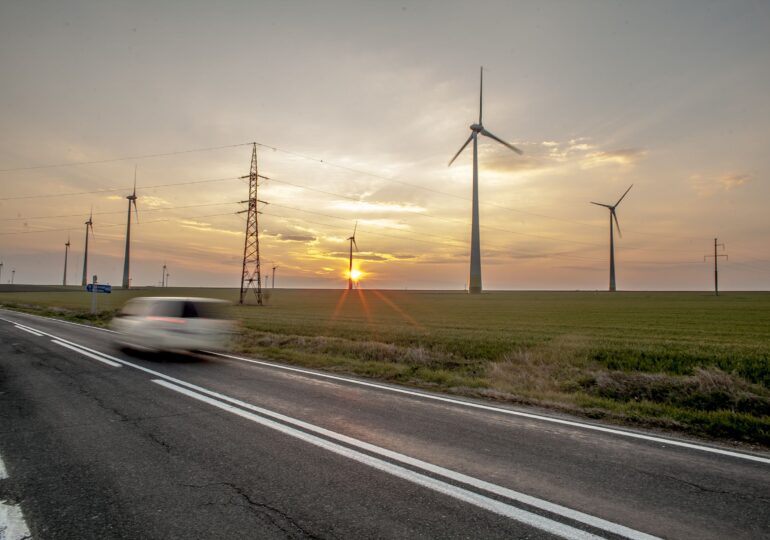
The new investments add to an energy landscape completely changed from the 1990s: wind farms on the Black Sea, extending the lifespan of the nuclear power plant in Cernavoda, and the proliferation of solar panels on homes and commercial buildings.
"The trend is irreversible. But we have to play it smart," said Liviu Gavrilă, vice president of the Romanian Wind Energy Association and manager at Enery, the company building the new solar park.
How the Decoupling Began: Collapse of the Communist Industry
Under Nicolae Ceaușescu's regime, Romania's economy was heavily industrialized and extremely polluting. Coal and oil-fired power plants fueled energy-intensive factories. After 1989, with privatizations and the closure of many industrial units, emissions dropped sharply.
"The first decline was 'history happening now, not an active decarbonization based on policies,'" explains Ioana-Maria Petrescu, former Minister of Finance. "But it continued, luckily, because Romania joined the European Union," says Petrescu.
Joining the European Union in 2007 imposed stricter environmental standards, introduced the carbon price, and brought funds for modernizing the energy system.
Result: in the first 17 years after 1989, carbon intensity in the energy sector decreased by 9.2%. In the next 17 years, the decline was 52%.
Doubled Economic Growth, Lost Communities
From 1990 to today, Romania's real GDP has doubled. At the same time, carbon absorption through forests has increased by 77%, according to official data.
But the transition had massive social costs. Mining towns depopulated, and entire communities declined.
Romania is thus an example of rapid decoupling, but also a warning about the social impact of accelerated changes.
The Easy-to-Harvest Fruits of Transition
Romania's success was largely based on shutting down coal power plants – a relatively simple technical step.
"We threw coal into furnaces and generated electricity with steam turbines for decades, and stopping them is low-hanging fruit. But this is only part of our emissions," explains William Lamb, researcher at the Potsdam Institute for Climate Impact Research.
The problem is that sectors like transportation or buildings are much harder to decarbonize.
The Cradle of Oil Doesn't Give Up Gas
Romania is also the country where, in 1857, the world's first modern refinery was built in Ploiești, notes The Guardian. During World War II, the oil fields in the area fueled a third of the German war machinery.
Today, the state relies on gas from the Black Sea through the Neptun Deep project and transforms the former coal-fired Mintia power plant into a gas one. However, expanding gas capacities raise questions about long-term economic viability in the context of European climate legislation.
An Eurobarometer survey shows that the proportion of Romanians who do not consider climate change a serious issue is double the EU average.
Romania – Model or Exception?
Net emissions have reached only 3 tons per capita – among the lowest in Europe, with only Sweden ranking lower.
"What happened in Romania should not become a moralizing discourse. 'You reach a point where growth no longer comes from oil and gas,'" warns Mihnea Cătuți, executive director of the Energy Policy Group.
Romania demonstrates that an economy can grow while emissions plummet. However, it remains to be seen if it can maintain the pace without repeating the social costs of the past.