
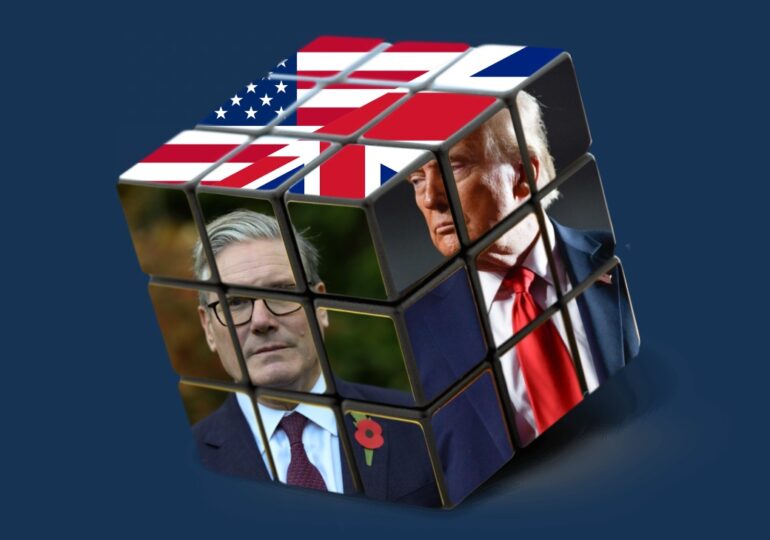
The Epstein case continues to threaten politicians. But not in the United States, as one might expect.
There is an irony in the enduring scandal of Jeffrey Epstein: it might never be more than a passing annoyance for President Donald Trump, who knew Epstein well, but it could remove British Prime Minister Keir Starmer from power, who never met the financier of sexual offenders, writes The Atlantic.
Starmer now has a disapproval rating of 71% and leads the most unpopular British government since World War II.
The reasons why the situation of the Labour Party leader is becoming increasingly difficult are related to morality, as decency and shame still matter in British politics. But there are also institutional reasons.
An American president is less democratically accountable than a British prime minister, as partisanship has disabled the checks and balances that the Founding Fathers of America imposed on the Chief Executive, as cited publication shows.
Mandelson gives Starmer trouble
Starmer's problems stem from the appointment of Peter Mandelson, a Labour politician known as the "Prince of Darkness," as the UK ambassador to the United States.
Mandelson had long been known for his friendship with Epstein, but still got the position, replacing Karen Pierce, an efficient career diplomat with close ties to the MAGA world, who was not particularly keen on giving up the post.
Mandelson's tenure lasted only eight months, until September, when it was revealed that he was even closer to Epstein than previously thought. He had expressed anger at the prosecution of Epstein for sex crimes in a Florida court in 2008. Which was bad enough for Starmer.
But the revelations contained in the batch of 3.5 million documents published at the end of last month by the Department of Justice have exacerbated the crisis.
Recordings seem to show Mandelson providing Epstein with confidential information. There are also direct payments for unspecified purposes from Epstein to Mandelson and his current spouse (Mandelson stated he does not remember receiving the money). There is even a photograph of Mandelson in intimate attire.
This is Mandelson's third embarrassing exit from public life throughout his long political career, but this time it seems to be the last. He is no longer a member of the Privy Council (which advises the king), the House of Lords, or the Labour Party.
But even such a thorough exposure of Mandelson's political career may not be enough to save Starmer.
Although voters granted the Labour Party a overwhelming parliamentary majority in 2024, Starmer seems to have failed to grasp how to use it. Little has been achieved, and Labour's problems seem to benefit the Reform Party, a new nationalist and populist formation led by Brexit instigator Nigel Farage.
A leadership crisis within the Labour Party is now anticipated. Turmoil seems to be affecting the value of the pound, and bookmakers believe there is only a 33% chance that Starmer will survive the year in office.
America is not easily impressed
The contrast with America is striking. For many American politicians, having dealings with Epstein is not a cause for shame. "It is indeed time for the country to perhaps focus on something else, now that nothing has come out about me," declared Trump in the Oval Office on February 3, about the major scandal.
The American president is mentioned thousands of times in the latest documents published, but there is no compelling evidence of his involvement.
Two billionaires from Trump's circle - Howard Lutnick, the Secretary of Commerce, and Elon Musk, the Republican super-donor and former government special employee - disregarded documents attesting to their plans to visit Epstein on his island.
The United States should be a puritan country compared to the "Godless Europe," but in reality, it is so saturated with scandals that new ones do not arouse much outrage.
A single dubious ambassador - Trump appointed many, almost all unnoticed by the public - would hardly be able to bring down a presidency in the USA, notes the publication.
The controversies involving recent British prime ministers seem odd by American standards. During the pandemic, Boris Johnson's Cabinet was affected by "Partygate" - the infamous boozy gatherings of government officials while the country was in lockdown. In contrast, parties at the White House during lockdown days might not even count among the top 100 Trump scandals.
The essential difference between two political systems
One might think that the British prime minister - who, by definition, has a parliamentary majority behind him in a country where Parliament is supreme - would behave more like an elected monarch than the American president, who should be constrained by mechanisms of control and balance.
But nowadays, the opposite seems to be true: parliamentary systems encourage coups, as if you remove the leader of your party, you could take his place. However, if you manage to impeach and remove the American president, you do not get to take his place.
The possibility of a vote of no confidence should hold the prime minister democratically accountable.
In the USA, impeachment is designed to be used in extreme cases. But its repeated use in recent decades - once against Bill Clinton and twice against Trump - has proven its ineffectiveness.
In a period of closely divided and highly partisan congresses, the chance of a conviction in the Senate is close to zero - even if the president does something like trying to remain in office after losing elections.
In the last half-century, Congress has increasingly ceded its authority to the president and the executive branch.
There is no longer a separation of powers
When Thomas Jefferson wrote about the disadvantages of parliamentary governance, he observed that "an elective despotism is not the government we fought for; but one which should not be founded on free principles, but in which the governmental powers should be so divided and balanced among several institutional bodies, that no one could exceed their legal limits."
When there is no separation of powers, but only a separation of parties, this complex system breaks down, leaving an imperial presidency with the concentrated power the Founders feared.
They would also be saddened by the fact that, 250 years after declaring independence from a tyrannical British king, the American system of government has less democratic accountability than the British one.
But perhaps they would not be completely shocked: the idea that there could be something intrinsic to America that immunizes it against autocracy was anticipated and considered unbelievable. "Human nature is the same on each side of the Atlantic," wrote Jefferson, adding: "The time to guard against corruption and tyranny is before they shall have gotten hold of us."
T.D.