

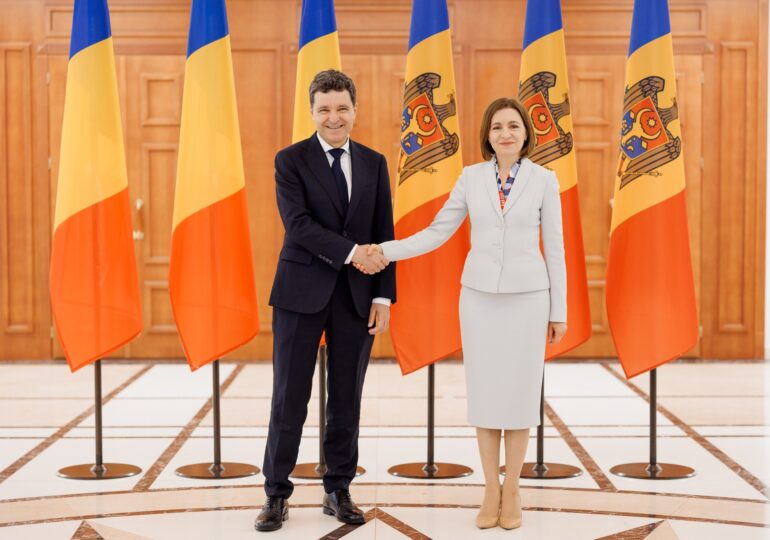
The recent statement by the President of the Republic of Moldova regarding a potential reunification with Romania has sparked strong reactions in the international press.
In an opinion article published by Kyiv Post and authored by Radu Magdin, an analyst and strategic communication consultant, the author argues that reunification is no longer an abstract hypothesis but a process that has already begun and is advancing step by step.
The starting point is a statement made by Maia Sandu in the podcast "The Rest Is Politics: Leading", hosted by Alastair Campbell and Rory Stewart. Sandu stated that if a referendum on reunification with Romania were to take place, she would vote in favor of it - a well-known statement, but articulated this time in a much more tense geopolitical context.
According to the analysis, the significance of the statement lies not so much in its novelty, but in the context in which it was made: Russia's war against Ukraine, Moscow's imperial ambitions, and the pressures exerted on the sovereignty and democratic institutions of the Republic of Moldova.
Maia Sandu openly admitted that current polls do not indicate a majority in favor of reunification, but she emphasized the clear majority for European integration, confirmed both by the 2024 referendum and the 2025 legislative elections.
This leads to the central question of the text: how should this statement be interpreted and what does reunification actually mean today?
"Reunification has already begun"
The author's argument is that the reunification between the Republic of Moldova and Romania is no longer about a distant future or a singular political moment. Unlike historical episodes in the past, the current process is unfolding gradually, through a series of concrete steps that, taken together, outline a deeper integration.
To understand this dynamic, Magdin writes, one must look not at grand political declarations, but at the specific components of the rapprochement between the two states.
Diplomatic alignment and Romania's support in the EU
Diplomatically, the Republic of Moldova and Romania have aligned more clearly since Maia Sandu came to power in December 2020. Chisinau has accelerated reforms and its European path, especially after the onset of Russia's large-scale invasion of Ukraine. In this context, Romania has become the main supporter of the Republic of Moldova within the EU.
Amid the degradation of the regional security environment, Bucharest has sought to convey messages of support in security matters, including through public statements by former President Klaus Iohannis. The common narrative is clear: the future of the Republic of Moldova is European, and a potential reunification would take place within the EU.
Reunification through citizenship
One of the most visible dimensions of the process is the reunification at the population level.
According to estimates cited by the author, approximately half of the citizens of the Republic of Moldova currently hold Romanian citizenship. The citizenship reacquisition policy - accelerated during the terms of Presidents Traian Băsescu and Klaus Iohannis - has allowed Moldovans to travel, work, and live freely in the EU.
Despite concerns about possible abuses of this mechanism, the system has largely functioned according to its original intent. The Moldovan diaspora, largely composed of Romanian citizens, played a decisive role in the narrow victory of the pro-European option in the 2024 referendum. Legally, the author notes, the Republic of Moldova is already "almost half Romanian."
Integration "on the ground"
The second major dimension is practical integration, project by project. Romania is the main economic partner of the Republic of Moldova and a key market for exports. Romanian companies are increasingly present, especially in the banking and energy sectors, and Bucharest is close to taking control of the strategic port of Giurgiulești.
Energetic interconnections with Romania and the European market have significantly reduced Chisinau's dependence on Russian gas and electricity, allowing Moldova to resist Moscow's energy blackmail, albeit at high social and economic costs.
Infrastructure connections are also deepening: new bridges are being built over the Prut River, and the first kilometers of highway in the Republic of Moldova will be built by Romania, on the Iași–Ungheni axis.
Bucharest has funded the renovation of kindergartens, cultural institutions, provided school buses, and supported the emergency medical system. These investments, the author emphasizes, have strengthened Romania's image as a partner delivering concrete results.
Two paths to the EU: classic accession or reunification
According to the analysis, these developments create a solid foundation for deeper integration - economic, social, cultural, and potentially political. Maia Sandu's statement is important because it explicitly links European integration to the possibility of reunification.
For the Republic of Moldova, joining the European Union remains the central objective. However, there are two scenarios: the classic path of accession, pursued resolutely since 2022, and an extraordinary path - reunification with Romania, which would automatically grant EU membership status.
Why Bucharest remains cautious
The author explains Romania's public restraint on this issue. Bucharest continues to let the initiative rest with Chisinau, avoiding direct political pressure. However, public ambiguity is complemented by accelerated practical cooperation, intended to demonstrate the benefits of step-by-step integration.
In conclusion, Radu Magdin argues that reunification is not a historical inevitability but the result of choices made step by step and of democratic legitimacy. More important than legal or geopolitical debates is the fact that the Republic of Moldova and Romania are already drawing closer to each other in a real, consistent, and largely irreversible manner.
Maia Sandu's statement did not trigger this process - it simply made it visible.