
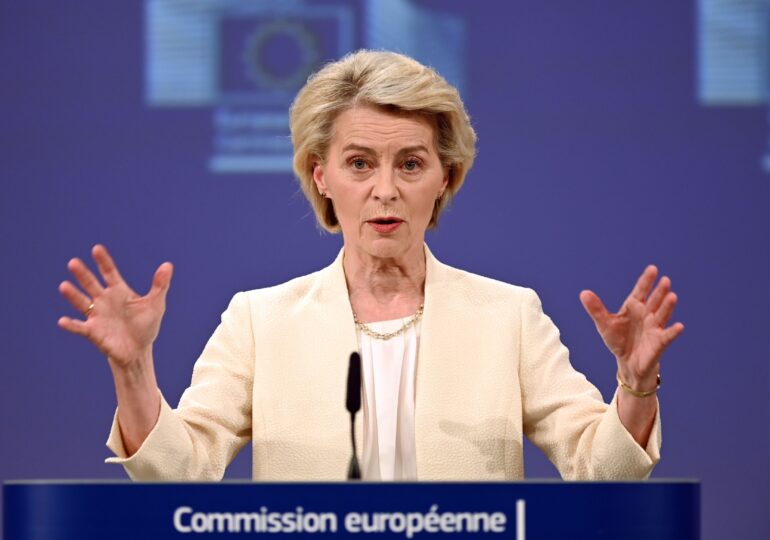
President of the European Commission, Ursula von der Leyen, advocates for the introduction of a „European preference” clause in sectors considered strategic, according to a letter addressed to the member states of the European Union.
The measure would require companies benefiting from public funding to be obliged to source components manufactured in Europe, as reported by AFP.
Letter to the 27: defending the strategic interests of the EU
"Europe must be able to defend its strategic interests and actively support its own manufacturing base," Ursula von der Leyen tells the leaders of the 27 member states in the document sent on Monday.
In this context, the head of the European Commission explicitly supports that "the European preference is a necessary tool" to achieve this objective, at a time when the EU is seeking solutions to strengthen economic competitiveness and reduce external dependencies.
Key topic at the EU competitiveness summit
Supporting the European economy and "Made in Europe" production is set to be one of the central themes of the EU leaders' summit dedicated to competitiveness, scheduled for Thursday in Belgium.
The European Commission has already prepared a draft law aimed at introducing the European preference in certain areas, including the automotive industry, considered strategic for the Union's economy.
The legislative text, expected on February 25, has been postponed twice in recent months due to divergences among member states. Discussions revolve around the economic impact of the measure as well as potential effects on supply chains and production costs.
An initiative supported by France, contested by Germany
The idea of "European preference" is strongly promoted by France, which sees this measure as a way to protect the national production chain of batteries for electric cars.
On the other hand, other member states, such as Germany, oppose the initiative, fearing that it could lead to increased supply costs for German auto manufacturers and other industrial producers.
In early February, the Vice President of the European Commission responsible for this issue, Stéphane Séjourné, publicly advocated for the adoption of such a policy in a political manifesto signed by over 1,000 business leaders: "We must establish, once and for all, a true European preference in our most strategic sectors."