

A new report published by Eurostat shows that 9.2% of the European Union population failed to adequately heat their homes in 2024 due to financial reasons or insufficient resources, an improvement of 1.4 percentage points compared to 2023.
The data comes from official statistics on living conditions and reflects significant differences between EU member states regarding „energy poverty” or the difficulty of coping with the cost of heating homes.
Where Romania Stands
According to Eurostat data, Romania ranks above the European average for heating issues in 2024. Approximately 10.8% of Romania's population failed to adequately heat their homes in 2024.
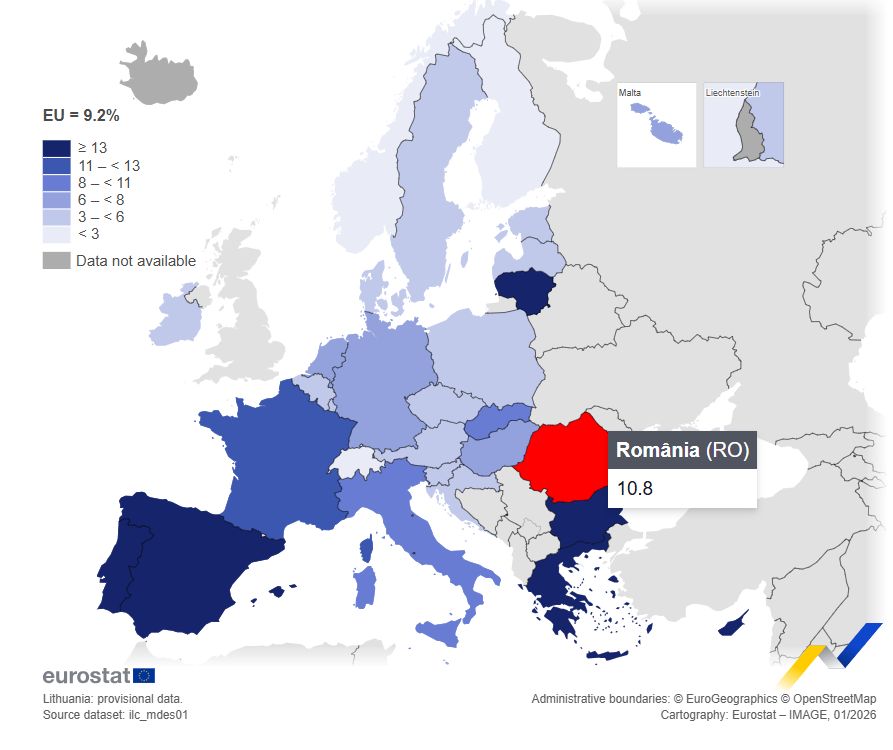
Besides being close to the EU average (9.2% in 2024), this value is significantly lower than in European countries with milder climates, such as Spain or Greece.
Ranking of EU Countries by Difficulty of Heating Homes
According to official Eurostat data, the distribution of EU member countries by the percentage of the population that failed to adequately heat their homes in 2024 is as follows:
- Bulgaria and Greece - 19%
- Lithuania - 18%
- Spain - 17.5%
- Romania - 10.8%
- France - 11.8%
- Italy - 8.6%
- Germany - 6.3%
- Estonia and Luxembourg - 3.6%
- Poland and Slovenia - 3.3%
- Finland - 2.7%.
These differences highlight that in the EU, not only climate influences the ability to keep homes warm, but also socio-economic factors: population incomes, energy costs, energy efficiency of homes, and governmental support for vulnerable families.
For the EU as a whole, the percentage of people unable to heat their homes decreased from 10.6% in 2023 to 9.2% in 2024, indicating a slight improvement in the situation amidst market adjustments and energy policies adopted in recent years.
At the same time, countries in northern and central Europe, such as Finland and Poland, have managed to maintain very low levels of this indicator, highlighting structural differences between regions in the EU.